B2B automation: 5 workflows to sell faster
B2B process automation: 5 priority workflows, tools and methodology to reduce manual tasks and accelerate your sales. Find out how.
Article summary
- B2B process automation means replacing repetitive manual tasks (order entry, follow-ups, quotes) with digital workflows driven by rules or AI.
- B2B salespeople spend ~30% of their time actually selling. The rest goes to low-value administrative tasks.
- 5 workflows are top priority: lead capture, quote generation, order processing, invoicing and customer follow-up.
- Sales automation can reduce administrative time by up to 30%, limit errors and accelerate sales cycles.
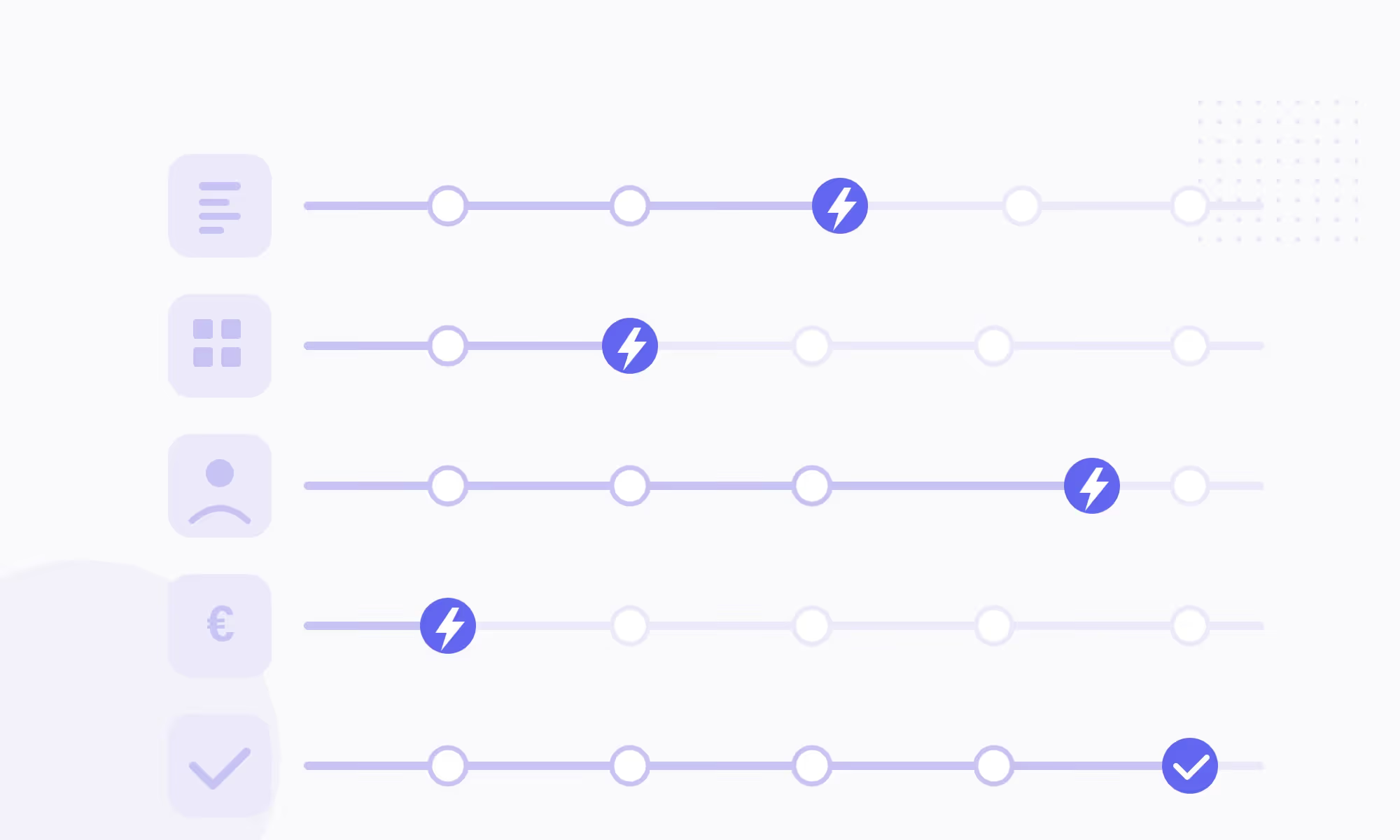
B2B process automation refers to the use of digital tools to automatically execute commercial, logistical or administrative tasks that were previously performed manually. In practice, this means entrusting intelligent workflows with order entry, quote generation, invoice tracking and prospect follow-up — so that teams can focus on customer relationships and selling.
In a context where professional buyers expect responses as fast as in B2C, companies that retain manual processes are losing ground. A B2B lead not handled within the first 5 minutes is 9 times less likely to convert. The question is no longer whether to automate, but which workflows to tackle first.
What is B2B process automation?
B2B process automation covers all technologies that enable commercial tasks to be executed without human intervention. The scope ranges from capturing a lead on a web form to automatically generating an invoice after delivery, including prospect scoring, creating personalised quotes and sending order confirmations.
The difference from simple digitalisation is fundamental. Digitalising means turning a paper order form into a PDF. Automating means ensuring that an order received by email is automatically integrated into the ERP, that it triggers a stock check, generates a picking slip and sends a confirmation to the customer — all without any human intervention in the chain.
Concrete example: an industrial SME receiving 200 orders per week by email and phone. Each order requires 15 minutes of manual entry into the ERP. By automating data extraction from email and direct injection into the order management system, this company recovers 50 hours of productivity per week — the equivalent of one and a half full-time positions.
Moving to a centralised order management system is often the first lever to make this transformation a reality.
5 B2B processes to automate first
Not all processes lend themselves to automation with the same level of return on investment. To identify the right candidates, three criteria matter: task frequency, unit time consumed and the risk of human error. Here are the 5 workflows that consistently tick all three boxes.
Lead capture and qualification
The optimal automated workflow works as follows: a prospect fills in a form, the CRM records it in real time, automatic scoring evaluates its potential (sector, size, behaviour on the site), and the salesperson receives a notification only when the lead reaches a maturity threshold. Without this automation, teams waste time manually sorting contacts of which 70% are not ready to buy.
A common pitfall: scoring only on declared data without integrating behavioural signals (pages visited, documents downloaded).
Quote generation and follow-up
Automating quote creation, particularly via CPQ-type tools, helps reduce processing times and shorten the sales cycle by limiting manual tasks and back-and-forth (Salesforce). The principle: dynamic templates integrate negotiated pricing by account, specific commercial terms and product references, then send the quote with integrated electronic signature. An automatic follow-up is sent if the customer has not responded within 5 days.
To avoid: creating overly rigid templates that do not cover special cases (exceptional discounts, specific delivery terms).
Order processing
This is often the most profitable workflow to automate. Whether an order arrives by email, e-commerce portal or EDI, the goal is for it to be injected directly into the ERP without re-entry. DJUST OMS, for example, centralises all order channels in a unified B2B order management system that orchestrates stock checking, picking and shipping.
The immediate gain: elimination of entry errors and reduction of processing time from 24 hours to a few minutes.
Invoicing and payments
In 2026, electronic invoicing becomes mandatory in France for B2B transactions. This is a constraint, but also an opportunity to automate the entire financial workflow. Best practice: connect the invoicing module to the ERP and e-commerce portal so that each delivered order automatically triggers the invoice, the accounting entry and the payment reminder at due date. Companies that still manage invoicing on spreadsheets are exposed to payment delays and avoidable disputes.
Customer follow-up and nurturing
The B2B sales cycle lasts an average of 3 to 6 months. During this period, an automated sequence of 5 to 8 emails spaced over 4 to 6 weeks maintains contact without mobilising salespeople.
Typical schedule: Day 0, educational content; Day +7, sector case study; Day +14, solution comparison; Day +21, demo proposal.
The pitfall to avoid: sending identical generic emails to all segments. Personalisation and segmentation of email campaigns significantly improve their performance.
How to deploy B2B automation: a 4-step method
The most common mistake is trying to automate everything at once. The method that works relies on a progressive logic: start with the most painful workflow, prove the ROI, then expand.
Prioritisation scorecard: use this before each project
Step 1: Map existing workflows. Before choosing a tool, list every manual task in your sales cycle. For each task, note the time consumed, the frequency and the observed error rate. A 2-hour workshop with the sales administration and sales teams is generally sufficient to identify the 3 most time-consuming workflows.
Step 2: Select the platform. The determining criterion is not the number of features, but the ability to integrate with your current ERP and CRM. An API-first solution like DJUST allows connection to any existing system without heavy migration, reducing the time to production to a few months.
Step 3: Deploy a pilot on a single workflow. Start with the process that scores highest on the scorecard. If it is B2B order management, deploy the OMS module on one channel (e.g. email orders), measure results for 4 weeks, then expand.
Step 4: Measure and iterate. Three KPIs to track: average order processing time, error rate and volume of orders processed without human intervention. If results are on track, extend automation to the other identified workflows. To go further, explore how AI can optimise B2B sales and purchasing.
3 mistakes that cause B2B automation projects to fail
Automation is not a purely technical project. Failures rarely come from the technology itself, but from the way the project is managed. Here are the three most common pitfalls, along with the method to avoid them.
Launch checklist: 3 pre-deployment warning signals
Automating a poorly defined process. If the business rules are not clear in manual mode (who approves what, which threshold triggers which action), automation will reproduce disorder at scale. Before any implementation, document the target workflow with a flow diagram validated by operational teams. Real scenario: a mid-sized distribution company automated order validation without defining approval thresholds by amount. Result: €50,000 orders automatically validated, with no management oversight.
Neglecting change management. Tool adoption is a key success factor in transformation projects. Nearly 70% of initiatives fail due to resistance to change and lack of support (Qualia Technik). Implementing change management strategies — including training and the involvement of key users — can significantly improve adoption, which can exceed 75% in mature organisations.
Choosing a non-integrable tool. An automation platform that does not communicate with the existing ERP or CRM creates more problems than it solves. The non-negotiable criterion: an API-first architecture that connects to existing systems without overhauling the infrastructure. This is the difference between a 3-month deployment and a project that drags on for 18 months.
To go deeper into the digital transformation of your operations, also consult the B2B e-commerce trends shaping the market in 2026.
The integration of AI and automation into commercial processes can significantly improve the productivity of sales teams, with estimated gains of between 20% and 30% according to McKinsey, particularly through the reduction of administrative tasks and the optimisation of commercial targeting.
Another often underestimated lever is choosing the right B2B e-commerce platform to centralise all channels.
Teams that master the entire B2B sales process — from prospecting to invoicing — get the most out of automation.
Finally, for companies selling through distributor networks, an automated B2B marketplace solution makes it possible to extend commercial reach without multiplying manual tasks.
FAQ
What is the difference between automation and digitalisation in B2B?
Digitalisation means moving from paper to digital. For example : sending a purchase order by email instead of fax. Automation goes further: it eliminates human intervention on repetitive tasks by using business rules and workflows to execute actions automatically, from order receipt through to delivery confirmation.

How long does it take to deploy a B2B automation project?
The timeline depends on the scope. For a single workflow such as order processing, allow 2 to 4 months with an API-first SaaS platform. A multi-workflow project (orders, quotes, invoicing) generally takes 6 to 9 months. The main accelerating factor is the quality of integration with existing systems, particularly the ERP and CRM.
What is the typical ROI of B2B process automation?
The first results are visible from the 3rd month. Companies see on average a 30 to 50% reduction in time spent on repetitive tasks, a drop in data entry error rates to below 1%, and a shortening of the sales cycle by 20 to 35%. For a team of 5 salespeople, this represents between €400,000 and €600,000 in recovered commercial potential per year.
Do you need to replace your ERP to automate?
No. Modern B2B automation platforms, particularly those based on an API-first architecture, integrate with existing ERPs without migration. The goal is to complement the ERP with an orchestration layer that manages workflows between different systems (CRM, e-commerce portal, logistics), not to replace it.

.avif)