API-first approach: benefits for integrating ERP, CRM and WMS
Discover how an API-first approach simplifies ERP, CRM and WMS integrations. Learn its benefits, implementation steps and common pitfalls to avoid.
Article summary
- API-first places API design and the OpenAPI contract before code, which makes every ERP, CRM, or WMS integration more reliable.
- 74% of organizations identified as API-first in 2024, compared to 66% a year earlier: the model has become a software development standard.
- Major benefits for a B2B platform: real-time data synchronization, reduced time-to-market, and modular scalability.
- Success relies on three levers: flow mapping, API governance, and change management.
The API-first approach consists of designing and documenting a system's APIs before developing its features and interface. The API becomes the central contract around which teams align, rather than a layer added as an afterthought. For a B2B commerce company, this architectural choice is decisive: it conditions how the sales platform interacts with the ERP, CRM, and WMS. This article details the benefits of the API-first approach for making these integrations more reliable, the method for implementing it, and the costliest pitfalls. Goal: transform an ecosystem of siloed tools into a unified, actionable data flow.
API-first approach: definition and difference from code-first
L'approche API-first inverse l'ordre de développement traditionnel. Au lieu d'écrire le back-end puis d'exposer une API a posteriori (le modèle code-first), les équipes définissent d'abord la spécification de l'API, souvent au format OpenAPI. Cette spécification décrit les endpoints, les formats de données, l'authentification et les règles de versioning. Elle sert de contrat partagé entre développeurs, architectes et intégrateurs. Cette logique prolonge celle du composable commerce, où chaque brique métier dialogue par API standardisée.
Why this detail matters for B2B commerce: a clear contract prevents catalogs, prices, or orders from being exposed inconsistently from one system to another. Concretely, a front-end team can develop on mocked data while the back-end progresses, which parallelizes tasks and reduces inter-team dependencies.
The classic code-first trap: every new integration need generates a custom, poorly documented, and difficult-to-maintain endpoint. Technical debt accumulates and weakens interoperability. Conversely, API-first promotes reusable components and documentation that is actionable from day one, which secures the entire B2B sales process.
Key takeaway: code-first accelerates an isolated project; API-first secures an ecosystem of tools intended to communicate for the long term.
Why API-first transforms ERP, CRM and WMS integration
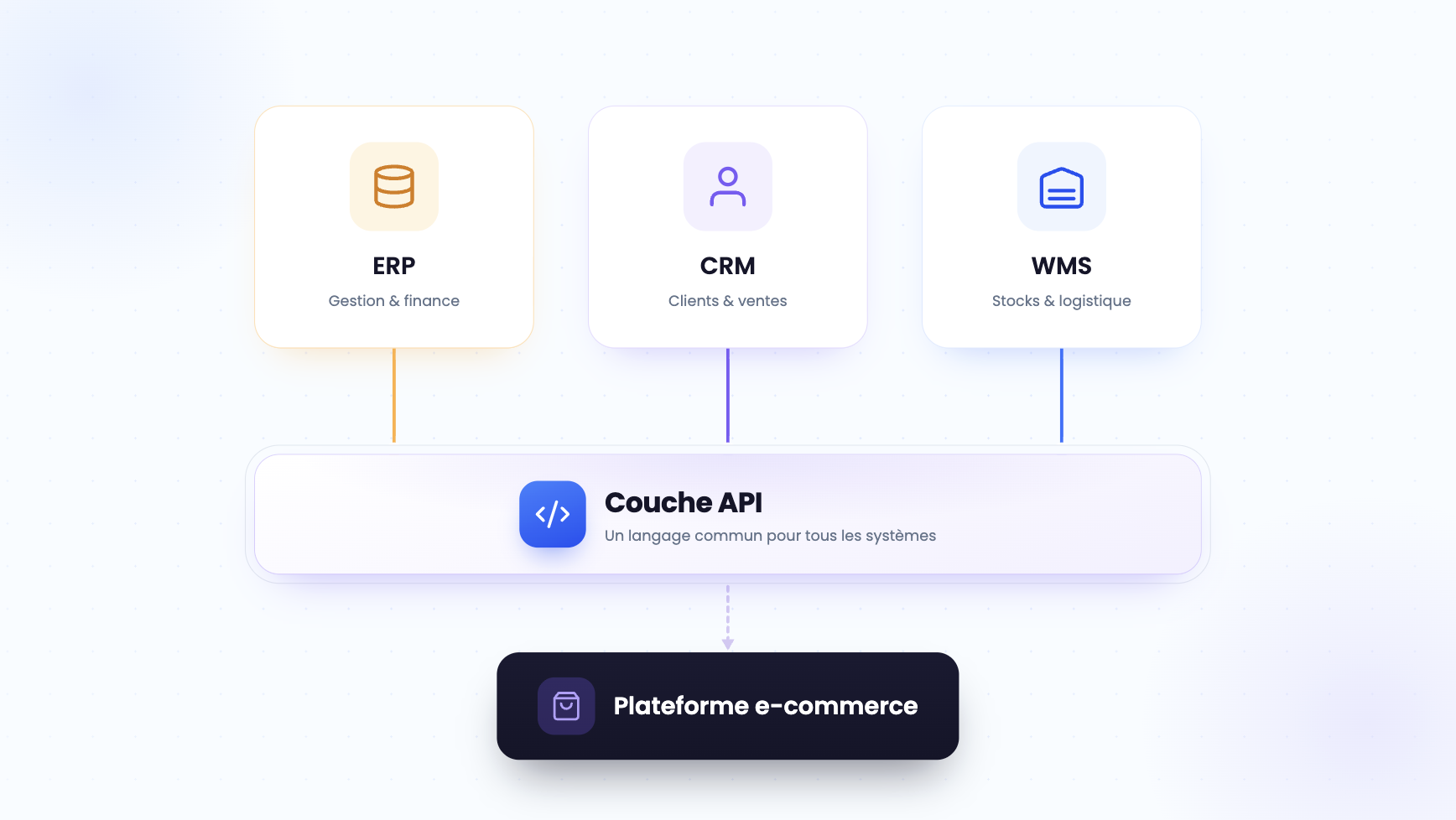
In a B2B company, the ERP manages inventory and invoicing, the CRM centralizes customer accounts and their pricing conditions, and the WMS manages the warehouse and logistics. Without a coherent API layer, these systems exchange data via flat files or point-to-point connections, which multiplies synchronization breaks: stock displayed as available but out of stock, a customer price not updated, an order lost between two tools.
The API-first approach treats each system as a data provider or consumer via a stable contract. The commerce platform becomes the orchestration point: it queries the ERP for real-time stock, retrieves conditions from the CRM, transmits validated orders to the WMS, and fuels replenishment. At DJUST, this mechanics relies on an API connector and a DataHub that connect the platform to any ERP, which simplifies long-term ERP integration.
The typical example: an online order automatically triggers stock updates in the ERP, invoice creation, and picking orders in the WMS, without manual re-entry. The trap to avoid is stacking point-to-point connections between each tool. This spaghetti architecture quickly becomes unmanageable as soon as one system changes. A centralized API layer isolates changes and preserves interoperability, much like a modular architecture.
Framework: the 4 layers of an API-first integration
Layer 1 · Source systems: ERP, CRM, WMS, PIM (reference data: stock, customers, prices).
Layer 2 · API contracts: OpenAPI specifications, versioning, authentication, security.
Layer 3 · Commerce platform: flow orchestration and application of B2B business rules.
Layer 4 · Sales channels: e-commerce, marketplace, mobile app, sales force.
5 concrete benefits of API-first for connecting your systems
Adopting an API-first approach is not just a technical choice: gains are measured in time-to-market, data reliability, and the ability to open new B2B eCommerce channels. The Postman State of the API report confirms the shift: 74% of organizations identify as API-first in 2024, compared to 66% a year earlier, and 63% of teams deliver an API in less than a week. Real-time synchronization streamlines B2B order management, from order taking to shipping. The five benefits below summarize the operational impact for a B2B commerce platform.
How to succeed in ERP, CRM, and WMS integration with API-first
Successful API-first integration cannot be improvised. It follows a clear sequence: map data, formalize API contracts, and then manage their governance over time. This discipline avoids unpleasant surprises when connecting the ERP, CRM, and WMS, and secures the platform's scaling, whether it is monolithic or headless commerce.
Map data flows before writing a line of code
Before any development, list the exchanged objects (products, prices, customers, orders, stocks) and identify the master system for each data point. This repository mapping avoids synchronization conflicts, for example, two tools claiming to hold the customer price. Concrete method: build a flow-by-flow table (source, destination, frequency, endpoint format), validate it with business teams, and then freeze it before writing contracts. This document becomes the backbone of the CRM-ERP integration.
Govern APIs: versioning, security, and documentation
An API lives and evolves. Without governance, every modification risks breaking an existing integration (breaking change). Three rules limit this risk: version APIs to never break compatibility, secure each endpoint with authentication and encryption, especially on sensitive components like payments tailored for B2B, and document continuously so teams rely on a single source. Example: an API style guide imposes naming and error-handling conventions, while automated tests detect incompatible changes before production.
3 pitfalls to avoid with an API-first architecture
The API-first approach does not protect against all errors. Three pitfalls consistently reappear in B2B integration projects, and each has a concrete remedy.
1. Multiply point-to-point connections. Connecting each tool directly to all others creates a spaghetti architecture, where the slightest change propagates everywhere. The remedy: use a centralized API layer that isolates changes and clarifies dependencies.
2. Neglect governance and versioning. An endpoint modified without versioning breaks downstream integrations and freezes teams. Establishing a versioning policy and regression tests from the start avoids this technical debt.
3. Underestimate organizational maturity. API-first assumes a culture of documentation and shared governance between IT and business teams. A Magento migration vers une plateforme moderne en cloud commerce platform often fails less due to technology than due to this change management. When choosing your software for B2B sites, evaluate your teams' maturity as much as the tool's capabilities.
Reading: a score below 5 suggests consolidating foundations before industrializing; a score greater than or equal to 8 signals a base ready for new integrations.
DJUST, the B2B commerce platform built API-first
DJUST applies the principles described in this article to its own core. Built on a composable and headless architecture, the platform exposes all its functions via documented APIs, which allows for connecting any ERP, CRM, or WMS using an API connector and its DataHub. Your stock, price, and order data synchronize in real-time, without manual re-entry or custom development that is difficult to maintain. This logic shortens time-to-market: a B2B e-commerce project generally deploys in 4 to 6 months, then evolves brick-by-brick at the pace of your business. You retain control of your information system while opening new sales channels.
FAQ
Is the API-first approach suitable for SMEs ?
Yes. An SME does not need a dedicated API team to benefit. Modern B2B platforms already expose documented APIs and ready-to-use connectors, making the approach accessible without heavy projects. The true success factor remains clarity on the data to be synchronized and the choice of a tool well-integrated with the existing ERP.

How does API-first secure ERP and CRM integration ?
Each API exposes a precise contract (endpoints, formats, rights d'accès) and applies authentication and encryption. The versioning guarantees qu'une évolution ne casse pas les flux en place, and the tests automatisés détectent les changements incompatibles. This rigueur protège les données sensibles échangées entre l'ERP, le CRM and the plateforme de commerce, like les tarifs clients or les commandes.
How long does an ERP integration take with API-first ?
The delay depends on the complexity of the information system and the number of flows. With an API connector and adapted tooling, the connection to an ERP can be done very quickly, and a complete e-commerce project generally deploys in a few months. To decide between solutions and know which B2B e-commerce platform to choose, compare above all the richness and stability of their APIs.
What is the difference between API-first and code-first ?
In the code-first approach, developers write application code first, then generate an API from it. The API-first approach reverses the sequence: the specification of the API and its OpenAPI contract are defined before any development. The result is documentation actionable from the start, consistent endpoints, and a much more reliable ERP, CRM, or WMS integration.
Do you need to be headless to adopt an API-first approach ?
No, but the two complement each other. A headless architecture separates front-end from back-end and communicates via API, which naturally extends an API-first logic. It remains possible to adopt API-first on a more traditional base. The essential thing is that every business function be accessible via a stable and documented API contract, regardless of the architecture type.
-modified.avif)
.png)