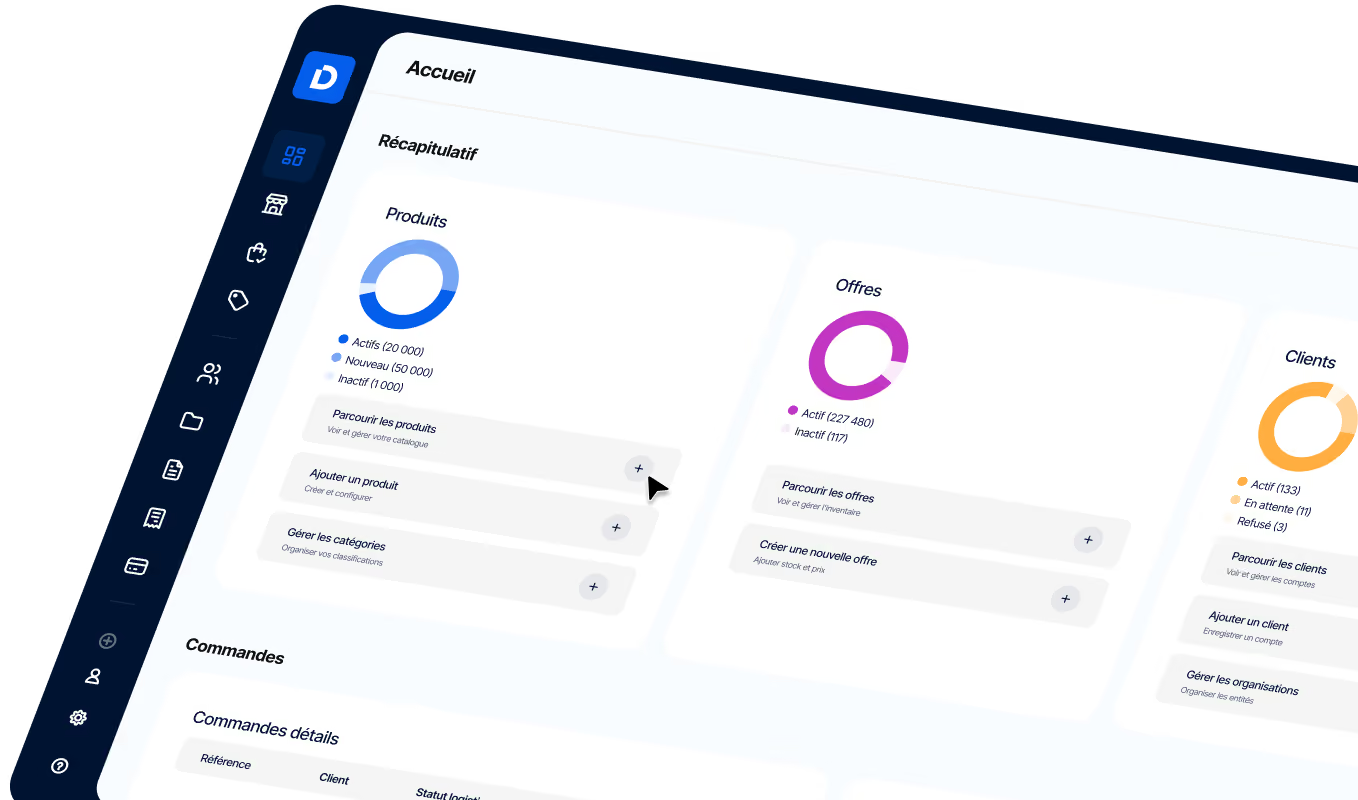
How AI Is Transforming B2B Decision-Making
Discover how AI is transforming B2B decision-making: predictive analytics, automation, real-time management, and business performance
Article summary
- In B2B, AI is transforming decision-making by using data to move from retrospective analysis to predictive and prescriptive decisions.
- It helps anticipate trends, automate analysis, and dramatically shorten decision-making cycles.
- AI is embedded across every business function: sales, supply chain, finance, and marketing.
- Platforms like DJUST make decision intelligence accessible, explainable, and ready to use.

In a complex B2B environment, strategic decision-making depends on data. Decision-makers work with large volumes of data, or big data, from finance, supply chain, and marketing. They must coordinate multiple stakeholders and assess risk. Fortunately, decision intelligence helps guide those decisions. AI turns raw data into actionable insights, giving organizations a competitive edge.
Why decision support is a strategic priority in B2B
The B2B buying process involves 6 to 10 decision-makerswho gather multiple inputs before approving a transaction. This collaborative process lengthens sales cycles and creates uncertainty. That’s why the challenge is to make reliable, fast, well-documented decisions.
What’s more, my B2B business decisions — supplier negotiations, production planning, investments, and more — have a major financial and operational impact. Looking back at the data is no longer enough. AI makes it possible to move from retrospective analysis to predictive and prescriptive analysis. With machine learning and predictive models, companies can anticipate customer demand or adjust production based on market trends.
In a complex environment, it helps manage thousands of requests by providing forecasts that balance supply and demand. According to a Gartner forecast for 2027, 50% of business decisions will be augmented or automated by AI agents.
What is AI-assisted decision-making?
AI-assisted decision-making combines artificial intelligence — algorithms, machine learning, and deep learning — with business expertise. In practice, AI analyzes massive datasets to identify patterns that are invisible to the human eye. A model can forecast demand in real time or recommend the best commercial action. This process involves three levels:
- Descriptive (summarizing the past)
- Predictive (projecting the future)
- Prescriptive (recommending actions).
The concrete benefits of AI for B2B decision-making
- Data-driven decisions: AI turns raw data into actionable analysis. It can then be used to optimize sales with AI.
- Trend anticipation: with predictive analytics, companies can identify weak signals — stockouts, changing needs — before they affect the business. They gain more agility in strategic decision-making.
- Intelligent automation: AI eliminates repetitive information-gathering and processing tasks. The result? Teams spend more time on high-value decisions, both strategic and creative. In the end, the company reduces operating costs and speeds up its decision cycle.
- Faster decisions: decision intelligence improves response times for complex decisions. Rules and models — decision trees, neural networks, reinforcement learning — are defined in advance to deliver results in near real time.
Finally, this approach builds trust: decisions can be measured through dynamic dashboards and audited against business goals.
How AI is transforming business decision-making processes
AI is embedded in every link of the B2B business process:
- In the supply chain, companies use AI for order management automation. Intelligent supply chain systems use machine learning to predict inventory needs and adjust production.
- In finance, AI is used for fraud detection and cash flow optimization (AI and B2B payments). It anticipates movements and flags anomalies.
- In marketing, platforms integrate AI and eCommerce to recommend products and personalize the customer experience.
More broadly, AI makes it possible to manage decisions at scale. Driven by both AI and operations research, teams can design algorithms capable of solving ambitious planning problems. Decision-support systems are also becoming more dynamic:
- they process natural language (chatbots, voice assistants)
- they take historical and real-time data into account (“real time”)
- they use large language models or fuzzy logic to deliver interpretable answers.
That said, humans still have a role to play. AI suggests recommendations, but the business expert validates the final choices and adjusts the overall rule set. This human-AI collaboration builds trust in the final outcome, because the algorithms can be traced and the results explained.
How to integrate AI into the B2B decision-making process
To make this transformation a success, follow a step-by-step plan:
Step 1: Identify a concrete use case
Choose an area where AI can deliver clear value, such as improving demand forecasting or speeding up invoice processing.
Step 2: Ensure data quality
Make sure you have clean, relevant data. Data quality and governance are essential to the success of the project.
Step 3: Build and test a prototype
Develop a simple model — statistical or machine learning — and test it on a small scope to validate the approach. Business decision-makers need to be involved: they must understand the process and remain in control of the final decision.
Step 4: Train teams
Invest in training — data literacy, decision models — or hire data science talent. 62% of executives believe that AI literacy is now important for their teams’ day-to-day work.
Step 5: Put governance in place
Appoint an AI lead or create an internal committee to approve projects, while addressing ethics and privacy concerns. Algorithms must also be auditable to prevent bias and stay compliant with regulations.
Step 6: Integrate AI with business tools
Connect artificial intelligence APIs to your business applications for a continuous decision system that tracks indicators in real time.
Step 7: Measure and adjust
Define performance indicators — ROI, shorter decision times, customer satisfaction — and regularly adjust your AI strategy.
DJUST: using AI as a decision-support lever
DJUST offers solutions that integrate AI to improve B2B decision-making. With DJUST AI, companies can leverage predictive analytics, simulation, and real-time process optimization. DJUST AI forecasting models, powered by machine learning, can anticipate future demand and dynamically balance supply. In the commercial chain, our algorithms automatically adapt sales strategies to maximize margin.
Important: the tool is designed to be reliable and explainable, ensuring confidence in the results.
With AI, DJUST helps companies stay competitive, optimize sales, and control costs. Discover how our solutions can help you with DJUST AI.
-modified.avif)

.avif)

.jpg)