7 best e-commerce platforms: how to choose the right solution?
How to choose the best e-commerce platform? Comparison, criteria, price, mistakes: all our advice for making the right choice today.
Article summary
- B2C and B2B needs impose very different architectures and functionalities: negotiated rates, 30-day payment, multi-buyer accounts on the B2B side.
- The total cost varies from less than €50 per month in entry-level SaaS to more than €250,000 in the first year for an enterprise composable solution.
- Seven criteria structure the decision: business model, catalog complexity, architecture, integrations, SEO performance, scalability, total cost of ownership.
- Poorly prepared migration = loss of 40 to 70% of SEO traffic. The redirection plan and 90-day monitoring are non-negotiable.

What is an e-commerce platform?
An e-commerce platform is software that allows you to create, manage, and operate an online sales site. It gathers product catalog management, order taking, payments, logistics tracking, marketing, and customer service in a single interface. Not all e-commerce solutions are equal. Some are designed for general consumer commerce and simple B2C sales. Others integrate the constraints of inter-company commerce: differentiated pricing conditions by client, hierarchical validation of purchase orders, native integration with ERPs, payment on invoice. This design difference is the first variable to understand before any functional comparison.
The French ecosystem has over 200 e-commerce software programs, but 90% of the market is concentrated on about twenty players. Each solution addresses a specific segment: from the individual merchant opening their first online store to the large industrial group digitizing a network of distributors with a B2B platform designed for complex flows.
How to choose the architecture adapted to your B2B e-commerce platform?
E-commerce platforms are no longer distinguished solely by their deployment mode. Modern solutions often combine several technological approaches to reconcile speed of implementation, flexibility, and scalability. The challenge is therefore to choose an architecture capable of supporting your growth and integrating sustainably into your information system.
- The SaaS approach allows you to benefit from a hosted platform, automatic updates, and faster deployment, while limiting the maintenance load for internal teams.
- Open source technologies offer a high level of customization and great control over the technical environment. Some SaaS platforms even rely on open source components to gain flexibility.
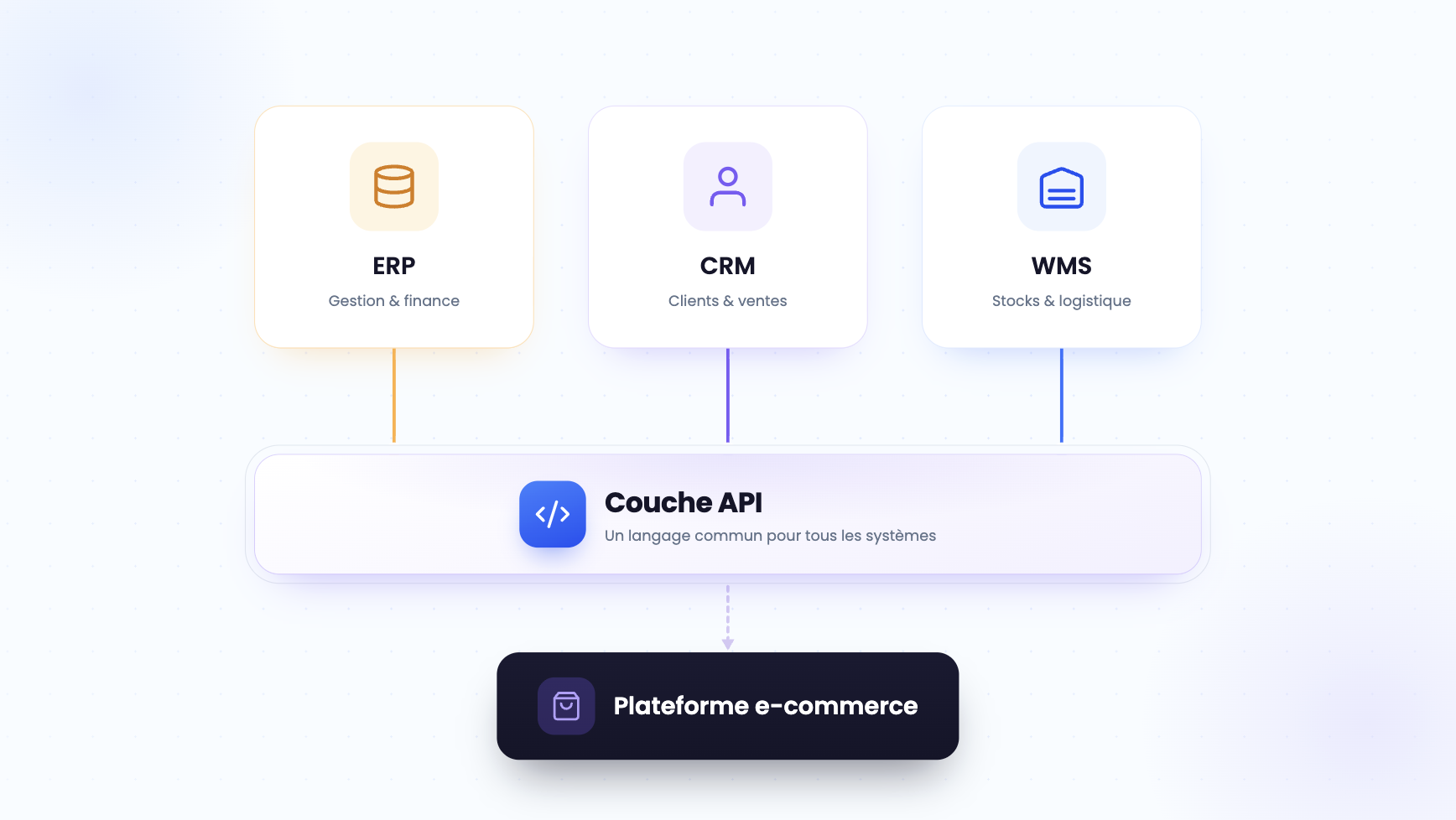
- Headless or composable architecture decouples the front-end from the back-end using APIs. It facilitates integration with ERP, CRM, PIM, or a marketplace, while allowing each component to evolve independently.
Today, a B2B platform like DJUST combines these different approaches to offer the simplicity of SaaS, the flexibility of an open architecture, and the scalability of a headless model, without forcing companies to choose between these different models.
Differences between B2C and B2B needs
In B2C, the challenge is the impulsive buying experience: quick cart, immediate payment, loyalty program, product recommendations. In B2B, the logic is entirely different. The buyer places an order for their company, negotiates prices, validates purchase orders internally, and often pays in 30 or 60 days. The best B2B e-commerce solution must manage multi-client pricing, account hierarchies, deferred payment, and native connection to ERPs like SAP, Sage, or Cegid. To learn more, consult our dossier on B2B eCommerce and its functional specificities.
7 criteria for choosing the best e-commerce platform
Identifying the right solution requires ranking your needs by priority. Too many companies embark on a functional comparison without having clarified their target business model, projected traffic, or critical integrations. This 7-criteria framework allows you to eliminate 80% of unsuitable platforms in less than an hour of scoping. It applies equally to a B2C merchant site project and a multi-channel B2B transactional platform.
- Business model: B2C, B2B, B2B2C, marketplace, or mix. Not all platforms cover all these cases. B2B pricing logic (client grids, volume discounts, structured quotes) is rarely included as standard on general public B2C solutions.
- Catalog and product complexity: Number of references, variants, configurators, kits, custom products. Beyond 50,000 SKUs, few platforms remain performant without infrastructure and cache tuning.
- Technical architecture: Monolithic, headless, or composable. Decoupled architecture becomes a prerequisite as soon as there are multiple front-ends, heterogeneous sales channels, or strong ERP, PIM, OMS integration.
- Integration capacity: REST or GraphQL APIs, native ERP, CRM, PIM, CMS connectors, webhooks, official SDK. A platform isolated from the IS generates duplicate entries, stock errors, and recurring operational costs.
- Performance and SEO: Core Web Vitals, server-side rendering, fine management of tags and structured data, multilingual support, hreflang, dynamic sitemaps. A platform that sacrifices SEO costs dearly in organic visibility.
- Evolvability and scalability: Ability to support 10 times the current volume, internationalization, multi-currency, multi-warehouse, launching new countries without redesigning the foundation.
- Total cost of ownership (TCO): License, hosting, integration, specific developments, maintenance, and support over 3 years. The entry price displayed by the editor rarely represents the actual cumulative cost.
Comparison of the 7 main platforms on the market
The table below summarizes the strengths and limits of the most structuring platforms on the European market in 2026. This is not a universal ranking but a guide to help direct a pre-selection. Each solution should then be validated by a use-case-oriented demo and an exchange with a client in production.
SaaS platforms for general consumer B2C e-commerce
Shopify, BigCommerce and Wix eCommerce dominate this segment. Shopify remains the leader worldwide with more than 4 million active boutiques. Assets: deployment in a few days, massive ecosystem of applications, hosting and security managed by the editor. Main limit: transaction fees outside Shopify Payments, the cost of advanced personalizations, and a model designed for B2C which struggles on complex B2B needs (differentiated catalogs, multi-user accounts, hierarchical validation). For a site up to 5 million euros of revenue single-channel, Shopify remains relevant. Beyond that, the architecture challenge becomes central.
Open source solutions: flexibility against maintenance
Open source technologies remain a reference for companies that seek a high level of customization and great control over their e-commerce platform. They offer an open code, a strong capacity for adaptation to business needs and a great freedom of evolution.
In contrast, when a solution is entirely self-hosted, the teams must also manage updates, security, performance and maintenance of the entire ecosystem. Without solid technical governance, these constraints can quickly make the total cost of ownership climb.
That is why B2B platforms, like DJUST, combine today the advantages of several approaches. The solution relies on a modular open source and headless architecture, while being offered in SaaS mode. The companies profit thus from the flexibility of an open architecture, the freedom of integration offered by APIs and the operational simplicity of a platform managed by the editor. This combination allows the growth of mid-market companies without choosing between customization, scalability and control of costs.
B2B solutions and modular headless platforms
For B2B models, marketplaces and multi-channel organizations, monolithic platforms quickly show their limits. Composable solutions like DJUST, commercetools or Adobe Commerce allow to orchestrate a unique catalog towards several channels: merchant site, distributor space, marketplace, commercial mobile application, physical point of sale. They separate the commercial logic (back) from the purchasing experience (front), which opens the way to advanced use cases: dynamic pricing by client, multi-legal entities, native ERP integration, B2B order management from end to end. It is the path preferred by B2B professionals in full digital transformation.
5 errors to avoid in your selection of e-commerce software
The choice of a platform engages the company for 5 to 10 years. The most costly errors are seen neither in the demo nor in online comparisons. They appear six to eighteen months after the going into production, when the first true use cases arise and volumes increase.
- Choosing on a polished demo: Ask to speak to 2 or 3 clients in production and see their back-office in real conditions.
- Underestimating the ERP integration phase: Connecting a platform represents 30 to 50% of the total budget. This is often absent from initial quotes.
- Not anticipating international growth: A platform that does not natively manage languages, currencies, and hreflang imposes a costly redesign later.
- Confusing license price and total cost: A license displayed at €2,000 per month can turn into a €500,000 TCO over three years. Request a 36-month TCO.
- Neglecting administrator experience: A platform lacking back-office ergonomics slows down all commerce, marketing, and logistics teams.
How much does an e-commerce platform cost?
The budget of an e-commerce solution depends on three variables: the economic model of the editor (SaaS, open source, composable), the functional scope included (simple B2C, complex B2B, marketplace) and the volume processed. Three large ranges structure the market in 2026.
For a serious B2B project, count between €80,000 and €250,000 in year 1 (license, ERP integration, deployment, support), then €30,000 to €100,000 per year in years 2 and 3 (license, support, functional evolutions). At this budget level, the return on investment is no longer measured in cost but in business impact: incremental volume captured, commercial productivity gained, retention rate. To anticipate the right investment priorities, consult the B2B e-commerce trends which will structure the budgets in the next 24 months.
Migration and deployment: succeeding the transition
The number one risk of a migration of e-commerce platform is the loss of organic visibility. A redesign poorly prepared can make the SEO traffic drop by 40 to 70 % in a few weeks, with a recovery sometimes superior to six months. The consequences are measured in lost revenue, eroded competitive visibility and internal confidence damaged. Four points are non-negotiable on every project of migration.
- Complete mapping of URLs: Page-by-page 301 redirection plan, validated before going into production.
- Technical audit: Speed, structured data, canonical tags, XML sitemaps, hreflang, indexability, robots.txt.
- Functional testing: Search, add to cart, checkout, payment, customer account, returns, invoices.
- 90-day monitoring: SERP positions, Search Console, server logs, GA4.
On a project involving B2B software, the stakes go beyond SEO. Service continuity for existing clients, training of commercial staff, switchover of ERP integrations, management of carts in progress and open accounts. A B2B migration is prepared 4 to 6 months in advance, with a dedicated committee associating IS, business, marketing and SEO. To learn more on the subject, see our article on which B2B eCommerce platform to choose.
DJUST: the best solution for your B2B e-commerce
For a B2B platform (brand, wholesaler, distributor or operator of marketplace), DJUST stands out as the reference solution. Thought out natively for B2B, it manages multi-client pricing, account hierarchies, deferred payment and end-to-end ERP integration, while offering the agility of a composable architecture. Where general public SaaS solutions struggle with B2B needs and open source accumulates technical debt, DJUST brings together performance, scalability and tailor-made purchasing experience to accompany your growth on the long term.
FAQ
What is the best e-commerce platform in France?
There is no universal "best" platform. The relevance depends on the business model, the volume of catalog and the technical maturity of the company. For a merchant who starts in B2C, Shopify remains the standard. For a B2B company with complex catalog and ERP integration, a modular headless solution like DJUST is better adapted.

Which e-commerce platform to choose to start?
For a B2B activity even in starting, prioritize from the outset a platform that manages client pricing, the due payment and the ERP connection like DJUST. Starting from zero after 18 months costs two to three times more than an initial structuring choice.
Difference between SaaS and open source?
A SaaS platform is hosted and maintained by the editor, who invoices a monthly or annual subscription. You access the latest versions without technical intervention. An open source platform is installed on your infrastructure, you own the code and the maintenance. SaaS offers speed and stability, open source brings flexibility and independence, but requires a solid technical team to stay up-to-date, secure and performant.
How long does it take to deploy an e-commerce platform?
For a standard B2C site on SaaS, allow 6 to 12 weeks including design, catalog integration, payments and go-live. For a B2B project with ERP integration, multi-buyer accounts and complex price list, the time frame goes to 4 to 9 months. Headless solutions add 30 % of time in phase 1 but accelerate subsequent evolutions thanks to their modular architecture.
Is headless adapted to B2B?
Yes, and it is emerging as a standard for multi-channel B2B companies. Composable architecture allows serving the same product catalog towards several front-ends: distributor portal, general public site, commercial mobile application, partner marketplace. It facilitates native integration with ERPs and accelerates the launch of new channels. It is today the option preferred by industrials and wholesalers in digital transformation.


.png)