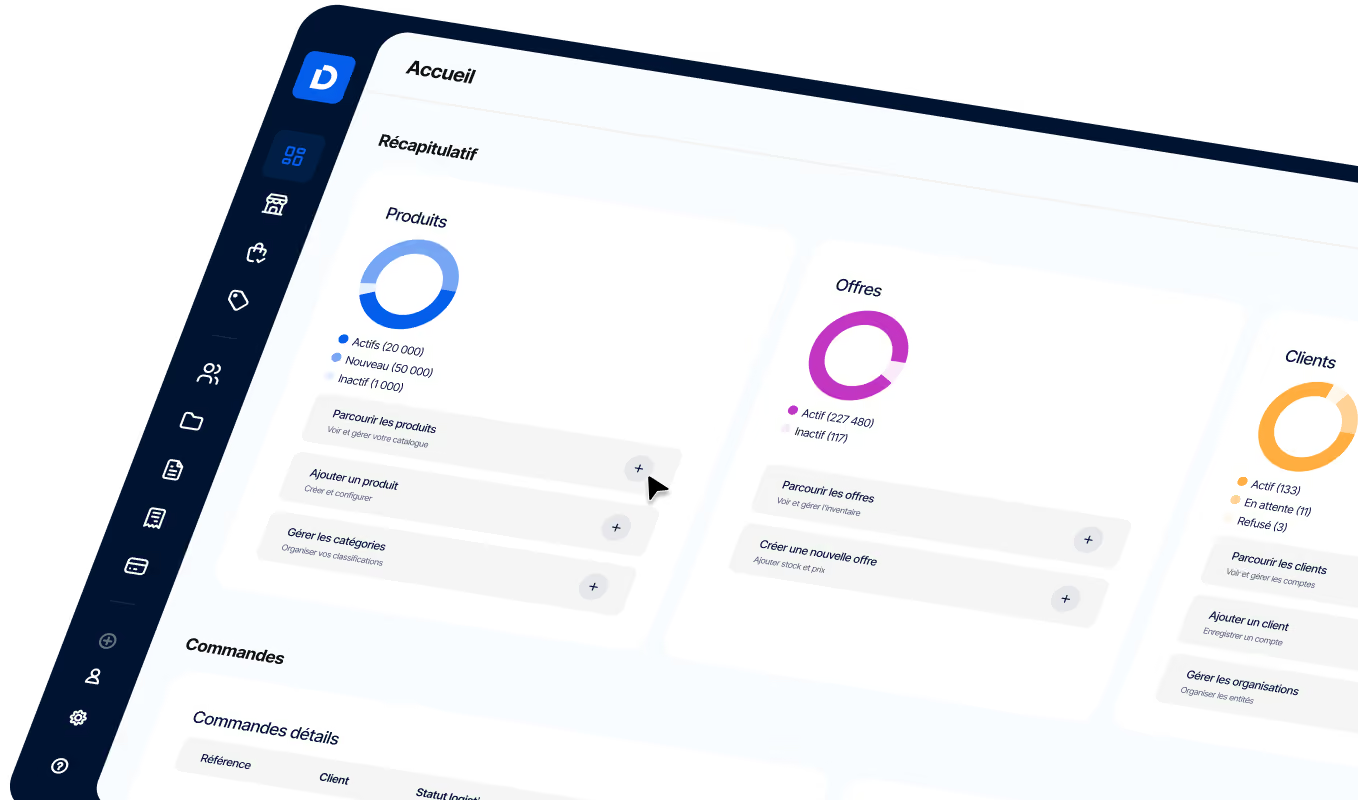
Analytics Clients: 10 AI Strategies for B2B
Transform your business with AI-powered customer analytics. Discover 10 ways to predict behavior, personalize experiences, and strengthen customer loyalty

Introduction: Why AI Is Changing the Game in B2B
B2B commerce is at a turning point. Business buyers now expect the same seamless experience they get in B2C: personalization, speed, and relevant recommendations. Yet many companies are drowning in massive volumes of customer data without turning it into truly actionable insights.
That’s where AI-powered customer analytics becomes essential. By combining big data, machine learning, natural language processing, and predictive analytics, B2B companies can not only understand their customers in depth, but also anticipate their needs and automate the right actions at the right time.
According to a Gartner study, 65% of B2B sales organizations will adopt data-driven decision-making by 2026. In this context, companies that know how to leverage AI-powered customer analytics in B2B e-commerce gain a decisive strategic edge.
What Is AI-Powered Customer Analytics?
AI-powered customer analytics uses artificial intelligence to analyze customer behavior, sentiment, and journeys. Unlike traditional tools that describe the past, predictive analytics helps anticipate what comes next and recommend concrete actions.
For example:
- Instead of simply seeing that a customer has already churned, AI detects the weak signals that point to a likely departure.
- Rather than segmenting only by company size, AI automatically groups customers based on hidden buying patterns.
- Rather than showing a static dashboard, AI analytics deliver a dynamic action plan.
In B2B e-commerce, this translates into better retention, more relevant cross-sells, and personalization at scale.
The 10 Levers of AI-Powered Customer Analytics in 2025
1. Predictive Customer Behavior Modeling
Predictive analytics makes it possible to forecast which customers are likely to buy, which accounts may reduce their orders, and which segments are the most profitable.
- Example: an industrial distributor can anticipate when customers will reorder certain components.
- Result: offers sent at the right time, higher conversion rates, and stronger loyalty.
In B2B e-commerce, predictive modeling is a growth engine: it directs sales and marketing efforts where they’ll have the greatest impact.
2. Intelligent Segmentation Through AI Clustering
Classic segmentation based on industry or company size isn’t enough. AI-powered customer analytics creates clusters based on hidden behaviors.
- Example: a raw materials supplier may uncover a segment of customers that always orders right after market indexes are published.
- Advantage: target that group with tailored content or promotions before competitors do.
This approach turns B2B segmentation into a living tool that evolves continuously thanks to AI.
3. Advanced Personalization Engines
Personalization is no longer limited to product recommendations. Modern engines adapt the entire journey: navigation, search, content, and pricing.
- Example: a B2B marketplace can offer dynamic pricing based on order volume and purchase history.
- According to Forbes, 80% of customers are more likely to buy when the experience is personalized.
In B2B e-commerce, this level of personalization increases satisfaction and drives long-term loyalty.
4. Sentiment and Intent Analysis
With NLP, companies can analyze thousands of conversations across support, email, and reviews to extract emotional signals.
- Example: a distributor detects recurring frustration tied to delivery delays.
- Action: adjust logistics processes before customers leave for a competitor.
Predictive analytics applied to sentiment helps prioritize the initiatives that create the most customer value.
5. AI-Enhanced Journey Mapping
Traditional journey mapping shows the steps. AI reveals the invisible friction points.
- Example: a materials supplier discovers that customers who view technical sheets before requesting a quote are 40% more likely to close.
- Consequence: enrich technical sheets and encourage customers to view them directly from the product page.
In B2B e-commerce, intelligent journey mapping maximizes conversion and lowers acquisition costs.
6. Next Best Action (NBA)
NBA systems automatically recommend the next best action for each customer.
- Example: offer a targeted discount to a hesitant buyer or send technical documentation to a prospect.
- Advantage: AI learns continuously and sharpens its recommendations over time.
NBA is the secret weapon for B2B sales teams that want to industrialize personalization.
7. Voice of Customer (VoC) and Insight Extraction
AI-powered customer analytics taps into support tickets, online reviews, and social posts to identify trends and pain points.
- Example: a manufacturer notices that customers often ask for a maintenance calendar.
- Solution: launch an automated alert tool or dedicated content.
VoC becomes a direct source of product innovation and continuous improvement.
8. Real-Time Behavioral Analytics
Real time is now critical.
- Example: a food wholesaler sees that a restaurant owner repeatedly searches for a seasonal ingredient without placing an order.
- Immediate action: offer a stock alert or a special deal.
In B2B e-commerce, this kind of instant intervention is a powerful lever for conversion and loyalty.
9. Churn Prediction and Proactive Retention
AI can detect weak signals such as a gradual drop in order volume or changes in buying habits.
- Example: an office supplies supplier notices that some customers are ordering less often, an early sign of disengagement.
- Response: a personalized retention plan with a discount, sales call, or exclusive content.
In B2B e-commerce, churn prediction is essential for protecting customer value.
10. AI-Driven Attribution
Modern attribution measures the impact of each interaction across a complex journey.
- Example: a technical webinar may not generate direct leads, but it strongly influences large contract signings six months later.
- Benefit: justify marketing investments that would otherwise remain invisible.
AI helps assign the right value to every action in B2B e-commerce.
Pitfalls to Avoid with AI Analytics
- Working with poor-quality data.
- Automating without human oversight.
- Confusing correlation with causation.
- Failing to act on the insights generated.
- Lacking clear objectives.
- Forgetting GDPR compliance and transparency with customers.
Where Is AI-Powered Customer Analytics Headed?
- Hyper-personalization: 1:1 experiences at scale.
- Emotion AI: understanding emotions, tone, and even facial expressions.
- Predictive commerce: anticipating needs and sometimes triggering automatic orders.
- Explainable AI: giving human-readable explanations for recommendations.
- Integrated ecosystems: centralizing all data in a single platform to unify the customer experience.
Conclusion: Work Smarter with DJUST
AI-powered customer analytics is no longer a luxury; it’s a competitive advantage.
The good news? You don’t need to transform everything at once. Often, it’s enough to start with one or two use cases to generate visible results, then expand gradually.
👉 With its unified B2B e-commerce platform, DJUST helps companies connect their data, activate predictive analytics, and harness the power of AI-powered customer analytics.
Want to see what that looks like in practice? Request a DJUST demo and discover how to accelerate sales with predictive customer intelligence.
📌 Internal resource to explore: AI for B2B e-commerce


.avif)

.jpg)