Intranet vs extranet: what are the differences for a B2B company?
Choose the right network for your B2B business. Learn the differences between intranet and extranet, with definitions and practical use cases.
Article summary
- The intranet is reserved for employees, while the extranet provides secure access to clients, suppliers, and partners to facilitate B2B exchanges.
- The extranet acts as a true B2B portal, allowing for the autonomous management of orders, deliveries, invoices, and personalized catalogs.
- The choice between intranet and extranet depends on your objectives : improving internal collaboration, developing exchanges with your partners, or combining both on a unified platform.
- The success of a project relies on rigorous access management, integration with your IS (ERP, CRM), and a fluid user experience to ensure security, productivity, and adoption.
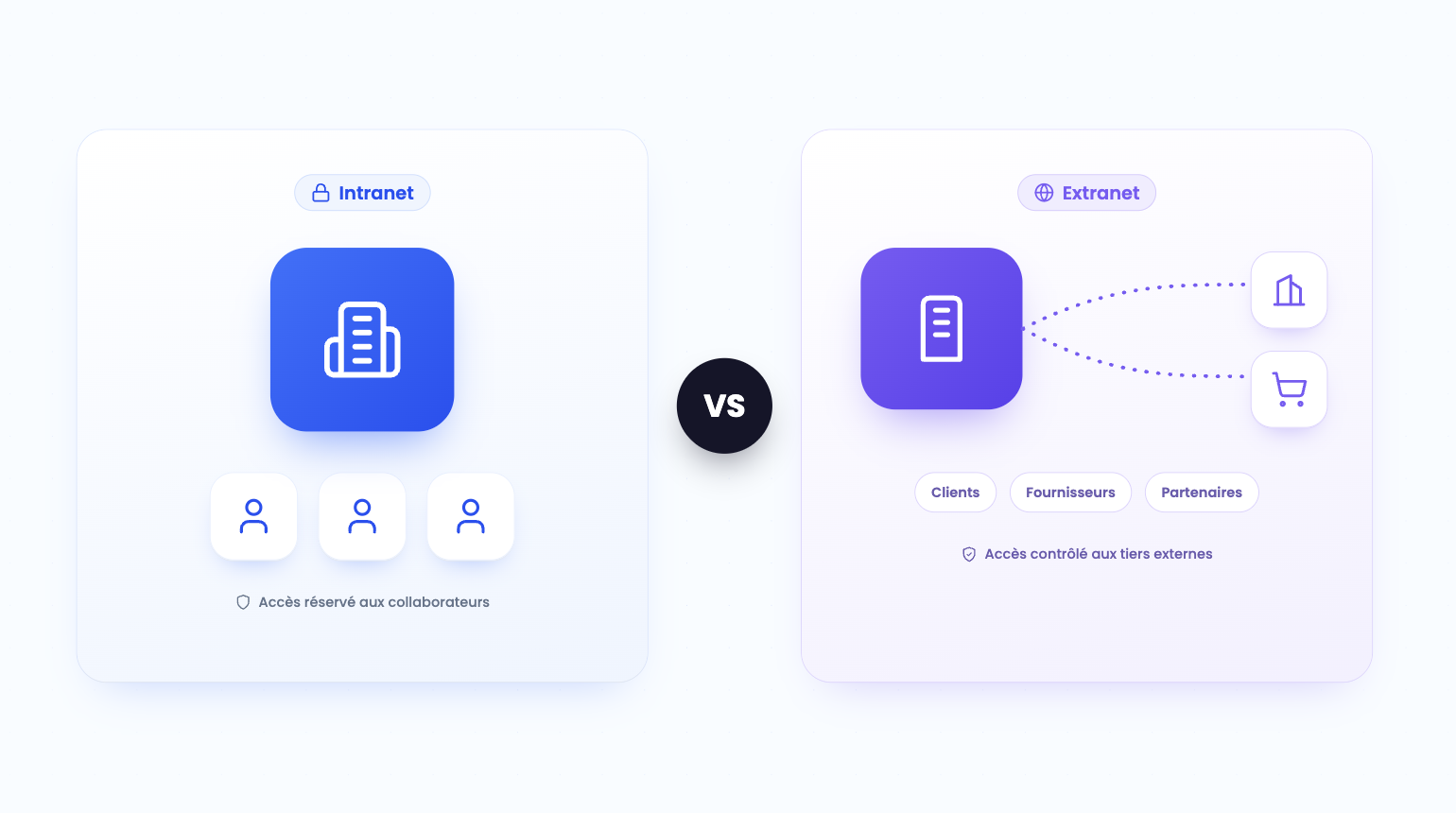
An intranet is a private network reserved for members of an organization, when an extranet opens a secure access to external third parties like clients, suppliers, or partners. Both rely on the same web technologies but do not target the same audience: the intranet serves internal collaboration, the extranet collaboration with the outside world. In B2B, this distinction is structural, because the extranet often takes the form of a commercial portal where clients place orders and track their deliveries.
Intranet and extranet: two simple definitions
Intranet and extranet are two private networks that rely on internet technologies, but their access perimeter differs. The intranet remains closed to collaborators; the extranet extends this perimeter to selected external users. Confusing them leads to a poor dimensioning of the project: opening an intranet to clients without partitioning exposes sensitive internal data.
Common trap : believing that an extranet is a simple open intranet. In reality, it adds a layer of security, authentication, and management of permissions for each external profile.
What is an intranet?
An intranet is a private network accessible only to the employees of an organization. It centralizes internal communication, document sharing, and access to work tools, behind a firewall and credentials. Concretely, a collaborator finds the directory, procedures, internal notes, and business applications there.
Mini-method : map strictly internal content (strategy, HR, work documents) before launching an intranet project, to dimension access rights and tree structure. Modern, the intranet today resembles a cloud tool, mobile and simple to use.
What is an extranet?
An extranet is a private network that opens a secure access to authorized third parties: clients, suppliers, distributors, or service providers. It extends a part of the information system to the outside, via a web portal protected by authentication and granular access rights.
Example : a client logs in to track their orders, download their invoices, or consult a negotiated catalog. Mini-method : apply the principle of minimization, each external profile only sees the data useful for their relationship. In B2B, an order management tool often constitutes the heart of the extranet.
Distinguish intranet and extranet in 3 questions
- Who accesses? Only employees (intranet) or also external third parties like clients and suppliers (extranet).
- For what purpose? Fluidify internal collaboration (intranet) or commercial exchanges with the outside (extranet).
- What level of openness? Closed network behind the firewall (intranet) or access controlled and partitioned by profile (extranet).
Intranet vs extranet: 5 key differences
Beyond the definition, five criteria clearly separate intranet and extranet: the audience, the objective, the access perimeter, the level of security, and the governance. The intranet targets collaborators and aims for internal productivity; the extranet targets external partners and aims for B2B collaboration and quality of service. Regarding access, the intranet remains partitioned behind the company firewall, while the extranet exposes a controlled door on the internet, with reinforced authentication. Security changes scale: more open, the extranet requires granular access rights, encryption of exchanges, and strict GDPR compliance. Finally, governance differs: the intranet is piloted by a single organization, the extranet involves sometimes several parties, clients as well as suppliers.
Trap to avoid : applying the security policy of an intranet to an extranet. An external access poorly partitioned multiplies the risk of data leakage.
Internet, intranet, extranet : no more confusion
Three environments rely on the same web technologies but do not address the same audience. Properly locating them avoids costly project mistakes.
Internet. It is the global network, open to everyone via a browser. For a company, it carries the showcase site, the marketing and the public online store : it is there that one seeks to improve an e-commerce site to capture prospects.
Intranet. It is the internal network, reserved for employees, dedicated to internal communication, document sharing and collaborative work.
Extranet. It is the secure extension of the intranet towards authorized third parties (clients, suppliers, partners), via a web portal with controlled access.
Simple rule : internet is public, intranet is internal, extranet is reserved for chosen externals.
Classic trap : treating the extranet like an open internet site. An extranet remains private and nominative, each user authenticates to only access their scope.
B2B example : the showcase site attracts prospects, the intranet tools up the teams, and the extranet transforms the customer relationship via a dedicated B2B sales portal.
What is an extranet used for in B2B ?
In B2B, the extranet goes beyond simple document sharing: it becomes a commercial portal that digitizes the relationship with clients and suppliers. Buyers now expect a self-service experience close to B2C. According to McKinsey's B2B Pulse 2024, a third of buyers prioritize digital self-service channels at every stage of the journey, and they use an average of ten interaction channels. A high-performing B2B extranet meets this expectation by centralizing orders, catalog, and billing on a single space, at the service of productivity and loyalty. This type of B2B tool benefits from being connected to the information system.
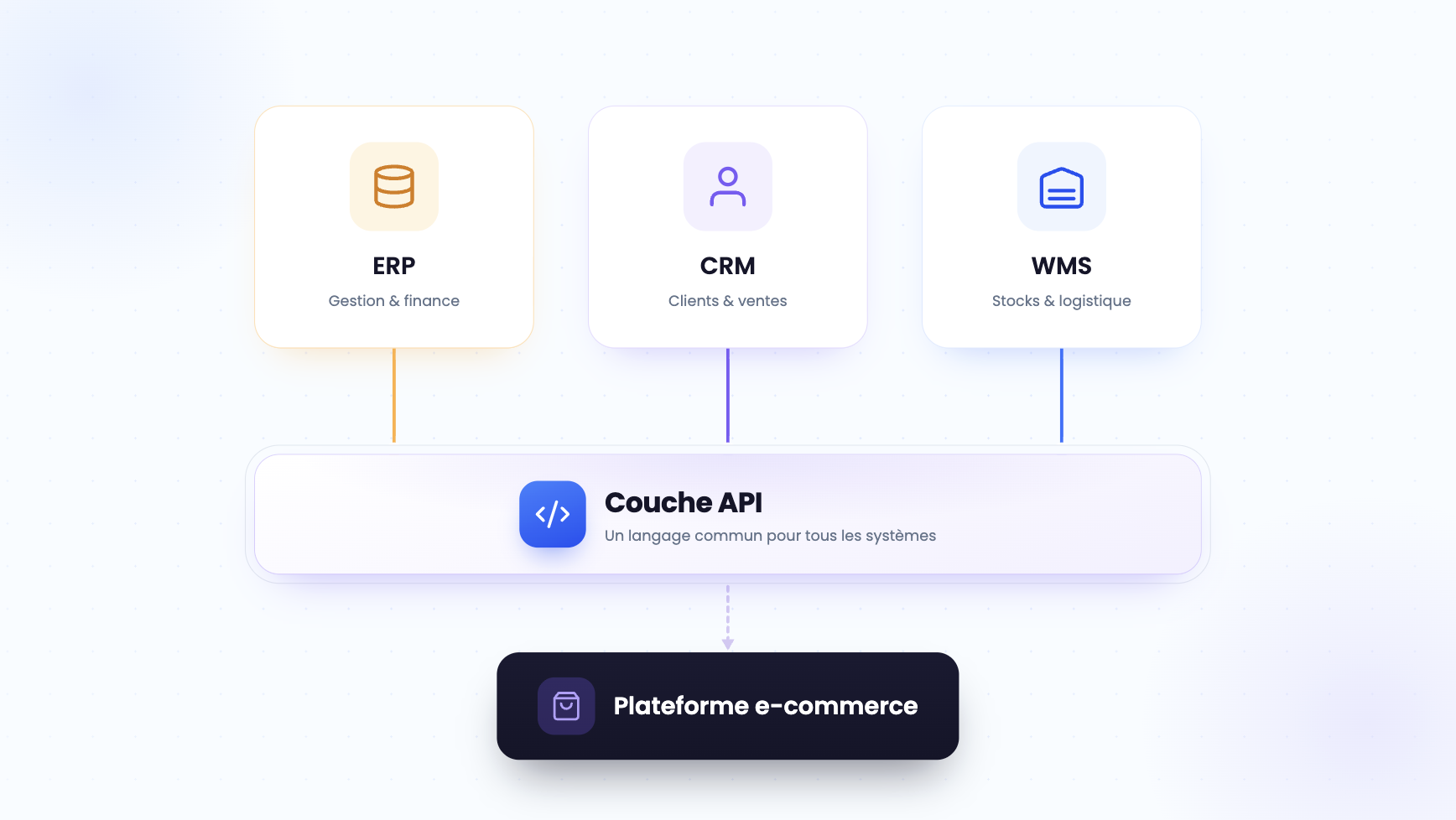
Trap to avoid : deploying a portal without linking it to the ERP, which recreates re-entries and errors.
The customer portal : ordering and tracking in autonomy
The customer portal is the most widespread extranet use in B2B. It allows each buyer to consult a catalog and negotiated rates, to place orders, to track their deliveries, and to download their invoices, without soliciting a salesperson. Example : a distributor gives their resellers a personalized space with their contractual prices and their purchase history.
Mini-method : prioritize the three most requested actions (order, track, invoice) before enriching the portal. The digitization of the B2B product catalog and the integration of a payment solution adapted to B2B fluidify the whole purchase experience.
The supplier portal : securing supplies
The extranet also serves upstream, with a supplier portal. Suppliers consult calls for tenders, update their availability, track purchase orders and deliveries, which secures the supply chain and reduces email exchanges. Example : a purchasing center pilots its replenishment and its supplier orders from a single space.
Mini-method : frame the access rights by supplier (reading, document deposit, stock update) to avoid any data leakage. A connected e-procurement portal effectively completes the device.
B2B extranet features to demand
- Catalog and prices personalized by client or supplier.
- Ordering and reordering in a few clicks, with automatic quoting.
- Tracking of orders, deliveries, and invoices in real-time.
- Granular access rights and profiles (reading, writing, administration).
- Connection to the ERP, CRM and to a scalable B2B site software connections.
Advantages and limitations of each network
Each network has its strengths and its constraints. The intranet excels on internal communication, productivity and security, because it remains partitioned; its limitation lies in its closed perimeter, unsuitable for external exchanges, and an adoption sometimes difficult without support. The extranet opens B2B collaboration, improves customer service and reinforces loyalty, but its opening increases the risk surface: it calls for rigorous management of access rights, data encryption and GDPR compliance. It is also more complex to administer and assumes a careful integration with the information system.
How to arbitrate? By weighing the volume of external exchanges, the sensitivity of the data and the IT resources available. Trap to avoid : underestimating the maintenance of an extranet ; without piloting of the access nor B2B process automation, the gains melt quickly. Artificial intelligence and automation help precisely to reduce this burden. The following table contrasts advantages and limitations.
How to choose between intranet and extranet?
The choice depends on your needs, rarely on the technology.
First step : audit your usages. Do you mainly need to fluidify internal communication, or to open an access to clients and suppliers?
Second step : evaluate the sensitivity of the data and the required level of security.
Third step : measure the volume of external exchanges ; an extranet is justified as soon as the partners are numerous and recurrent.
In most cases, the answer is not exclusive: intranet and extranet are complementary, and the same platform can carry both with distinct profiles and rights.
Example : an industrial SME starts with a customer portal, then adds an internal space for its teams.
Trap to avoid : multiplying partitioned tools, source of duplicates and maintenance costs ; better a unified foundation. To compare market solutions, a platform comparator helps to confront features, integration and total cost. A replatforming towards a modular platform is often the opportunity to unify intranet, extranet and e-commerce.
Decide in 5 criteria
- Audience to serve : mostly employees leans towards the intranet ; clients or suppliers, towards the extranet.
- Sensitivity of the data : very sensitive and internal, intranet ; shared with third parties, partitioned extranet.
- Volume of external exchanges : low, the intranet is enough ; high and recurring, the extranet is essential.
- Business objective : internal cohesion for the intranet ; revenue and customer service for the extranet.
- IT resources : limited, start simple ; solid, aim for a unified intranet and extranet foundation.
DJUST, the B2B portal that unites your sales and purchases
In practice, the extranet of a B2B company merges with its commerce platform. This is precisely what DJUST offers : a modular and headless solution that centralizes the catalog and B2B conditions, ordering, tracking, billing, and payments adapted to B2B. Your clients have a self-service portal to order and track their deliveries, your suppliers have a space dedicated to restocking, all with access rights partitioned by profile. As the platform connects to your ERP and your CRM, you unify e-commerce site, customer portal and supplier space on a unique foundation, without multiplying tools or re-entries. The management of negotiated prices and your B2B pricing strategy thus remains centralized and readable.
FAQ
What is the difference between an intranet and an extranet ?
An intranet is a private network reserved for an organization's employees, dedicated to internal communication. An extranet opens secure access to authorized third parties, such as clients or suppliers, via a web portal. The difference lies in the targeted audience and the level of openness: closed for the intranet, controlled and partitioned for the extranet.

What is a B2B extranet ?
In B2B, an extranet is most often a commercial portal intended for clients or suppliers. Clients place orders, track their deliveries, and consult their invoices; suppliers manage stocks and purchase orders there. It digitizes the relationship, secures exchanges, and increases autonomy and productivity for both parties.
What are the disadvantages of an extranet ?
Opening the extranet increases the risk surface: access rights must be finely managed, exchanges encrypted, and GDPR respected. It is also more complex to administer than an intranet and requires careful integration with the information system. Without access piloting or automation, its maintenance can weigh on teams.
Can you have an intranet and an extranet on the same platform ?
Yes, and it is often recommended. A single platform can offer an intranet for employees and extranet spaces for clients and partners, with distinct profiles, access rights, and authentication. Advantages : consistent experience, centralized governance, and reduced maintenance. In B2B, this unified foundation brings internal communication and digital commerce closer.
What is the difference between internet, intranet and extranet ?
Internet is the global network, open to everyone via a browser. The intranet is an internal network, reserved for a company's employees. The extranet is a secure extension of the intranet, open to authorized third parties like clients or suppliers. All three share the same web technologies but differ in audience and access level.
-modified.avif)

.png)