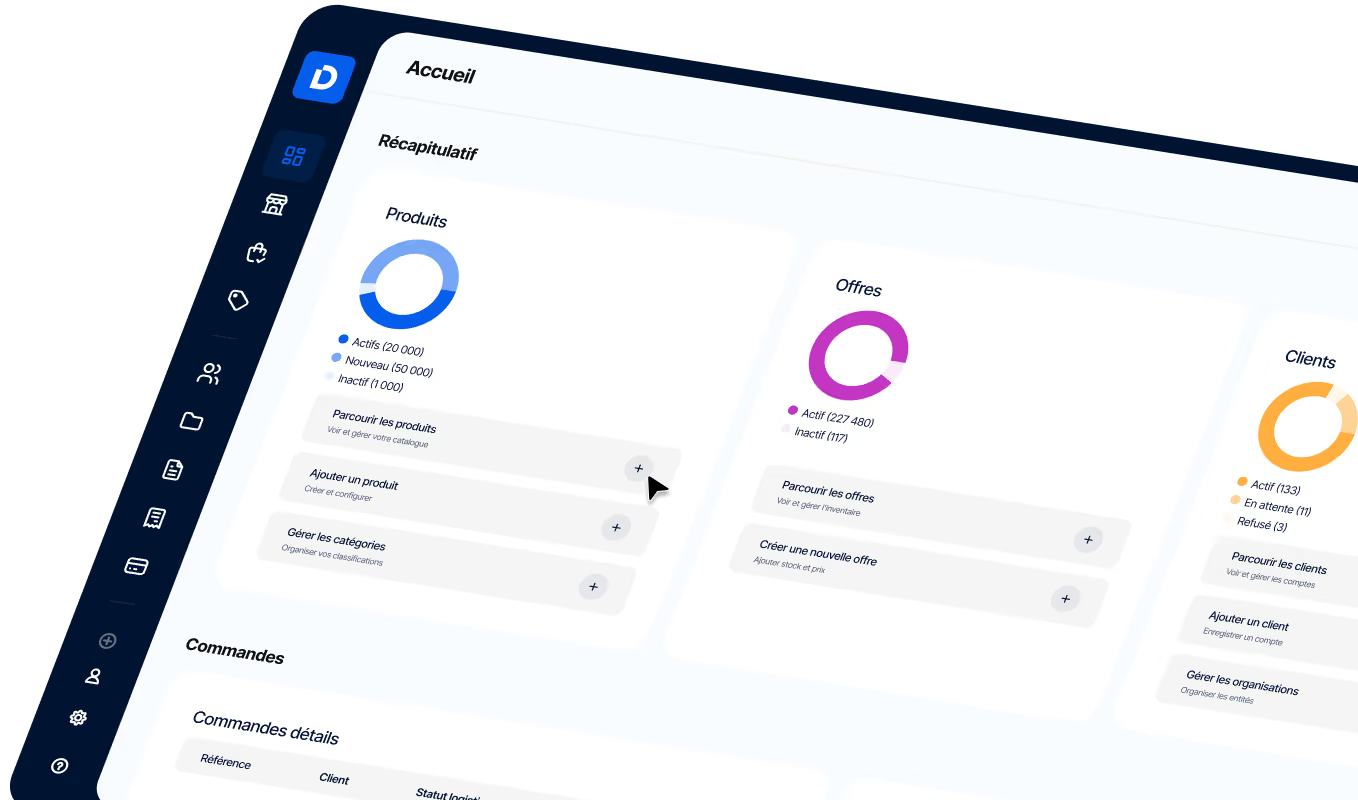
B2B Commerce Suites: What You Need to Know Before Investing
Are B2B commerce suites worth the investment? Discover how to choose the right suite for your business by exploring the benefits, key features, and best practices.

According to a McKinsey report, nearly two-thirds of B2B companies across all industries offer online commerce capabilities. The main reasons for this shift are:
- Online B2B stores simplify complex operations
- They improve customer satisfaction through flexibility and convenience
But to build one for your e-commerce business, you need a set of capabilities that integrates with your existing systems and brings every essential detail and process together in one place. That’s why you need an effective B2B commerce suite.
But what do these platforms include? What are the benefits and challenges? And how do you find one that meets your company’s specific needs?
Short on time? Here’s the key takeaway:
- B2B commerce suites are unified commerce platforms where all your B2B interactions are stored, processed, and updated.
- They integrate with your CRM, ERP, PIM, and other productivity tools, creating a single source of truth.
- Some of the key features of a B2B customer suite include order management, real-time stock updates, customizable product catalogs, and dynamic pricing.
- The B2B commerce suite you choose should be AI-powered, scalable, and user-friendly.
What is a B2B commerce suite?
A B2B commerce suite is a centralized platform that brings all your existing backend tools and systems together into a fully unified system, capable of handling complex B2B sales processes.
It’s designed to make transactions and interactions between B2B companies and their customers more seamless and organized.
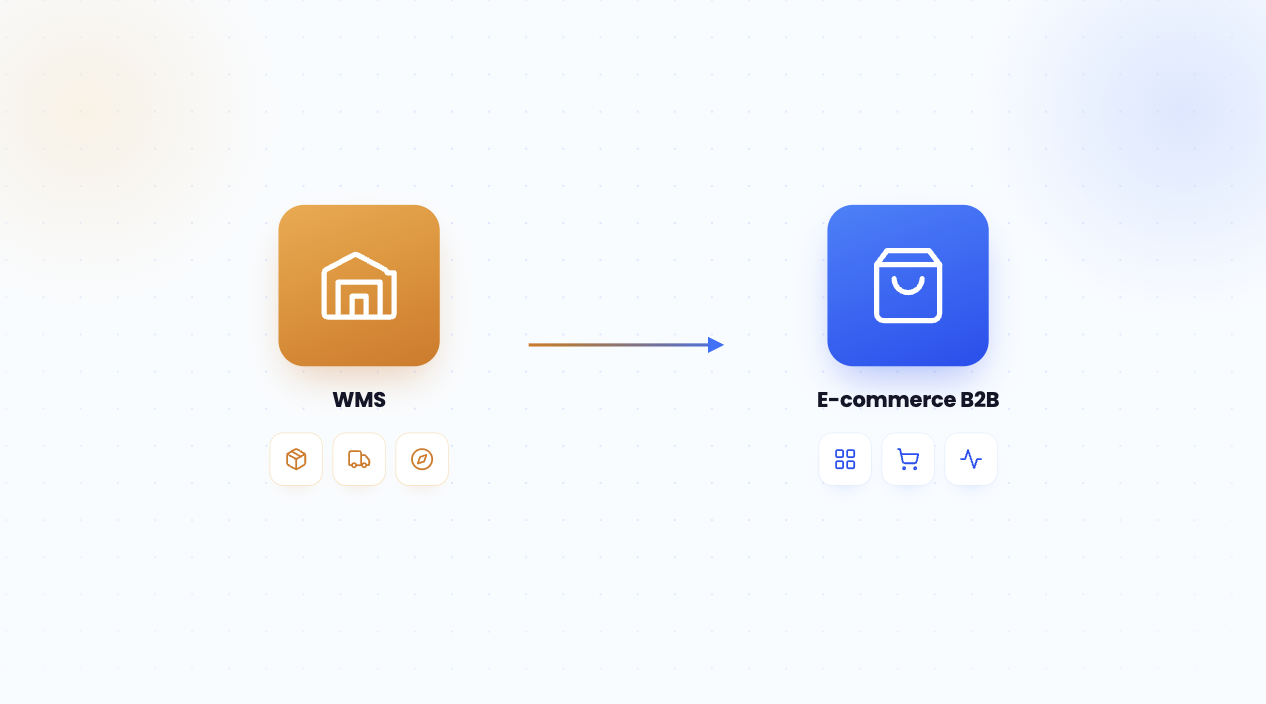
These suites often integrate with other enterprise systems, such as ERP, CRM, PIM, OMS, and even legacy systems. This connectivity simplifies operations, keeps all data in one place, and improves the efficiency and effectiveness of B2B transactions.
B2B commerce suites are built to:
- Manage complex sales processes.
- Display large product catalogs.
- Process bulk orders.
- Provide personalized services and volume pricing tailored to each B2B customer.
5 benefits of implementing an integrated B2B solution
To stay ahead of the competition, you need an agile, well-structured system that streamlines operations and delivers maximum customer satisfaction, and the right B2B commerce suite can help you get there.
Here’s how:
- Lower costs
An integrated suite eliminates the need to manage multiple tools, which reduces maintenance costs and IT support overhead. Automation and streamlined workflows lower operating costs by minimizing manual work. Accurate order processing and self-service portals also reduce return rates, helping you save on extra deliveries.
- Greater operational efficiency
B2B customer suites automate order processing, inventory management, and invoicing. This reduces human error and frees up time so you can focus on more strategic tasks.
Extensive integrations ensure that all information is synced in real time, creating a single source of truth. That means a consistent customer experience at every touchpoint.
- Better customer experience (CX)
Commerce suites let you deliver personalized experiences through customer-specific catalogs, pricing, and recommendations.
Your B2B customers, who are often short on time, can quickly find exactly what they need and place orders without going through marketing or sales calls. That improves customer satisfaction and loyalty.
- More sales and revenue
B2B customer suites are optimized with smart product recommendations, opening the door to cross-sell and upsell opportunities. That increases average order value, boosting sales and revenue.
In addition, faster and more accurate order processing reduces delays and increases customer satisfaction, driving repeat business and higher sales volumes.
Key features of B2B commerce suites
B2B commerce suites help companies create a seamless, organized, and personalized customer experience, ensuring maximum satisfaction. To do that, the platform you choose should include the following B2B e-commerce features:
- Powerful API integration: Extensive API integration is a key feature that defines how effective a B2B commerce suite is. It should sync with your existing systems, such as your B2B PIM, ERP, CRM, OMS, and even legacy systems, to create a unified view of your entire operation, including workflow validation.
For example, integrating your ERP system with a B2B commerce suite will ensure real-time inventory sync across your e-commerce site, preventing overselling and stockouts.
- Robust catalog management: A commerce suite should include B2B e-commerce catalog management capabilities with bulk uploads, customizable templates, and product information updates. You should be able to create and edit multiple catalogs tailored to different customer segments.
For example, with effective e-commerce for businesses, an electronics supplier can tailor product selections with specific pricing and discount structures based on the volume and contract terms of different distribution channels.
- Customer management: B2B commerce suites create a centralized repository for all customer data, including order history, account-specific pricing, and more.
Customer management also makes it possible to segment customers by industry, purchase history, and other targeted demographics for focused marketing and sales.
- Case management: Your B2B suite should be optimized with case management and complaint resolution features. Customers should be able to open a ticket when they run into issues such as incorrect deliveries or damaged products. This helps your team track and resolve problems quickly.
- Pricing: Another key feature of B2B commerce suites is dynamic pricing. It lets you set up multiple pricing formats to meet different customer needs, including tiered pricing, volume discounts, and customer-specific pricing.
- Omnichannel access: Because customers are always on the move, B2B commerce suites need to offer multi-device access. Customers should be able to switch between devices—mobile, tablets, and desktops—and access their B2B shopping carts without interruption.
For example, a buyer should be able to start an order on a desktop at the office and continue on mobile while on the go.
DJUST offers a B2B e-commerce platform where you can customize your own suite with:
- A seamless B2B customer portal
- Custom catalogs and tailored pricing
- Easy account management
- Powerful B2B integrations
- Quote management and price negotiation
- An omnichannel customer experience
4 things to consider when choosing your B2B commerce suite
While there are many benefits, B2B e-commerce platforms also come with implementation challenges. Here are a few things to know to minimize risk and maximize value:
- Although convenient, B2B e-commerce self-service features can feel impersonal to some customers. That’s why you need to build a platform that preserves the close relationships you’ve established with your customers, with fast order processing, real-time updates, and easy navigation. It will also make it easier to onboard customers to your B2B store.
- B2B transactions often involve complex pricing structures, including volume discounts, tiered pricing, contract-specific pricing, and more. So if you use a B2C solution for B2B, that could be a major problem. You need a solution designed specifically for B2B stores.
- B2B transactions involve multiple stakeholders, including procurement managers, executives, and finance departments. Each requires different levels of access and permissions, which can be difficult to manage.
How do you overcome these challenges? Choose a tool like DJUST that offers customization, scalability, integrations, and easy navigation, all on one platform.
Build a B2B store that fits your customers like a glove on our headless B2B e-commerce platform. From customizable pricing to scalability, we provide everything you need to launch an online store that handles the complexities of B2B customer relationships with ease.
Best practices for choosing a B2B commerce suite
You need a B2B commerce suite that gives your customers the personal touch of sales interactions while still delivering the efficiency of an online store. Here’s how to choose one that does both:
- Define your business goals: Identify your specific business challenges, processes, and needs. Consider factors such as order volume, product complexity, and customer management needs, and define your short- and long-term business goals. That will give your search for the perfect commerce suite a clear direction.
- Make sure it can scale: Check whether the platform you choose can handle higher order volumes, new product lines, and potential market expansion. That way, you won’t need to switch vendors as your business grows.
- Evaluate core features: Make sure the platform integrates with catalog management software and supports complex product data, bulk uploads, and real-time inventory and pricing updates. Look for a tool with self-service portals and dynamic pricing. We suggest signing up for trials and demos to see whether the features meet your current and future needs.
- Assess integration capabilities: Check whether the B2B suite syncs with your ERP, CRM, PIM, and other existing sales tools. Review its compatibility with third-party services such as payment gateways, logistics platforms, and marketing tools.
- Evaluate the user experience: Choose a platform with an intuitive, user-friendly interface to minimize training needs and improve user adoption.
- Responsive, mobile-friendly design: Make sure the platform is mobile-friendly and delivers a seamless, consistent experience across all devices.
In conclusion
As businesses become more digital, launching a commerce suite is no longer a luxury but a necessity. It gives your customers convenience and flexibility while simplifying complex B2B operations for your team. Robust integrations create an organized data repository that you can manage with ease.
On top of that, features like custom product catalogs, dynamic pricing, and real-time inventory updates improve customer satisfaction and loyalty. The result? You build lasting customer relationships, increase revenue, and stay ahead of the competition.
FAQ
Imported item 73
Yes. B2B commerce suites offer customization options that let you tailor the platform to your company’s specific needs. For example, you can customize product catalogs using the templates available in the suite. You can also offer multiple pricing structures for different customers to meet their specific needs.

-modified.avif)
.png)
.avif)

.jpg)