The best e-commerce solutions for wholesalers and distributors.
Discover how to choose the best wholesale e-commerce solution: platform types, key features, and criteria for a successful B2B project.
Article summary
- A wholesale e-commerce solution allows you to digitize B2B sales by managing catalogs, personalized pricing, bulk orders, and ERP synchronization.
- Key features include customer-specific pricing, real-time inventory, recurring orders, multi-user accounts, and ERP integration to automate workflows.
- Choosing the right platform should be based on objective criteria: business alignment, integration with your information system, scalability, total cost of ownership, and the quality of support.
- A successful deployment relies on data preparation, reliable ERP integration, a pilot project, and avoiding common pitfalls, such as a lack of synchronization or a B2C-style purchasing journey.
.avif)
A wholesale e-commerce solution is an online platform that allows a wholesaler or distributor to sell in bulk to professional clients: catalogs, negotiated rates, order taking, tracking, and invoicing all in one place. Unlike a B2C site, it manages the complexity of business-to-business commerce: customer-specific pricing, orders by batch or pallet, multi-user accounts, and ERP integration. When chosen correctly, it digitizes order taking, ensures the reliability of displayed stock, and frees up time for sales teams. If poorly sized, it simply replicates the inefficiencies of fax and email online, without any real productivity gains.
E-commerce solutions for wholesalers: definition and benefits
A wholesaler buys in large quantities to resell in batches to professionals, often with tiered pricing. A distributor ensures the flow of products to the final market. In both cases, sales rely on recurring orders, large catalogs, and commercial terms specific to each client. A B2B e-commerce solution for wholesalers digitizes this process: it displays an up-to-date catalog, applies the right price to the right buyer, and records the order without manual re-entry. A concrete example: a restaurant owner logs back in and reorders their usual selection in a few clicks, instead of sending a fax that has to be manually transcribed by the sales administration team. A common trap is to launch a simple storefront without reviewing processes: without account-based pricing or ERP integration, the solution remains purely cosmetic. To set the right foundation, wholesale and B2B distribution needs should be clarified upfront.
| Type of business | Role | Customers | Priority e-commerce need |
|---|---|---|---|
| Wholesaler | Bulk sales | Retailers, hospitality businesses, craftspeople | Fast ordering, volume-based pricing |
| Distributor | Market distribution | Businesses, resellers | Wide catalog, account-specific pricing |
| Manufacturer | Production and direct sales | Distributors, wholesalers | Omnichannel sales, real-time inventory |
Wholesalers, distributors, manufacturers: distinct e-commerce needs
These three profiles all operate in B2B but have different priorities. Wholesalers focus on fast ordering and volume-based tiered pricing. Distributors prioritize a rich catalog and account-specific pricing. Manufacturers aim to orchestrate multiple channels while protecting their network. For example, a food wholesaler for the restaurant industry needs a recurring order schedule, whereas a spare parts manufacturer prioritizes real-time stock visibility. A quick method: list your typical customers, their volumes, and their terms, then deduce the non-negotiable features of a B2B platform that fits your needs.
Why digitize wholesale ordering
Professional buyers order independently, at any time. According to Gartner, 80% of B2B sales interactions take place through digital channels, and buyers spend only 17% of their purchasing time interacting with suppliers. For a wholesaler, sticking to phone and fax means losing orders to more accessible competitors. Digitization also reduces manual entry: orders arrive structured, with no need for re-transcription. For example, a sales team can enter orders on a tablet, even offline, and everything syncs up later. Digitizing the B2B sales process frees sales reps from repetitive tasks. A trap to avoid: keeping a funnel designed for B2C, which is ill-suited for carts containing dozens of line items.
6 essential features for a wholesaler
Not all platforms are created equal when it comes to wholesale. Six features distinguish a truly suitable solution from a simple showcase site. They determine team productivity and the professional customer experience.
- Customer-specific and tiered pricing: each account sees its negotiated terms, with volume discounts applied automatically.
- Multi-warehouse inventory management: availability is displayed in real-time by warehouse to avoid making impossible promises.
- Bulk orders and reordering: customers reorder by batch or pallet and access their standard orders in a single click.
- Multi-user accounts and roles: multiple buyers per company, with approval workflows and budget limits per profile.
- Quotes and approval: quote generation, approval thresholds, and conversion into orders without double entry.
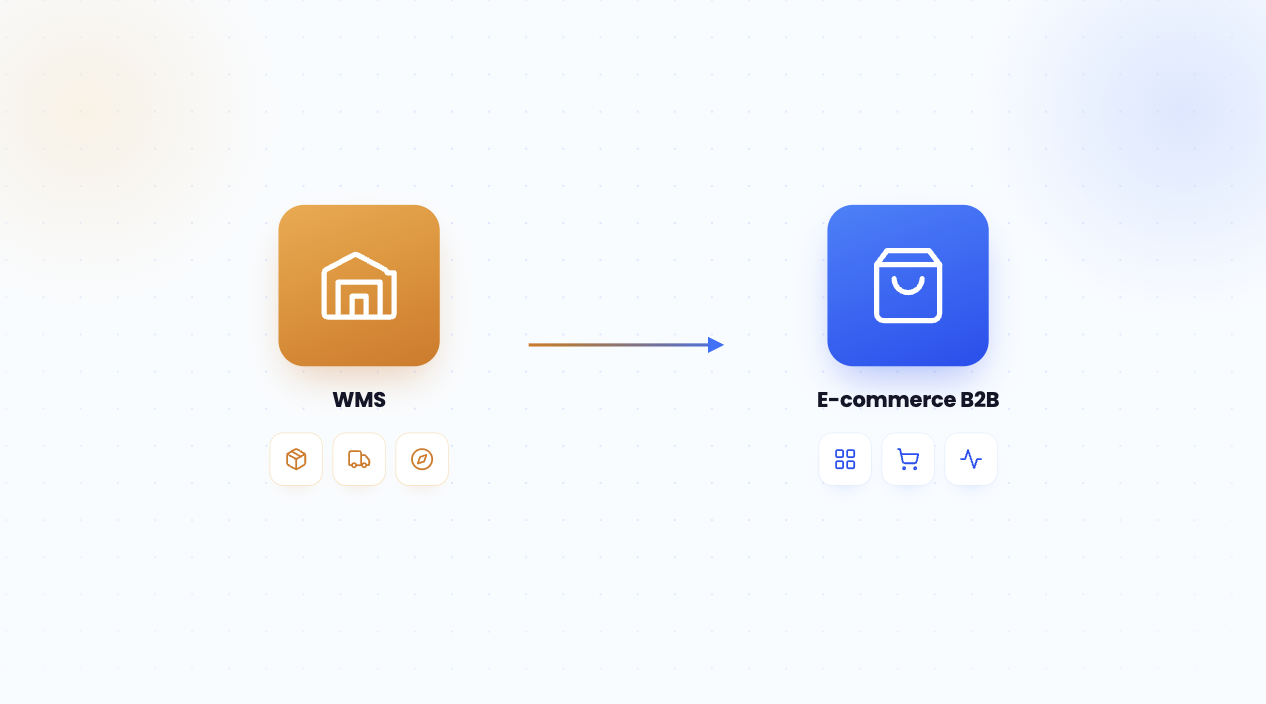
- Native ERP integration: catalog, pricing, inventory, and orders synchronized with your existing management system.
5 types of e-commerce solutions for wholesale
The market offers several families of solutions, ranging from turnkey software to custom-built architecture. Each addresses a different level of complexity and budget. The following table clarifies their principles, use cases, and limitations.
| Solution type | Principle | Ideal for | Main limitation |
|---|---|---|---|
| Dedicated B2B SaaS | Ready-to-use platform designed for B2B | Wholesalers looking to launch quickly | Limited customization |
| Generalist platform + B2B module | B2C e-commerce extended to B2B | Businesses operating in both B2B and B2C | B2B features may be limited |
| Self-hosted open-source | Open-source code that can be customized | Businesses with strong in-house IT teams | Maintenance and hidden costs |
| Composable / headless | Components connected via APIs | Complex, multi-channel projects | Technical expertise required |
| Order-taking solution / marketplace | Ordering app or marketplace | Field sales teams, procurement teams | More limited scope |
The choice depends primarily on the level of complexity and internal resources. A company without a technical team benefits from a dedicated B2B SaaS, while a multi-channel organization with large catalogs will benefit from a composable, API-first approach. For example, a wholesaler looking to first streamline their ordering process might rely on a B2B order management system before launching a full storefront. To decide methodically, determining the right type of B2B e-commerce solution prevents over-engineering the project. A B2B website software that is poorly calibrated is expensive to scale.
How to choose your wholesale e-commerce solution
Choosing an e-commerce solution for wholesalers means balancing business needs against technical and budgetary constraints. The decision goes beyond the sticker price: it encompasses the total cost of ownership, scalability, and the quality of support. A simple framework helps to objectively compare platforms rather than being swayed by a demo. For example, two solutions with similar pricing can diverge significantly once you add connectors, maintenance, and custom development. The classic trap is choosing based solely on feature richness without verifying integration with the ERP and inventory management: the most beautiful storefront becomes useless if orders do not sync correctly. Well choosing your B2B e-commerce platform requires comparing several offers and defining your priorities.
Building an objective comparison grid
Comparing without a method leads to choosing based on instinct. A weighted grid corrects this bias: assign a weight to each criterion (for example, 30% for business suitability, 25% for integration), then rate each provider from 1 to 5. The total score helps you decide based on facts, not just a demo impression. For example, an attractive platform might fall short once the cost of connectors and the depth of integration are weighted. Identifying the best e-commerce platform requires this objective approach. The method for choosing B2B order management software details criteria that are directly applicable.
ERP integration and inventory management: the technical foundation
Without a reliable technical foundation, an e-commerce solution for wholesalers remains fragile. ERP integration determines the consistency of prices, inventory, and orders between the store and the back office. Real-time inventory synchronization prevents displaying out-of-stock products, a major risk for high-volume orders. For example, an order for several pallets validated against non-updated stock leads to shortages and costly disputes. The process for modernizing from an existing ERP secures this component. Checking the quality of APIs and connectors during the selection phase avoids additional integration costs later on.
Successfully launching in 5 steps
Deploying an e-commerce solution for wholesalers follows five steps. Each produces a deliverable that determines the next, from scoping to management. This model limits risks and accelerates adoption by customers and teams.
| Step | Objective | Key deliverable | Tracking KPI |
|---|---|---|---|
| 1. Scoping | Define needs and priorities | Requirements specification, target catalog | Scope approved |
| 2. Data preparation | Clean up catalog, pricing, and customer data | Reliable product and pricing database | Percentage of complete product listings |
| 3. Selection and integration | Select the tool and connect the ERP | Configured platform, ERP data flows | Synced data flows |
| 4. Pilot | Test with a few customer accounts | User feedback, adjustments | Adoption rate |
| 5. Rollout | Deploy and monitor | Sales dashboard | Online orders, average order value |
Each step benefits from being marked by a short review. Scoping rules out out-of-scope requests. Data preparation prevents importing duplicates and incorrect prices. Integration connects the platform to the ERP for accurate stock and pricing. The pilot, conducted with a dozen volunteer accounts, validates real-world usage before a full rollout. Building a B2B e-commerce business plan A solid foundation aligns budget and objectives. A common mistake is to generalize without a pilot. A massive rollout on untested processes leads to user rejection that is difficult to recover from.
5 mistakes to avoid in wholesale e-commerce
Wholesale projects often fail for the same reasons. Anticipating them protects your budget and user adoption. Here are five recurring mistakes and the concrete solutions to address them.
- Neglecting customer-specific pricing: Displaying a single price point drives away negotiated accounts. Solution: configure conditions by customer from the start.
- Underestimating data preparation: A messy catalog pollutes the entire platform. Solution: clean and standardize products, prices, and inventory before importing.
- Forgetting ERP integration: Re-entering orders wastes time. The solution: connect your ERP and automate workflows.
- Copying a B2C funnel: High-volume orders require a tailored ordering process. The solution: prioritize order templates, lists, and quick-order features.
- Launching without support: Without training, teams fall back into old habits. The solution: train your sales staff and pilot customers.
These pitfalls are part of the mistakes to avoid in B2B commerce more broadly, and automating B2B order entry directly addresses several of them.
DJUST, the B2B e-commerce solution for wholesalers and distributors
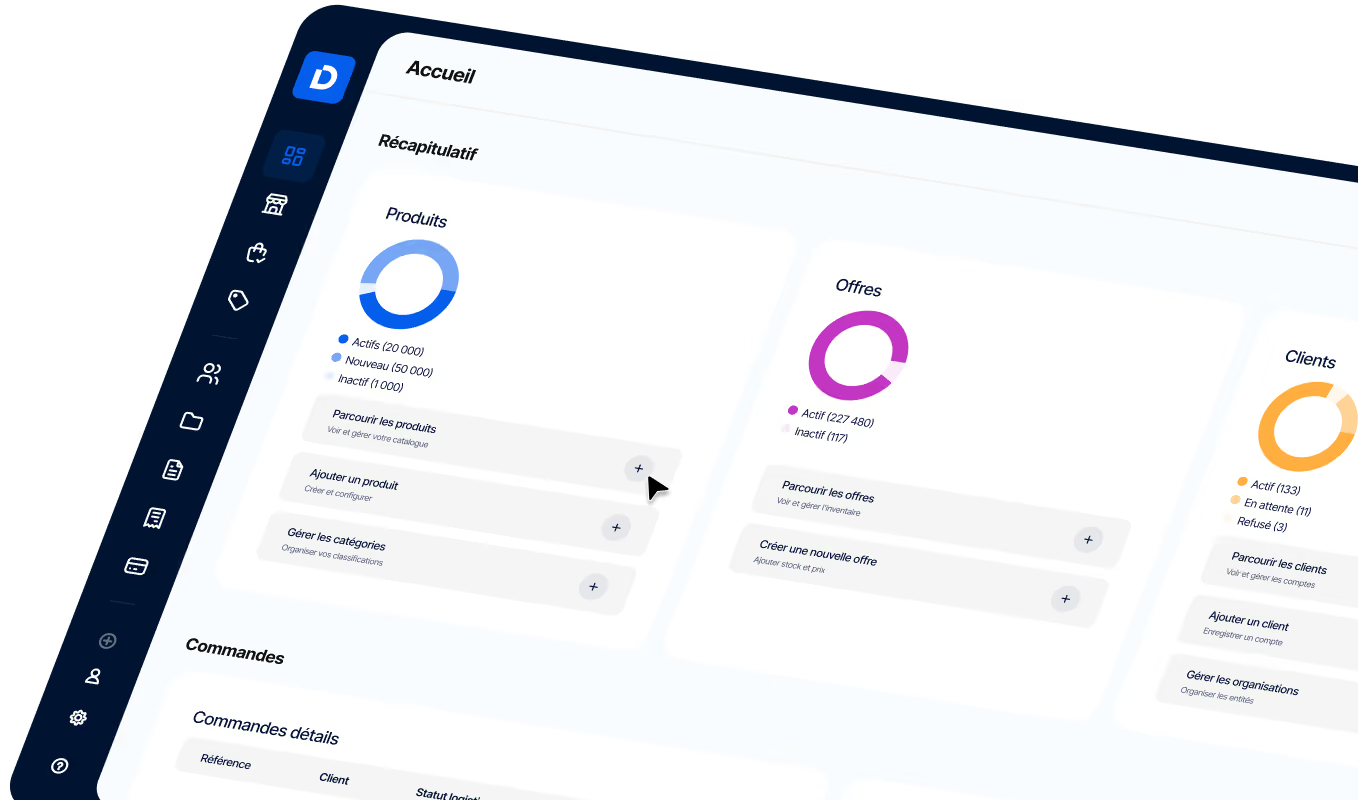
Among the solutions on the market, DJUST offers a B2B e-commerce platform designed for wholesalers and distributors: customer-specific pricing, tiered pricing, recurring order templates, and multi-user accounts are managed natively. Its ERP integration synchronizes catalogs, pricing, and multi-warehouse stock in real time, ensuring every professional buyer sees the right availability at the right price. Thanks to a composable, API-first architecture, the platform integrates with your existing IT system and evolves with your channels, from ordering sites to marketplaces. Your sales teams save time on data entry, your customers reorder independently, and wholesale finally goes digital without the burden of faxes and emails.
FAQ
How long does it take to launch an e-commerce solution for wholesalers?
The timeframe depends on the solution and data quality. A dedicated B2B SaaS solution can be deployed in a few weeks within a defined scope. A composable project, involving large catalogs and extensive customization, may take several months. Catalog preparation and ERP integration have the biggest impact on the schedule. A short pilot phase can then accelerate the full rollout.

What is the difference between an e-commerce solution for wholesalers and a B2C site?
A B2C site sells to individual consumers, featuring a single price point and a simple shopping cart. An e-commerce solution for wholesalers handles B2B complexities: client-specific negotiated prices, bulk orders, multi-user accounts, quotes, and ERP integration. It adapts to high volumes and the specific commercial terms of each business client, areas where a B2C sales funnel quickly reaches its limits.
Is an e-commerce solution for wholesalers suitable for SMEs?
Yes. SMEs benefit significantly from automation, as they often have smaller teams and the time saved on order entry is crucial. Dedicated SaaS solutions make digitalization accessible without requiring a large technical team. The key lies in defining a realistic scope, preparing data, and choosing a scalable tool that can support future growth.
Should the solution be connected to the ERP?
Yes, it is highly recommended. The ERP centralizes inventory, pricing, and invoicing. Without integration, orders must be re-entered manually, negating time savings and increasing the risk of errors. Real-time synchronization of stock levels and prices ensures reliable information for the customer. Checking the quality and range of available connectors when selecting the platform helps avoid additional costs.
How are prices and inventory managed on a per-client basis?
Management settings are configured within the solution and synchronized with the ERP. Each account is assigned a specific price list, with volume-based discounts applied automatically. Inventory levels are displayed by warehouse in real time to prevent stockouts. Documenting pricing and availability rules—and then testing them via a pilot program—ensures the accuracy of the displayed information before the system is rolled out to all customers.

.png)
.jpg)