Mid-Market E-Commerce: Which Platform Should You Choose in 2026?
Discover the mid-market e-commerce platform built for your needs. Compare the key selection criteria and find a B2B solution that supports your growth.
Article summary
- Mid-market e-commerce refers to mid-sized and fast-growing companies that need a B2B platform capable of handling complex catalogs, negotiated pricing, business orders, and ERP integrations, without the overhead of enterprise solutions.
- Choosing a B2B e-commerce platform depends first and foremost on your business processes: SaaS, open source, composable/headless, and B2B-native platforms each offer different advantages depending on your level of customization, technical resources, and growth goals.
- The 5 decisive criteria are native B2B features, integration capabilities (ERP, CRM, PIM), architecture, total cost of ownership (TCO) over three years, and time to market, rather than the license price alone.
- A successful project relies on a structured approach: map your needs, define integrations, compare solutions using real-world use cases, then roll out gradually. A B2B-native platform like DJUST makes that transition easier while keeping costs and risks under control.
.png)
Mid-market e-commerce refers to online commerce solutions built for mid-sized companies, sitting somewhere between SMBs and large enterprise accounts. These organizations have outgrown entry-level tools, but don’t need the complexity of an enterprise-grade platform. In B2B, they need a platform that can handle product catalogs, negotiated pricing, orders, and ERP integrations without driving up costs or timelines.
Mid-market e-commerce: what are we talking about?
The mid-market includes companies that are too large for consumer-grade solutions and too agile for enterprise rollouts. In France, this segment largely overlaps with ETIs, or mid-sized companies, defined by INSEE as having 250 to 4,999 employees and generating up to €1.5 billion in revenue. In B2B e-commerce, these organizations share specific needs: managing a large B2B product catalog, applying customer-specific negotiated pricing, orchestrating complex orders, and connecting the platform to ERP and procurement processes. Why treat it as a separate segment? Because professional buyers have shifted toward self-service: according to McKinsey, e-commerce is now the leading B2B revenue channel.
Common pitfall: choosing a B2C solution and then trying to adapt it for B2B, which drives up costs and slows growth. A B2B platform designed for this segment avoids that trap.
Typical mid-market company profile. Headcount: 250 to 4,999 employees. Revenue: up to €1.5 billion. E-commerce priority: scale without overbuilding, with a platform that keeps pace with growth and integrates with existing IT systems.
4 types of B2B e-commerce platforms
The market breaks down into four main categories, each with its own trade-offs. SaaS platforms offer fast deployment and outsourced maintenance, but limited customization when B2B processes become more complex. Open-source solutions give you full control, but they require a technical team and increase total cost of ownership. Composable and headless platforms decouple the front end and back end through APIs: they deliver flexibility and speed to market, making them ideal for a mid-market company that wants to evolve without rebuilding everything. Finally, B2B-native solutions include customer accounts, approval workflows, and quotes out of the box. This is a strategic choice, because it shapes growth for years to come.
Pitfall to avoid: aiming for an oversized enterprise solution for the mid-market, with disproportionate costs and complexity. The right approach is to define your B2B sales processes and target architecture first, then compare tools.
Where does DJUST fit in this landscape?
In all four. Delivered as SaaS, the platform offers the deployment speed and outsourced maintenance of an out-of-the-box solution; its headless, composable architecture, powered by APIs, brings the flexibility and speed to market of a modular approach; its B2B-native coverage (customer accounts, negotiated pricing, approval workflows, quotes, complex orders) meets the most demanding processes from day one; and its extensibility, close to the open-source mindset, gives you control over customization without the maintenance burden. The mid-market gets the best of all four worlds: speed, flexibility, rich B2B functionality, and openness, without the drawbacks.
5 criteria for choosing the ideal platform for mid-market e-commerce
Beyond the type of solution, five criteria will determine the decision. The first is native B2B functionality: customer accounts, contract pricing, quotes, replenishment. The second is the depth of integration with ERP, CRM, and PIM systems, where budgets most often spiral. The third is architecture, which determines scalability and omnichannel capabilities. The fourth is total cost of ownership, which should be assessed over three years, not just the first year. The fifth is time to market. Quick method: score each solution from 1 to 5 against these criteria, weight them according to your priorities, then put the top three through a demo using your real use cases. A robust order management system, a replenishment platform for recurring purchases, and B2B order automation often make the difference. Pitfall to avoid: focusing on license price and forgetting integration and maintenance.
The 5 criteria to score
- Native B2B functionality: customer accounts, negotiated pricing, quotes, replenishment, approval workflows.
- Integration: ERP, CRM, and PIM connectors, plus API quality and data synchronization.
- Architecture: modular, headless, or composable, so you can evolve without rebuilding everything.
- Total cost of ownership: license, integration, maintenance, and upgrades, assessed over three years.
- Time to market: launch timeline and ability to iterate quickly.
How to make the project a success: method and pitfalls
Choosing the right platform is good; delivering the rollout successfully is better. The winning approach starts with business needs, not technology. First, map your current sales processes and order flows. Second, list the essential integrations (ERP, CRM, payments) and the non-negotiable B2B workflows. Third, shortlist three solutions and test them against real scenarios, not generic demos. Fourth, plan a phased migration to reduce risk. Why this level of rigor? Because a poorly prepared migration is expensive and slows growth. A classic pitfall: underestimating change management and adoption by the sales team. To compare options objectively, a solution comparison tool helps you evaluate scope, integration, and cost. A well-run project is also a chance to improve an existing e-commerce site, with the right software for a B2B website and real B2B process automation.
DJUST: the B2B-native platform built for the mid-market
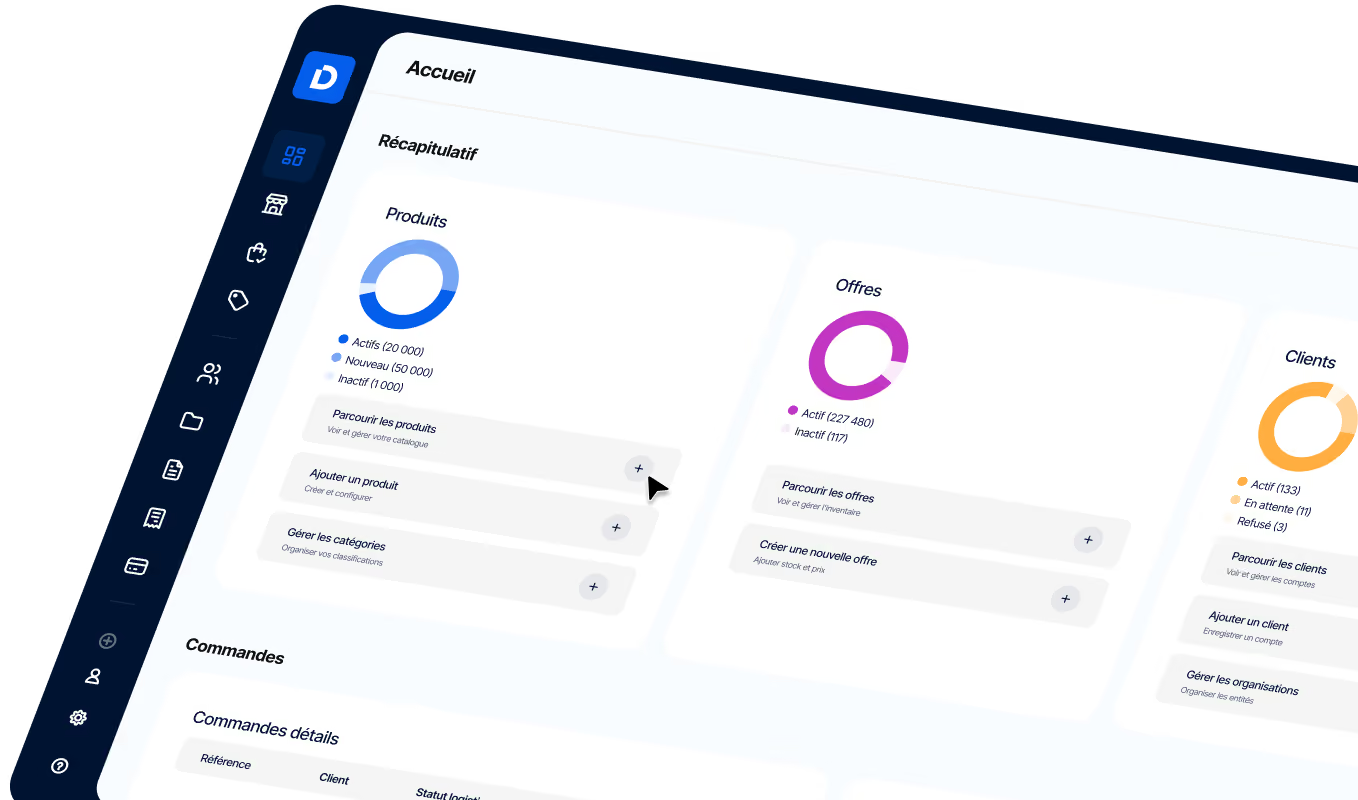
To orchestrate this transition without falling into the trap of overbuilding, choosing a solution designed natively for B2B commerce is critical. That’s exactly why the DJUST platform was built: to address these flexibility and integration challenges. Combining the power of a headless SaaS architecture with rich ready-to-use B2B functionality (negotiated pricing management, approval workflows, complex orders), DJUST enables ETIs to launch their e-commerce site or B2B marketplace quickly. By minimizing time to market and total cost of ownership (TCO), the solution integrates seamlessly with your existing ERP and CRM ecosystem, ensuring controlled, fully scalable growth.



.jpeg)