AI Pricing in B2B: Optimize Your Margins
AI Pricing in B2B: Key Use Cases, Implementation Steps, and KPIs to Improve Margins and Close Deals Faster
Article summary
- AI pricing uses machine learning algorithms to analyze historical sales data, competitor prices, customer behavior, and market signals in order to recommend or automatically set the optimal prices for each product, customer, and transaction.
- In B2B, pricing complexity is extreme: contract-specific rates, volume discounts, tiered pricing, currency fluctuations, and negotiated terms make manual price management impossible at scale.
- 5 practical use cases are driving adoption: customer-specific price optimization, margin leak detection, dynamic quoting, competitive price monitoring, and demand-based price adjustments.
- The main prerequisite is clean, connected data: fragmented price lists spread across spreadsheets, ERP modules, and sales teams will undermine any AI pricing initiative.
.avif)
AI pricing refers to the use of machine learning models and predictive algorithms to determine the optimal price for a product or service through real-time analysis of market conditions, customer data, the competitive landscape, and transaction history. Unlike static pricing rules or manual spreadsheet-based approaches, AI pricing systems continuously learn from new data and adjust their recommendations to maximize revenue, protect margins, and improve conversion rates.
In B2B commerce, pricing is fundamentally more complex than in B2C. A single product can carry dozens of different prices depending on the customer, contract, order volume, geographic region, and payment terms. Managing that complexity manually — through spreadsheets, email negotiations, and ad hoc discounts — creates pricing inconsistencies, margin leakage, and slow quote turnaround times that cost deals.
This article explains how AI pricing works in a B2B context, identifies the highest-ROI use cases, and outlines a step-by-step approach to implementation. For companies already exploring AI across their commercial stack, this topic complements the broader discussion of AI tools for e-commerce and AI in B2B e-commerce.
What Is AI Pricing?
AI pricing is a data-driven approach in which machine learning algorithms analyze large volumes of transactional, competitive, and behavioral data to automatically recommend or set prices that maximize a defined objective — revenue, margin, market share, or conversion rate.
The system ingests data from multiple sources: ERP transaction history (actual invoiced prices by customer, product, and period), CRM data (deal stage, customer lifetime value, contract terms), competitor price feeds, cost-of-goods data, and external market signals (commodity indices, exchange rates, seasonality). Machine learning models then identify patterns invisible at human scale: which customers are price-sensitive, which products have pricing power, where discounts are eroding margin without improving conversion, and how competitor moves affect demand.
3 Levels of Pricing Maturity in B2B
The key distinction is that AI pricing doesn’t replace human judgment; it strengthens it. Sales reps and pricing managers still control final prices, but they work from data-backed recommendations rather than intuition. The best systems provide explainable recommendations: "this price is 3% higher than the current contract because the customer’s order frequency has increased by 20% and competitor X has raised prices on equivalent products."
That transparency is essential for adoption of a B2B pricing strategy, where sales teams need to justify prices to procurement departments.
Why B2B Pricing Needs AI: 4 Structural Challenges
B2B pricing is structurally different from B2C. Four challenges make manual or rules-based pricing increasingly unsustainable as companies scale.
- Combinatorial complexity. A distributor with 50,000 SKUs, 5,000 customers, 3 warehouses, and 4 currency zones faces 3 billion potential price points. No spreadsheet can optimize that matrix. AI models evaluate each combination individually, identifying the optimal price at the intersection of product, customer, and context.
Practical test: count the number of unique price points in your ERP. If it exceeds 100,000, manual management is no longer viable.
- Margin leakage through discounts. In most B2B organizations, sales reps have room to offer discounts to close deals. Without guardrails, that leads to systematic over-discounting. McKinsey estimates that 5% to 15% of revenue is left on the table through suboptimal pricing in distribution companies. AI identifies where discounts drive volume versus where they simply erode margin without changing buying behavior.
- Slow quote turnaround times. Complex B2B quotes often require multi-level pricing approval. A quote that takes 48 hours to approve loses out to a competitor that responds in 4 hours. AI pricing pre-validates prices within defined guardrails, enabling instant quoting for standard scenarios and sending only exceptions to human review.
- Opaque competitor pricing. Unlike B2C, where competitor prices are publicly visible, B2B pricing is largely hidden behind customer portals and negotiated contracts. AI can ingest available signals (public catalogs, tender results, win/loss data) and infer competitive positioning, even without direct access to competitor prices.
For companies selling through digital channels, these challenges are amplified. A B2B e-commerce platform has to show the right price to the right customer in real time, with no manual intervention. That makes AI pricing not just useful, but operationally essential.
5 AI Pricing Use Cases in B2B
AI pricing isn’t a single feature. It’s a set of capabilities that address different parts of the pricing workflow. Here are the 5 use cases that deliver the most measurable impact in B2B environments.
Customer-level price optimization
The highest-impact application of AI pricing is price optimization at the individual customer level. Instead of applying uniform margin targets across customer segments, AI models assess each customer’s price sensitivity based on purchase history, order frequency, product mix, and competitive alternatives. A neural-network-based approach, like the one used by companies such as PROS and Zilliant, can define a unique optimal price for every customer-product-location combination, eliminating the margin gaps that segment-based pricing inevitably creates.
Real-world example: an industrial distributor discovers that 30% of its accounts are underpriced (they would accept higher prices without resistance) while 15% are overpriced (which leads to lost deals). AI rebalances that without changing overall price levels.
Margin leakage detection
AI models analyze the full pricing waterfall — from list price to invoiced price — to identify where margin is lost: excessive discounts, missed surcharges, incorrect cost allocations, outdated contract prices that keep getting renewed. This analysis often reveals that 2% to 5% of revenue is leaking through pricing inconsistencies no one is actively monitoring. The fix is systematic: AI flags anomalies, and pricing managers review and correct them. For companies handling payments through a B2B payment platform, connecting pricing data to payment data closes the loop from quote to cash.
Dynamic quoting
AI pre-calculates prices within approved guardrails, allowing sales reps to generate quotes instantly for standard requests. Only exceptions — unusual volumes, non-standard terms, strategic accounts — require manual approval. The result: quote turnaround drops from 48 hours to under 1 hour for 70% to 80% of requests.
Competitive price intelligence
AI ingests available competitive signals (public catalogs, tender results, win/loss data from the CRM) and adjusts pricing recommendations accordingly. The goal isn’t to blindly match competitor prices; it’s to understand where competitive pressure requires a response and where differentiation justifies a premium.
Demand-based price adjustments
For products with variable demand — seasonal items, commodity-linked products, capacity-constrained services — AI adjusts prices based on real-time demand signals. It’s the B2B equivalent of airline or hotel yield management, applied to industrial and distribution contexts where demand swings directly affect profitability.
How to Implement AI Pricing: A 4-Step Approach
Implementing AI pricing isn’t a technology project; it’s a commercial transformation that requires alignment across pricing, sales, IT, and finance. Here’s the approach that works.
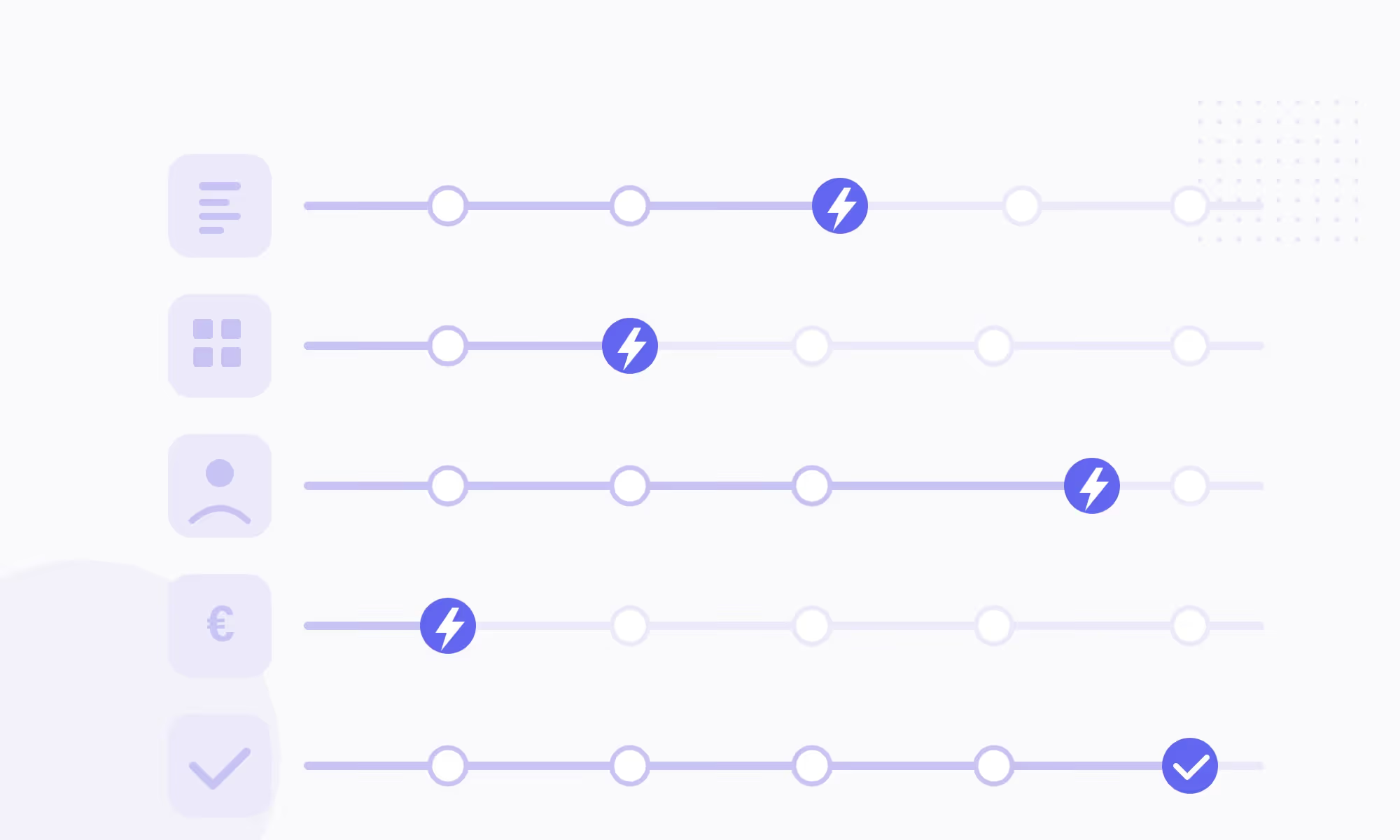
AI Pricing Implementation Roadmap
Step 1: Audit and unify pricing data
The strongest predictor of AI pricing success is data quality. Consolidate all price lists, discount matrices, contract terms, and cost data into a single source of truth. If prices live in 4 different spreadsheets maintained by 4 different people, start there. Map every transaction from the last 24 months with the actual invoiced price, list price, applied discount, and realized margin. That history is what the AI model will learn from.
Step 2: Configure the model and define guardrails
Work with the pricing team and sales leadership to define the rules: what is the minimum acceptable margin by product category? What discount authority does each sales role have? What triggers escalation for manual review? These guardrails ensure the AI operates within boundaries the organization is comfortable with. The model is then trained on historical data to learn the relationship between price, volume, conversion rate, and margin across different customer segments.
The B2B sales process should be reflected in the model: if deals typically involve 3 rounds of negotiation, the AI should account for that in its initial price recommendation.
Step 3: Launch a pilot
Select 2 to 3 product lines or customer segments for the pilot. Run AI recommendations in shadow mode for 4 to 6 weeks: the AI generates price recommendations, but the sales team can accept or override them. Compare AI-recommended prices with the prices actually invoiced. Measure three things: margin delta (do AI prices generate higher margins?), conversion rate (are deals closing at the same pace?), and adoption (what percentage of recommendations do sales reps accept?). If margin improves by 0.5% to 1% with stable conversion rates and adoption above 60%, the pilot is validated.
Step 4: Deploy and integrate
Roll AI pricing out across all product lines and customer segments. Integrate the pricing engine into the CPQ (Configure Price Quote) system, ERP, and B2B e-commerce platform so AI-recommended prices automatically appear in quotes, orders, and online catalogs. Train sales reps to interpret and communicate AI-recommended prices to customers.
The most common objection from sales teams is “AI doesn’t know my customer.” Answer it with data: show them the conversion-rate and margin comparison from the pilot. Numbers usually speak louder than methodology arguments.
Companies looking to increase B2B sales through better pricing should treat AI pricing as a continuous improvement program, not a one-off project. Models get better over time as they ingest more transaction data, and the commercial impact compounds quarter after quarter.
4 KPIs to Measure AI Pricing ROI
AI pricing is an investment, and its return has to be proven with metrics. Four KPIs capture the essential dimensions: profitability, speed, consistency, and adoption.
AI pricing KPIs
The adoption rate is the leading indicator: if sales reps don’t use the AI recommendations, margin improvement won’t materialize. Adoption below 50% after 3 months signals a trust problem, usually caused by recommendations that feel disconnected from market reality. The fix is almost always better data — feeding the model more competitive signals — or better guardrails — tightening the acceptable price range.
For companies integrating AI pricing with AI in B2B payments and real-time B2B payments, the full quote-to-cash cycle becomes data-driven, from pricing through payment terms and collections.
Choosing the right technology platform is also critical. Companies exploring B2B open banking or advanced payment orchestration need to make sure pricing, ordering, and payment systems share a common data layer so AI insights can flow smoothly across the entire commercial stack.


.jpeg)