E-procurement B2B: Why Integrate It Into Your B2B E-Commerce Platform?
Transform your purchasing process with e-procurement. Discover how it works, its benefits, and how to integrate it into your B2B e-commerce.
Article summary
- E-procurement digitizes the entire B2B purchasing process, from purchase request to payment, to automate workflows and reduce errors.
- Connected to a B2B e-commerce site, it lets buyers place orders from their own platform while automatically syncing catalogs, orders, and invoices via API, EDI, or punchout.
- The benefits are both operational and financial: better visibility into purchasing, task automation, lower invoice processing costs, and compliance with e-invoicing.
- The success of an e-procurement project depends on proper integration and effective change management, to drive team adoption and maximize return on investment.
E-procurement, or electronic procurement, refers to the use of digital platforms to manage an organization’s entire purchasing process, from purchase request to supplier payment. Built for B2B, it automates ordering, approval, receiving, and invoicing to cut costs, secure workflows, and save procurement teams time.
Integrated into a B2B e-commerce site, e-procurement connects buyers and sellers directly: both systems continuously exchange catalogs, orders, and invoices. This article explains what it is, how it works, its measurable benefits, and how to connect e-procurement and e-commerce without rebuilding your platform.
E-procurement: definition and scope
E-procurement, or electronic procurement, brings together digital solutions that dematerialize an organization’s purchasing management, from a department’s stated need all the way to supplier payment. This digitalization applies exclusively to B2B: professional purchasing, both direct and indirect, never consumer buying. Unlike a simple online purchase, an e-procurement solution includes business rules, an approval workflow, and a negotiated catalog specific to each organization. It sits within a broader digital ecosystem, alongside the B2B e-commerce platform and the company’s other sales channels.
E-procurement, e-purchasing, online procurement: what are we talking about?
The term e-procurement covers several names: online procurement, electronic purchasing, or e-purchasing. They all describe the same reality: centralizing and automating business purchasing on a single platform. In practice, a procurement team lists its suppliers, publishes a negotiated catalog, and lets employees place orders in just a few clicks. Example: a maintenance team replenishes spare parts through an integrated supplier catalog, without going back to a paper purchase order.
E-procurement vs. B2B e-commerce: two complementary models
These two terms are often confused because both are tied to online supply chains. B2B e-commerce platforms are designed to meet sellers’ commercial needs, while online procurement platforms are built to meet buyers’ expectations. On the seller side, a B2B e-commerce site displays a catalog, manages the cart, and processes payment. On the buyer side, an e-procurement solution selects suppliers, applies an approval workflow, and places the order. Example: a manufacturer publishes its offer on its B2B platform while its customers manage purchasing from their own e-procurement tool. The two meet when they are connected.
| Criterion | E-procurement | B2B E-commerce | E-sourcing |
|---|---|---|---|
| User | Buyer, purchasing department | Seller, manufacturer | Buyer (upstream) |
| Objective | Digitize purchases, from need to payment | Sell online: catalog and collection | Identify and select suppliers |
| Scope | Ordering, validation, reception, invoicing | Showcase, cart, customer payment | Requests for proposal, e-auction, listing |
| Example | Ordering from a negotiated catalog | Self-service portal for pro clients | Launching a supplier tender |
How does e-procurement work? The procure-to-pay cycle
E-procurement automates the procure-to-pay (P2P) cycle, meaning the entire purchasing process from need to payment. This cycle breaks down into three main phases: product and supplier selection, ordering and receiving, then invoicing and payment. At every step, the platform exchanges data in real time with supplier systems via EDI or API to eliminate manual entry and secure workflows. The goal: every purchase order follows a clear, controlled, and traceable path. Some platforms go further by using artificial intelligence to automate order entry and quotes.
The 6 steps in the procure-to-pay cycle
The digitized purchasing process follows a clear sequence, from need to payment. Expert tip: define your approval rules upfront (amount, budget, supplier) so the workflow runs without manual intervention. Example: an order under €500 goes straight to the supplier; above that, it’s sent to the purchasing manager.
- Purchase request: an employee submits a need on the platform.
- Approval: an automated workflow makes a decision based on amount, budget, and supplier.
- Purchase order: the approved request becomes a purchase order sent to the supplier.
- Catalog and punchout: the buyer orders from a negotiated catalog or via punchout.
- Receiving: delivery is checked and matched against the order.
- Invoicing and payment: automatic invoice-to-order matching, then payment.
Electronic catalog and punchout: the heart of ordering
The electronic catalog is the cornerstone of e-procurement: it showcases the negotiated, up-to-date offer from approved suppliers. Two formats coexist: the catalog hosted on the platform and punchout, which redirects the buyer to the supplier’s site while bringing the cart back into their approval workflow. Example: a buyer configures an order on the seller’s site, then sends it back to their purchasing tool for approval. The article on B2B punchout explains this mechanism in detail, as does the guide to digitizing your B2B product catalog.
The benefits of e-procurement for buyers
An e-procurement platform gives every purchasing team in a company a centralized workspace and a unified dashboard. This consolidation of information streamlines operations and running costs, helping boost productivity. It also stores all purchasing documents in one place, making reporting and data analysis easier. For buyers, the benefits come down to four concrete levers.
Streamlined purchasing processes. Automated process tracking ensures a smooth handoff from one task to the next. At each step, the next person in the chain is notified. Nothing gets forgotten or left pending indefinitely.
Carefully selected suppliers. Supplier selection is a major part of B2B purchasing. An e-procurement solution preselects suppliers and performs a full review: legal documents, reputation, pricing, quality.
Visibility into the purchasing process. Dashboards make it easy to see the status of each purchase, step by step: purchase order updates, delivery date, invoice to be paid.
Workflow automation. Accurate tracking of every purchasing project, from order to invoicing and delivery, automatically detects errors and reduces both financial costs and the time lost to them.
Pitfall to avoid: rolling out these dashboards without defining shared KPIs, which risks collecting data nobody uses.
| Lever | Expected gain | KPI to track |
|---|---|---|
| Order automation | Less manual entry and errors | Error rate, processing time per order |
| Data centralization | Real-time spending visibility | Share of controlled spending, reporting lead time |
| Supplier selection | Reliable and compliant suppliers | Rate of listed suppliers, compliance |
| Electronic invoicing | Reduced processing cost | Cost per invoice, payment lead time |
E-procurement and B2B e-commerce: why integrate them?
For several years now, company procurement teams have had very specific requirements and strict processes to follow. Sellers can no longer stand out by simply offering quality products on their B2B e-commerce site: they have to support their customers’ new buying models.
Integrating an e-procurement solution with a B2B e-commerce site is therefore a must for sellers who want to stay relevant and competitive. It helps them adapt to their customers’ purchasing processes, make ordering easier, and build loyalty through long-term, trusted relationships.
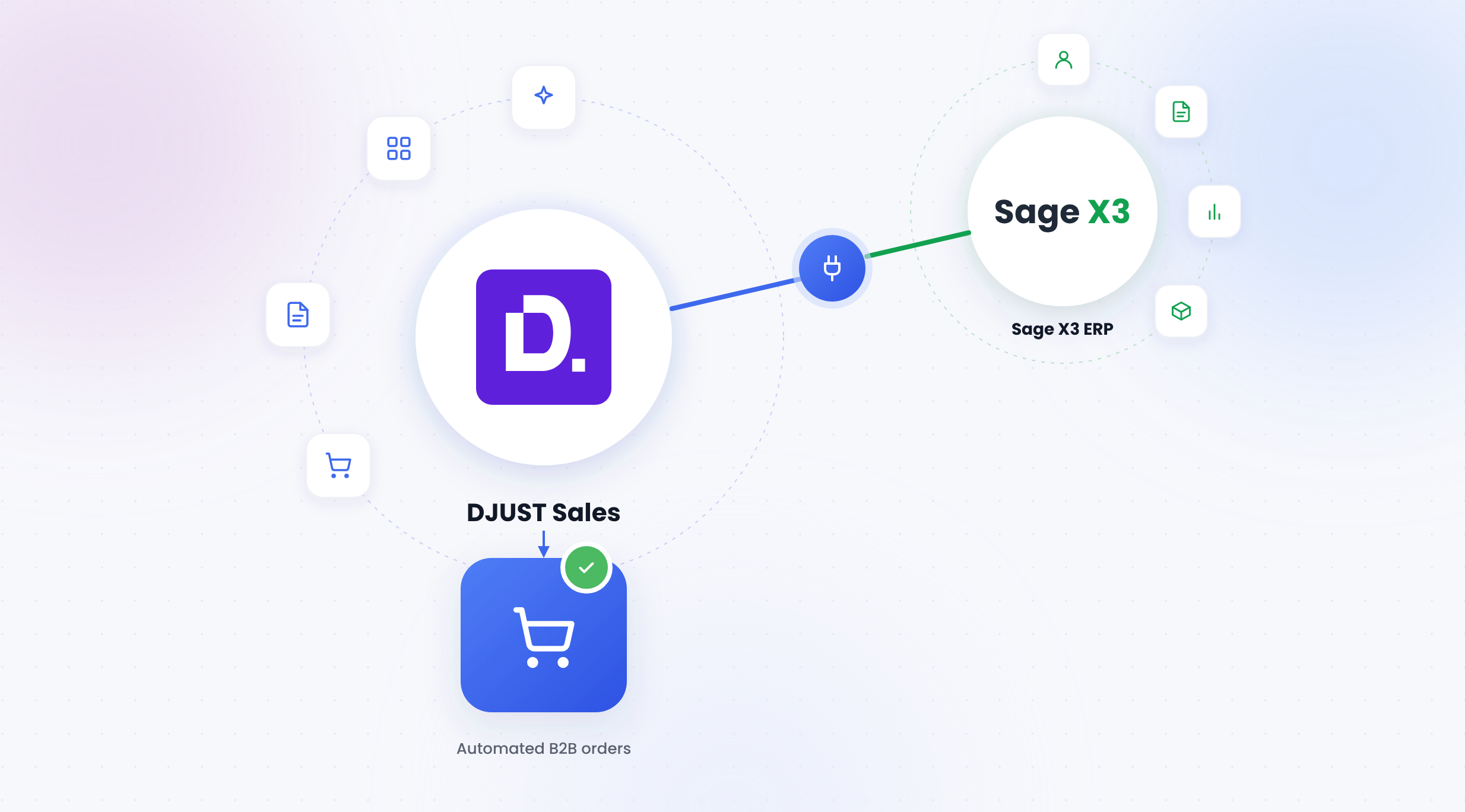
This integration does not mean rebuilding the seller’s site from scratch. The two tools are complementary and automatically and continuously exchange procurement data: inventory, stock, orders, purchase orders, invoices, credit notes, deliveries. Seller and buyer keep their usual work environments and operate in parallel within their own scope without affecting the other.
Technically, this connection relies on punchout, EDI, or APIs. It allows the seller to serve an order management system as well as a multi-vendor B2B marketplace without changing tools.
Example: a distributor connects its e-commerce portal to its key accounts’ e-procurement platform, so they can order from their usual environment. This approach addresses the challenges of B2B commerce for distributors and streamlines the entire B2B sales process.
- Map the purchasing systems used by your key customers (ERP, e-procurement platform).
- Choose the connection method: punchout, EDI, or API.
- Synchronize the catalog and negotiated terms (pricing, discounts, availability).
- Automate the exchange of orders, purchase orders, and invoices.
- Test the flows with a pilot customer before a full rollout.
Key challenges and measurable benefits of e-procurement
The benefits of e-procurement are measurable, and the stakes go beyond productivity alone. Financially, going paperless dramatically reduces the cost of processing an invoice: from €14 to €20 for paper, versus €1 to €2 for an electronic invoice, an overall saving estimated at between 50% and 75% according to the French Directorate General of Public Finances. Across Europe, the European Commission estimates the potential annual savings from electronic invoicing at €64.5 billion.
There’s also a regulatory issue. Under the 2024 Finance Act, receiving electronic invoices becomes mandatory for all VAT-liable companies on September 1, 2026; issuance will follow for large companies and mid-sized businesses on that same date, then for SMBs and microbusinesses on September 1, 2027. Exchanges must go through an approved platform. A well-connected e-procurement solution ensures compliance while capturing productivity gains, traceability, and the CSR benefits of going paperless. On the payment side, B2B-friendly payment methods complete the chain, and negotiated terms become more visible, supporting stronger B2B pricing strategy control.
AI is accelerating the shift, driven by B2B e-commerce trends and the rise of agentic commerce, which automates an increasing share of purchasing. Pitfall to avoid: treating the reform as a simple compliance requirement without rethinking the purchasing process means paying for the tool without capturing the gains.
| Indicator | Figure | Source |
|---|---|---|
| Paper invoice processing cost | €14 to €20 | DGFiP, Ministry of Economy |
| Electronic invoice cost | €1 to €2 | DGFiP, Ministry of Economy |
| Overall processing saving | 50 to 75 % | DGFiP, Cebit, Oct. 2024 |
| Potential annual savings (EU) | €64.5B | European Commission |
| Mandatory electronic invoice reception | Sept 1st, 2026 | Finance Law 2024 |
| Mandatory issuance (PME, TPE, micro) | Sept 1st, 2027 | Finance Law 2024 |
How do you choose and deploy an e-procurement solution?
Choosing e-procurement software isn’t just about comparing features: the solution has to integrate with existing systems and actually be adopted by users. A powerful tool that nobody uses delivers no ROI. To make the choice more objective, comparing market solutions, such as the DJUST vs. alternatives comparison, helps you assess functional scope, integration, and total cost of ownership.
How to choose your e-procurement software
Five criteria shape the decision. Mini-method: score each solution from 1 to 5 on each criterion, then weight them according to your purchasing priorities. Example: a high-volume company will weight ERP integration and automation more heavily, while an SMB will prioritize simplicity and time to market. For recurring purchases, a replenishment platform usefully complements the setup.
- Functional coverage: catalog, punchout, workflow, electronic invoicing, reporting.
- Integration: ERP, EDI, API, and B2B e-commerce connectors.
- Compliance: electronic invoicing, data security, CSR.
- User experience: simplicity, mobility, team adoption.
- Total cost of ownership and return on investment.
Successful change management and deployment
The success of an e-procurement project depends first and foremost on user buy-in. Change management rests on three pillars: involving the relevant departments (purchasing, finance, legal), training teams, and rolling out in stages. Mini-method: launch a pilot on one indirect purchasing category, measure the gains, then scale up. Example: a procurement team starts with office supplies before extending the tool to strategic purchases. This gradual approach also prepares the organization for AI in order management.
DJUST: e-procurement connected to your B2B commerce
At DJUST, e-procurement is not designed as a standalone tool, but as a natural extension of your B2B commerce. The modular, headless platform orchestrates the entire chain on a single foundation: product catalogs and negotiated terms, order capture and tracking, B2B-friendly payments, and invoicing. It connects directly to purchasing environments via punchout, EDI, or API, without requiring a redesign of your site. In practical terms, a distributor can connect its B2B sales portal to its key accounts’ e-procurement solution in just a few weeks, while keeping control of its offer and pricing. Result: autonomous buyers, secure workflows, and a sharp productivity boost for sales administration, without multiplying tools or manual entry.
FAQ
What Is B2B E-Procurement?
E-procurement, or electronic procurement, refers to the full set of digital solutions that automate business purchasing, from purchase request to supplier payment. Built for B2B, it brings catalog management, approvals, ordering, and invoicing together on a single platform to reduce costs, make processes more reliable, and save procurement teams time.

What’s the difference between e-procurement and e-sourcing?
E-sourcing comes into play upstream: it helps identify, compare, and select suppliers through public tenders or online auctions. E-procurement takes over downstream, once suppliers have been approved: it handles ordering, receiving, and invoicing. The first selects the partners; the second executes and manages day-to-day purchasing.
What’s the difference between e-procurement and procure-to-pay (P2P)?
Procure-to-pay refers to the full purchasing process, from the initial need through to payment. E-procurement is the software layer that digitizes and automates this P2P cycle, in whole or in part. In other words, procure-to-pay is the process; e-procurement is the technology that powers it by connecting the product catalog, approval workflow, ordering, and supplier payment.
Is e-procurement only for large enterprises?
No. Once reserved for large enterprises, e-procurement is now accessible to businesses of all sizes, including SMBs and mid-sized companies. SaaS solutions lower the entry cost and shorten the time to get up and running. An SMB can start with one indirect purchasing category, then gradually expand the scope as the benefits become clear.
How Do You Integrate E-Procurement into a B2B E-Commerce Site?
Integration connects the seller’s e-commerce site to its customers’ e-procurement platforms via punchout, EDI, or API. The two systems continuously exchange product catalogs, orders, purchase orders, and invoices, without rebuilding the site. The seller keeps its own environment, while the buyer orders from theirs: both gain in efficiency, reliability, and processing speed.


.png)
.jpg)