Shopify B2B Solutions: Are They Right for Complex Businesses?
Find the best B2B e-commerce solution. Compare Shopify B2B, its limitations, and alternatives for businesses with complex needs.
Article summary
- Shopify B2B is available on all paid plans as of April 2, 2026 : custom catalogs (up to 3 outside Plus), Net15/30/60/90 terms, multi-buyer accounts.
- Shopify Plus starts at $2,300 per month (around $27,600 per year), with unlimited catalogs and advanced B2B features.
- Shopify recognized as a Leader in the Forrester Wave B2B Commerce Solutions 2024.
- Structural limitations for complex B2B : no native RFQ, no native EDI, no multi-level approval workflows, no real-time ERP-driven pricing.
- Recommended alternatives for manufacturers, multi-entity distributors, or regulated use cases: Adobe Commerce, commercetools, and composable B2B platforms like Djust.

Shopify B2B in 2026: What the Platform Covers
In just four years, Shopify B2B has gone from a Plus-only add-on to a native suite available on all paid plans. On April 2, 2026, Shopify extended its B2B engine — companies, catalogs, negotiated pricing, and net terms payments — to the Basic, Grow, and Advanced plans at no extra cost. That shift changes how the market sees the platform: using Shopify for a light B2B business no longer requires moving to Shopify Plus. The difference between plans now comes down to functional depth and how much complexity they can handle, not access to B2B itself.
Native Features on All Plans
Available on all paid plans: company profiles with multiple buyers and locations, up to 3 custom catalogs, volume-based pricing rules, vaulted credit cards, net terms payments Net 15/30/60/90, quotes and purchase orders, and a dedicated B2B checkout. A concrete example: a DTC brand on Shopify Advanced can launch a wholesale business with 5 distributors and negotiated pricing without changing plans.
Features Exclusive to Shopify Plus
Reserved for the enterprise plan: unlimited catalogs (vs. 3 max on lower plans), direct catalog assignment by company location, partial payments and deposits, ACH for high-value B2B transactions, company-level store credit, order review rules via Shopify Functions, API limits 500% higher, and 24/7 support. Example: a B2B platform managing 200 distributors with individual pricing grids cannot scale on an Advanced plan.
6 Shopify B2B Limitations for Complex Businesses
Shopify B2B is powerful for DTC + light wholesale or hybrid models. It starts to fall short as soon as a company runs advanced procurement processes, regulated use cases, or deep ERP integrations. Here are the six issues that consistently come up in pre-replatforming audits led by specialized agencies.
1. No native RFQ. Quote-to-order, which is central in industrials, construction, or custom manufacturing, isn’t handled natively. You need a third-party app or custom development.
2. No native EDI. Electronic Data Interchange, required by major distributors and retailers, needs a third-party middleware layer. That adds cost and complexity.
3. No multi-level approval workflows. Procurement-finance-executive approval chains aren’t native. That’s a blocker for any B2B business where purchases must be approved by several people.
4. Limited complex pricing. No dynamic pricing based on cost, contract duration, or market indexes. B2B order management that relies on real-time ERP pricing grids is out of scope.
5. Limited B2B analytics. Reporting by company, buying behavior, and sales performance by account manager isn’t native. You’ll need third-party BI or custom reporting.
6. Not an ERP. Shopify Plus is excellent for the storefront, but it doesn’t handle multi-entity accounting, financial consolidation, or supplier purchasing. An ERP layer becomes mandatory beyond a certain scale.
When Shopify B2B Is Enough — and When You Need Another Platform
Choosing between Shopify B2B and a dedicated platform is rarely a purely technical decision. It’s a trade-off between deployment speed, functional coverage, and growth trajectory. Here’s a quick decision framework to review with your project team before any RFP. For a broader overview, see our article on which B2B eCommerce platform to choose, which breaks down the selection criteria.
For brands launching a wholesale channel alongside an existing DTC business on Shopify, the native solution is the fastest option. For manufacturers, distributors, and wholesalers with a 100% B2B model, differentiated catalogs, 60-day payment terms, multi-level approvals, and structured B2B eCommerce needs, the functional gap remains significant.
How Much Does Shopify B2B Cost in 2026?
Shopify B2B pricing needs to be read on two levels: platform cost and total implementation cost. The entry price shown by Shopify never reflects the real cost of a serious B2B project. Recent B2B e-commerce trends confirm that a mature B2B project consistently requires a significant integration budget.
Beyond the license, the total 12-month cost includes ERP integration (NetSuite, SAP, Microsoft Dynamics), a custom theme ($15,000 to $50,000 for agency development), third-party apps (RFQ, EDI, BI), and post-launch maintenance and support. For a realistic enterprise project generating $1M in annual revenue, the total monthly cost often reaches $5,000 to $8,000. At $10M in revenue, it rises to $15,000 to $25,000.
3 Alternatives to Shopify for Advanced B2B
When Shopify B2B reaches its limits, three solution families take over. Each fits a specific business profile. The right choice depends on functional complexity, budget, and the team’s technical maturity.
• Adobe Commerce. An enterprise monolithic solution for large B2B/B2C accounts. Code-level customization is possible. High cost, heavy integration, rich ecosystem. Best for brands with very large catalogs and unique functional needs.
• commercetools. A headless, API-first platform for B2B/B2C scaleups. Pure composable architecture, maximum scalability. Requires strong technical expertise. Best for complex multichannel organizations.
• DJUST. A unified composable B2B platform built for intercompany commerce: differentiated catalogs, net terms payments, multi-buyer accounts, native marketplace, and seamless ERP integration. Best for B2B brands, wholesalers, and multichannel distributors.
The generic term “B2B website software” covers very different realities. A use-case-driven demo and a conversation with two or three live customers remain the best filters for validating the right choice.
DJUST: An Alternative Built for Complex B2B E-commerce
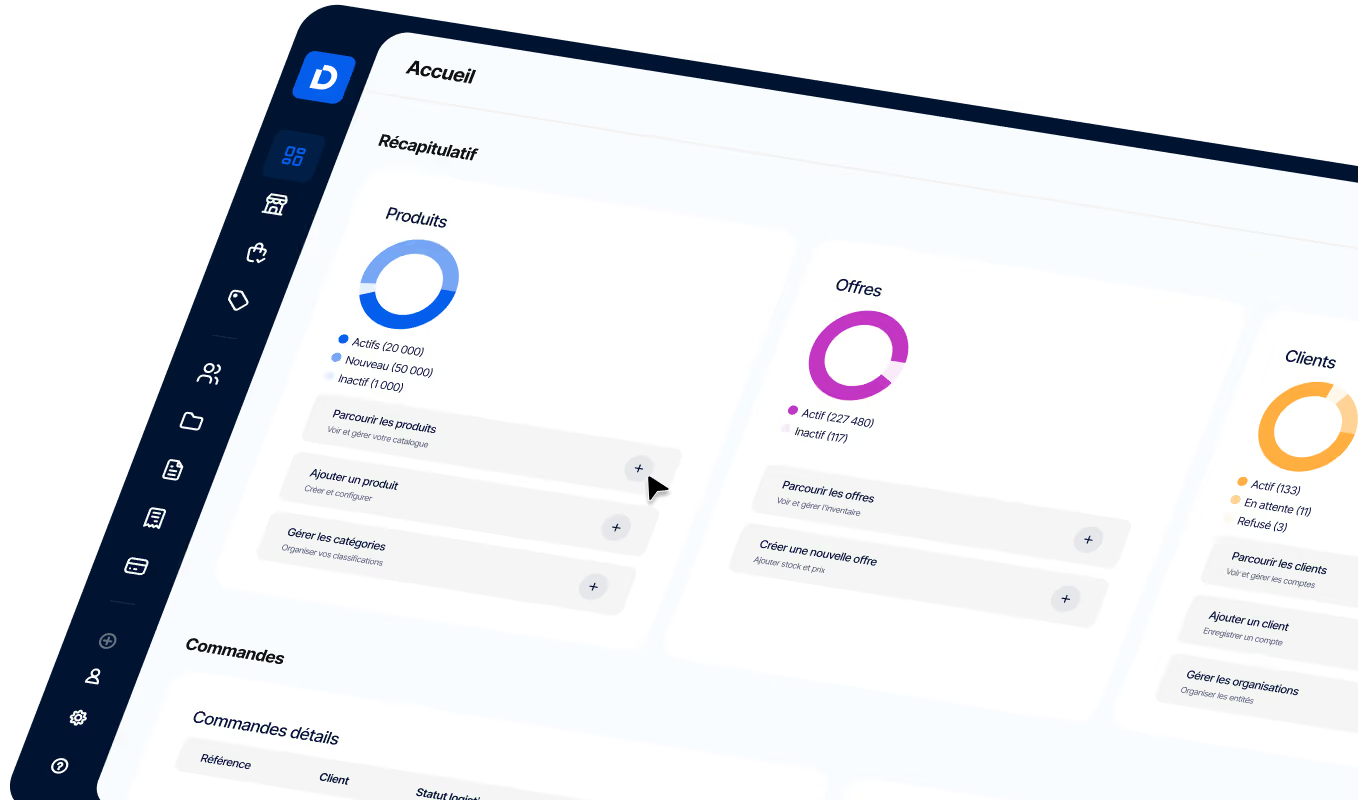
When Shopify for B2B no longer covers your business needs, the challenge isn’t just switching platforms — it’s adopting a solution built natively for intercompany commerce. Thanks to its SaaS, open source, headless, and modular architecture, DJUST lets you manage differentiated catalogs, contractual pricing, multi-buyer accounts, approval workflows, B2B marketplaces, and advanced integrations with ERP, CRM, or PIM systems. Designed for manufacturers, distributors, and wholesalers, our platform helps companies gain flexibility and scalability without multiplying custom development or third-party apps.



.png)
.jpeg)