B2B E-commerce Trends: Key Opportunities
What are the latest trends in B2B e-commerce? Let’s break them down together. We’ll cover personalization, user experience, and more.
Article summary
In short:
- B2B e-commerce is aligning with B2C standards: seamless buying journeys, polished user experience, personalization, and simplicity are now must-haves, even in complex sales cycles.
- B2B marketplaces are emerging as a core model: they make it easier to expand the offer, accelerate time to market, and connect business buyers and sellers efficiently.
- Data and automation are driving performance: dynamic pricing, product recommendations, inventory management, and sales forecasting increasingly rely on data-driven tools.
- Technology sovereignty and secure transaction flows are becoming strategic priorities: regulatory compliance, data control, and payment reliability are now key criteria when choosing a B2B e-commerce platform.

For a long time, B2B was seen as nothing more than a digital extension of traditional sales. An online catalog, an order form, sometimes a basic customer portal. Good enough... back then. But today, in 2025, that approach no longer holds up. B2B eCommerce is undergoing a rapid, structural shift.
In 2025, the B2B e-commerce trend is clear: business buyers now expect purchasing experiences that are just as seamless, fast, and personalized as the ones they get in B2C. This shift is being driven by the digitization of processes, the rise of advanced technologies such as data, automation, and artificial intelligence, and growing pressure on sales performance.
In this article, we look at the major B2B e-commerce trends, the expectations of business buyers, and the practical levers companies can use to adapt their digital strategy and improve customer experience, sales, and productivity.
The B2B e-commerce landscape today
Market growth and momentum
The B2B e-commerce market has been growing steadily worldwide for several years. According to various industry studies, online sales between businesses now represent several billion euros and are growing faster than B2C commerce in some sectors, such as manufacturing, distribution, and specialty retail.
The health crisis acted as a catalyst, but today’s momentum goes far beyond that context. Companies have realized that digital is a strategic lever for expanding sales channels, improving operational efficiency, and better meeting the expectations of business buyers.
Another key factor is the globalization of trade. B2B e-commerce makes it easier to access new markets, sell globally, and reach customers across multiple channels without geographic constraints. To understand the basics and specificities of this model, we’ve put together a dedicated guide to B2B e-commerce.
New B2B buyer expectations
B2B buyers have also changed dramatically, as shown by the 2025 Fevad study. Today, a large share of purchasing decisions is made by younger profiles, generations that are used to digital, social media, and mobile commerce. Their behavior is strongly shaped by their personal experiences as B2C consumers.
These buyers expect what they already know and what they’re used to: smooth, intuitive navigation, personalized pricing, real-time stock availability, and frictionless self-service buying journeys. A typical profile might look like this: before even contacting a sales rep, the business buyer carries out an in-depth online research phase. They compare offers, review content, analyze feedback, and expect a seamless buying journey.
This shift is forcing B2B companies to rethink their e-commerce site, no longer as a simple online catalog, but as a true customer experience and sales performance tool.
The forces reshaping B2B e-commerce
Digitizing internal processes
Many B2B companies still rely on fragmented systems that lack flexibility and create interoperability issues. Implementing a B2B eCommerce platform connected to existing systems (ERP, CRM, PIM) makes it possible to automate order capture, centralize customer and product information, and ensure synchronization across ERP, CRM, PIM, and the e-commerce platform. This approach directly helps improve sales performance and provides greater visibility into activity. Digitization therefore becomes both an operational efficiency tool and a competitive advantage.
Logistics constraints and sustainability
Logistics has become a key differentiator. B2B buyers expect reliable delivery times, accurate visibility into availability, and flexible delivery options. At the same time, environmental concerns are pushing companies toward more responsible logistics: less packaging, optimized flows, shorter supply chains, and transparency around carbon impact.
What’s fundamentally changing is that logistics is now experienced by the buyer as a direct extension of the brand. A delay, a stockout, or a lack of information is no longer seen as an operational incident, but as a broader company failure.
On the other hand, logistics that is managed smoothly and under control becomes a discreet but highly effective sales asset. The most advanced players understand this: they turn logistics constraints into measurable competitive advantages that can influence buying decisions long before commercial negotiations begin.
B2B e-commerce trends to watch
Personalization & user experience
Personalization is now one of the leading B2B e-commerce trends. Buyers expect journeys tailored to their profile at several levels:
- Customer-specific catalogs,
- Negotiated pricing visible online,
- Personalized payment terms,
- Product recommendations based on purchase history.
A smooth, personalized user experience has a direct impact on conversion rates, customer loyalty, and average order value. It’s also a key factor in strengthening brand perception and standing out in a competitive market, all good reasons to improve your e-commerce site and optimize the B2B customer experience.
Omnichannel and touchpoint integration
B2B buyers explore multiple channels: e-commerce platforms, sales teams, marketplaces, physical stores, and customer service. The goal is to deliver a consistent experience, no matter which channel they use.
Customers should be able to start a purchase online, complete it with a sales rep, and track their order from a single interface. A single interface on an effective B2B eCommerce platform is exactly what makes this possible, by bringing all customer interactions together in one place.
Self-service & automation
Self-service has become a must-have B2B e-commerce trend. 75% of business buyers want to be able to manage purchases independently, without relying on a sales rep, as shown by a Gartner study. This shift reflects a strong demand for speed and flexibility.
Customers don’t just want to place orders on their own. They also want to view invoices, track deliveries, and manage returns without sales intervention. Combined with automation, this approach helps companies streamline sales processes, reduce operating costs, and improve team productivity.
Data & analytics
Every online interaction, every product viewed, every purchase made by a business buyer provides valuable information for the company. This is the raw material for your decision-making. As highlighted in the 2023 Forrester study, the strongest B2B players use data to anticipate demand, adjust offers for existing customers, reduce overstock, and track sales performance more precisely.
A data-driven approach also makes it possible to analyze customer behavior across digital channels: website, online store, mobile app, and social media. All that’s left is to prepare your meetings effectively in advance with a clear agenda covering the features of an e-commerce site.
Headless architecture & technical flexibility
Headless architecture is emerging as a major innovation in B2B eCommerce. Already adopted by nearly 72% of companies in the United States, this approach separates the front end (user interface) from the back end (business logic), delivering advanced technical flexibility.
Among other things, it enables advanced interface customization, easier integration with existing systems, and faster deployment of new channels. Thanks to headless commerce, companies can adapt their online site without overhauling their entire technical architecture, while staying competitive in a fast-growing market.
Sustainability and responsibility
B2B companies are facing clear expectations around environmental issues. They need to make their commitments transparent, reduce their environmental impact, and verify the responsibility of their supply chain.
E-commerce platforms play a key role in this effort. They make it possible to track environmental metrics, optimize product flows, and offer more responsible alternatives, such as second-hand. More than just another checkbox, sustainability is becoming a differentiator and a trust factor between partners in an increasingly demanding global market.
International expansion & marketplaces
Thanks to online e-commerce, companies can enter new markets, reach a global customer base, and sell their products far beyond their usual geographic area.
B2B e-commerce makes it possible to manage multiple currencies and languages while also relying on B2B marketplaces to expand visibility. That said, this trend requires careful management of pricing, taxation, and international logistics.
Challenges for B2B companies
Organization & change management
Adopting a new platform or a new online sales model requires team buy-in and changes to internal practices. Taking a new path with your team or giving them a new tool can help build digital skills and improve efficiency.
However, without change support, e-commerce projects may never reach their full potential. So make sure your team isn’t left on its own when it comes to learning new software or rolling out new processes.
Technology choices & security
If you’re introducing something new, knowing how to use it won’t be your only concern. You need to be sure it won’t disrupt the other moving parts already in place. Choosing a B2B e-commerce solution is strategic if it is scalable, secure, and able to integrate with the existing ecosystem.
In practice, many companies still keep stacking tools instead of building a coherent architecture. The result: silos, internal friction, and greater dependence on technical teams. A mature technology approach, by contrast, means making structural choices, even if that means giving up some secondary features. Security, meanwhile, should no longer be treated as an add-on layer, but as a design principle.
Managing and using data
Collecting data isn’t enough. Companies need to make their data reliable by clearly identifying where it comes from, centralizing it in a defined and easily accessible place, and using it effectively to guide decision-making.
The difference isn’t in the volume of data collected, but in the ability to turn it into concrete, fast decisions. Entire Excel files full of data are just wasted time if they don’t carry weight in your final choices. The most effective organizations build a shared data culture, where data is no longer reserved for analysts but is accessible to business teams. This democratization helps align marketing, sales, and operations around the same numbers.
How to capitalize on these trends
Equip yourself with a flexible platform built for B2B
To fully benefit from B2B e-commerce trends, companies need a B2B e-commerce platform that offers the right breadth of features: customer account management, complex catalogs, advanced pricing, and approval workflows.
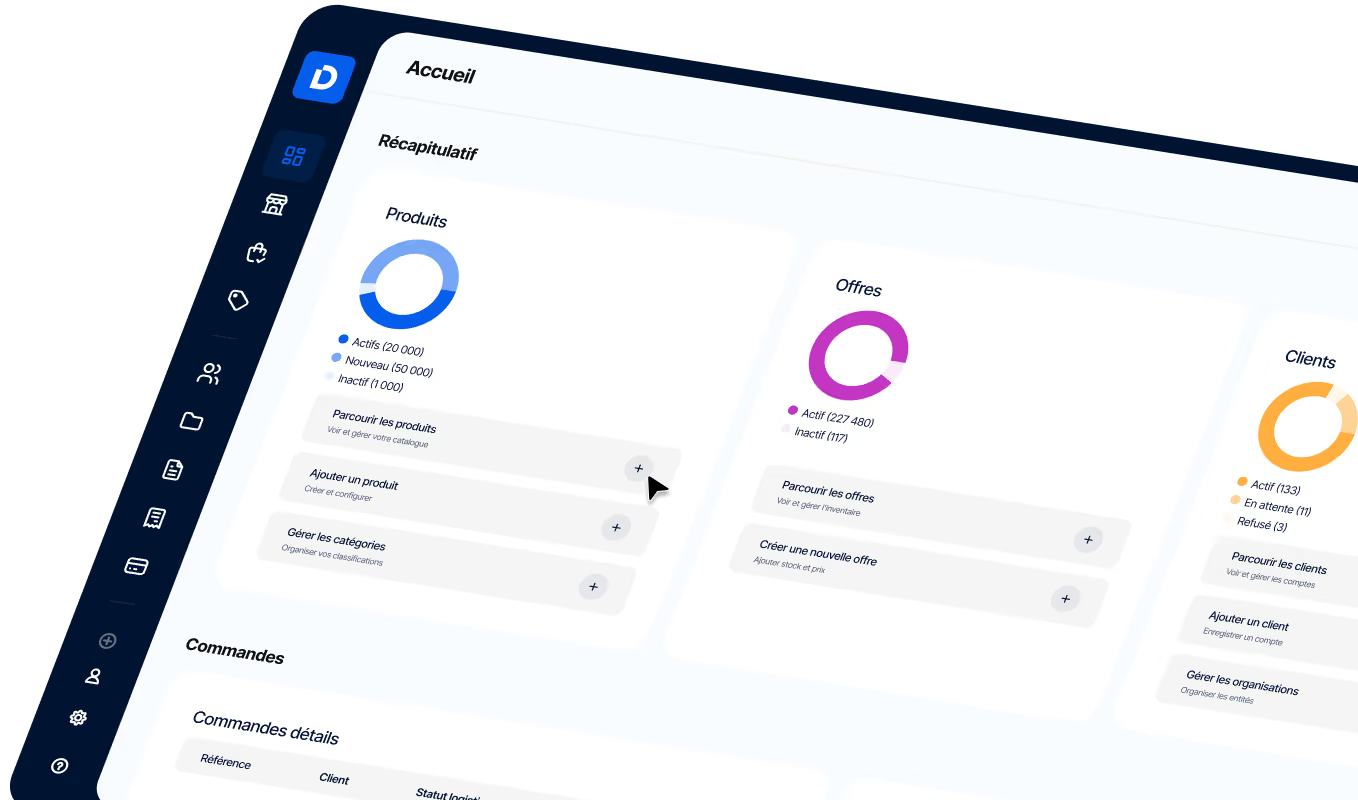
An overly rigid solution freezes processes and limits adaptability, while B2B models are evolving quickly. The most clear-sighted companies choose platforms that support innovation rather than slow it down. This approach turns the tool into a driver of transformation, not just another sales channel. To take the leap, discover how a B2B e-commerce platform like DJUST can orchestrate all these levers in a unified, scalable solution.
Outlook for B2B e-commerce
Digital is no longer just one channel among others; it’s the foundation of the B2B commercial relationship. As digital becomes the norm, the competitive advantage shifts. It no longer lies in having a platform, but in how you use it. More than ever, companies need to align strategic vision, operational excellence, and customer experience to build a lasting competitive edge.
The companies that succeed won’t necessarily be the most innovative on paper, but the ones that know how to anticipate new paradigms and invest in the right technologies. In this new balance and constant evolution, inaction becomes the biggest risk of all.
Sources
- Gartner: FB2B Buying: How Top CSOs and CMOs Optimize the Journey
- Forrester: Is Your B2B Organization Insights-Driven?
- Statista: E-commerce platform technologies - statistics & facts
- Fevad: B2B purchasing and e-commerce: how practices and customer expectations are evolving
-modified.avif)


.png)
.jpeg)