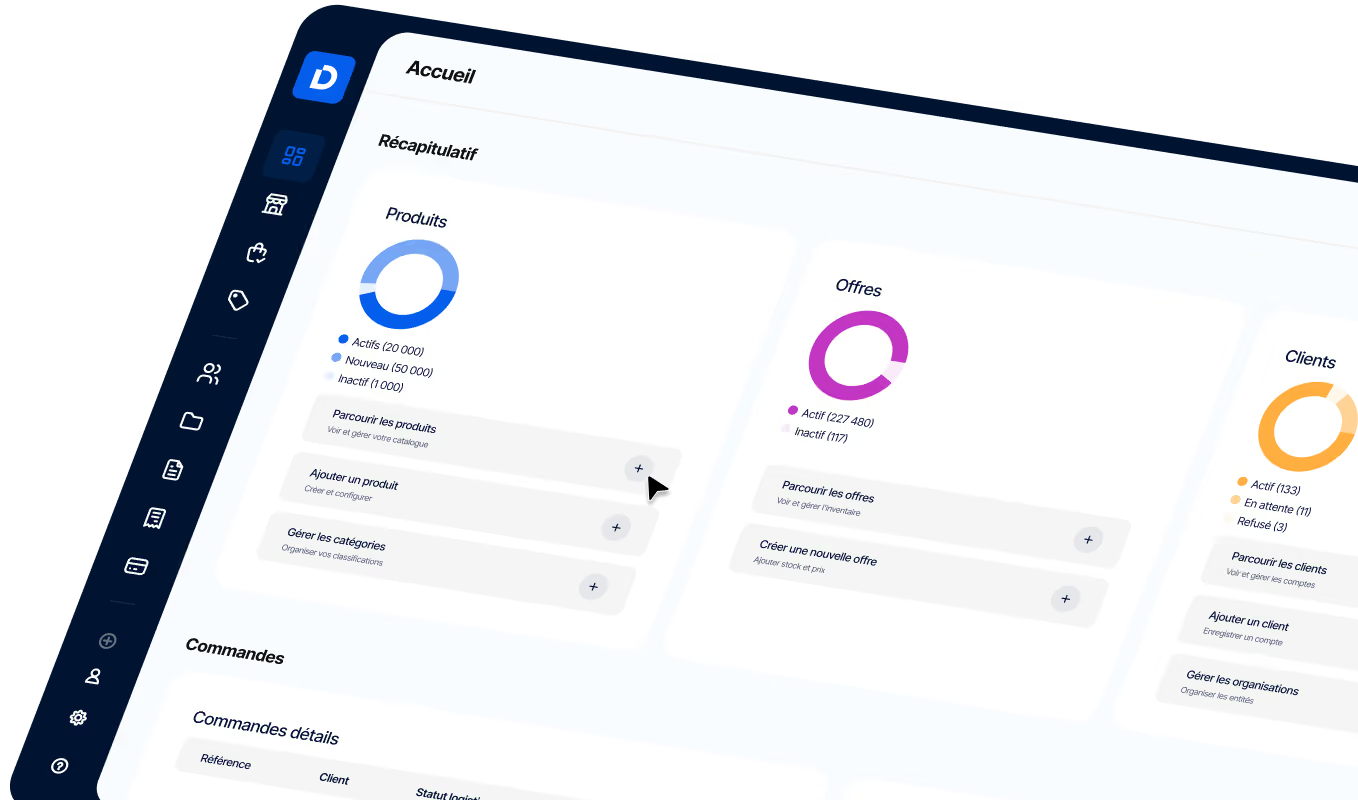
How to Choose the Right Retail Inventory Management System
Discover how to choose the right retail inventory management system. Our guide covers the essential features, expert tips, and vendor recommendations to consider in 2025.
Article summary
- A modern retail store inventory management system delivers real-time stock visibility, automates reordering, and integrates seamlessly across all sales channels.
- Selecting the right retail inventory management software involves a thorough evaluation of its scalability, total cost of ownership (TCO), vendor support, and its ability to solve specific issues like stockouts, excess inventory, and human errors.
- AI-driven insights for forecasting future demand and cloud-based accessibility are key features of an IMS that can future-proof your retail operations and optimize inventory levels.
In a context where product availability directly shapes customer satisfaction, inventory management has become one of the cornerstones of commercial performance.
According to IHL Group, inventory errors — whether stockouts, overstocks, or returns — cost the global retail sector more than $1.77 trillion every year.
That staggering figure points to a simple reality: without control over inventory flows, margins shrink, cash flow tightens, and customer loyalty erodes.
And yet, many retailers still rely on Excel files, aging in-house software, or fragmented IT systems.
The result: unexplained stock discrepancies, human error, replenishment delays, and unhappy customers.
A modern retail inventory management system (IMS) helps break that cycle of inefficiency. It centralizes data, automates product tracking, and provides real-time inventory visibility across every channel — stores, warehouses, e-commerce, and marketplaces.
Beyond logistics, it becomes a real strategic growth lever.
This article takes a deep dive into the features, selection criteria, and best practices of a high-performing inventory management system — so inventory management is no longer a bottleneck, but an accelerator for your business.
Why modernizing inventory management has become essential
A direct impact on profitability
Inventory often represents between 25% and 45% of a retail company’s tied-up capital. Poor management creates two major cost drivers:
- Stockouts, which mean lost sales and a loss of customer trust.
- Overstocks, which drive storage costs, markdowns, and faster product obsolescence.
On top of that, there are less visible but equally heavy consequences: frustrated teams, administrative complexity, and an inability to anticipate demand.
Customer expectations no longer tolerate inaccuracy
Today’s omnichannel customer expects a seamless experience: they want to check product availability online, reserve an item and pick it up in store, or have it delivered without delay.
When the information shown doesn’t match actual stock, trust breaks down.
That’s why real-time inventory visibility has become a non-negotiable requirement.
Growing operational complexity
Retailers now have to juggle dozens of channels, suppliers, and touchpoints.
Logistics and commercial operations are becoming more complex: inter-store transfers, omnichannel returns, split orders, and dropshipping sales.
Without a unified tool capable of orchestrating all these flows, companies expose themselves to costly management errors.
That’s where retail inventory management systems come in, designed to streamline and secure the entire product lifecycle.
What is a retail inventory management system?
A retail inventory management system (IMS) is software that tracks, controls, and optimizes product availability at every stage of the supply chain.
Unlike a general-purpose ERP or a basic stock-counting tool, it provides a detailed, real-time view of product movements, from supplier receipt to final sale.
A modern IMS connects every touchpoint:
- Physical stores: automatic tracking of sales and returns through the POS.
- Warehouses: tracking of receipts, transfers, and stock counts.
- E-commerce and marketplaces: instant updates to stock levels shown online.
The goal is to create a single source of truth: every product is tracked by a unique identifier (SKU), and every movement — sale, receipt, transfer — is recorded in real time.
The concrete benefits
- A dramatic reduction in inventory discrepancies.
- Faster replenishment.
- Synchronization across sales channels.
- Improved data reliability.
- Less time spent on manual entry.
In short, a high-performing IMS turns a logistics constraint into a commercial performance tool.
Signs your current system is no longer fit for purpose
Before looking for a new solution, it’s essential to identify the symptoms of an outdated tool.
Here are the most common warning signs seen in retail businesses:
1. Repeated stockouts and overstocks
When your team only discovers stockouts after a customer points them out, or when products pile up in backroom storage without moving, it’s a sign of poor inventory control.
Without real-time visibility, it’s impossible to anticipate demand or balance stock across stores.
2. Too many manual processes
An effective inventory management tool should eliminate most data-entry tasks.
If your teams still rely on Excel spreadsheets or emails to track transfers, returns, or stock counts, they’re wasting valuable time and multiplying errors.
3. Fragmented visibility across channels
Do your store managers have to call another location to check availability?
If so, you’re dealing with phantom inventory — the gap between actual stock and what the system shows.
This makes it impossible to reliably promise click-and-collect or omnichannel shipping.
4. Limited integrations with your other tools
Modern retail businesses rely on a connected architecture: POS, ERP, PIM, CRM, e-commerce platform.
A system that doesn’t communicate with these building blocks creates data silos and leads to inconsistencies.
5. Decisions based on instinct rather than data
Without reliable indicators — turnover rate, margins, stock value, forecasts — your teams buy and replenish “by feel.”
A modern IMS delivers this data instantly, enabling decisions based on the real performance of each product or store.
The strategic stakes behind a modern inventory management system
A retail inventory management system isn’t just an operational tool: it’s a driver of digital transformation.
It connects data, processes, and teams to build a business driven by performance and responsiveness.
Bringing physical and digital together
As unified commerce grows, the line between store and e-commerce is disappearing.
An IMS connects these worlds by synchronizing sales, returns, and availability.
Each channel becomes an extension of the other: an online customer can order an item available in store, and vice versa.
Smoothing the customer experience
The shopping experience depends directly on inventory reliability.
Being able to guarantee “item in stock” or “delivery tomorrow” depends on system accuracy.
A properly configured IMS makes that promise possible, strengthening customer satisfaction and loyalty.
Reducing tied-up capital costs
With inventory optimization, it becomes possible to adjust stock levels based on actual demand, seasonality, or local trends.
The result: fewer products sitting in warehouses, more cash available, and better net margins.
Encouraging cross-functional collaboration
An IMS centralizes data for everyone: leadership, procurement, sales, finance.
Everyone works from reliable, up-to-date information, which improves coordination and reduces internal friction.
The role of AI in modern inventory management
Artificial intelligence is radically changing how retailers plan replenishment.
Where traditional methods relied on historical averages, AI makes it possible to anticipate demand by factoring in multiple variables: weather, seasonality, marketing campaigns, local events, and social trends.
Systems like DJUST use this data to automatically adjust replenishment thresholds and reduce forecasting errors by up to 50%, according to McKinsey estimates. This intelligent automation frees teams from repetitive tasks and lets them focus on strategy, analysis, and customer relationships.
The key features of a modern retail inventory management system
A retail inventory management system is more than a product database: it’s a strategic platform that connects operations, logistics, and customer relationships.
To get the full value from it, you need to understand its main functional pillars.
1. Real-time inventory visibility: the backbone of efficiency
Real-time visibility is the first performance criterion for an IMS.
Every movement — sale, return, transfer, receipt — is recorded instantly in the system and synchronized across all channels.
In practical terms, that means a product sold online is immediately deducted from store stock, and a returned item is instantly added back in.
This continuous updating prevents inventory discrepancies and customer disappointment caused by inaccurate availability.
For multi-site networks, this visibility also makes it possible to:
- transfer an item between two stores instead of reordering it;
- reduce lost sales;
- improve stock turnover metrics.
A retailer that can show exact product availability on every channel gains a decisive competitive edge.
2. Automation and replenishment rules
Automation is the second pillar of a high-performing inventory management system.
The best systems allow you to:
- set automatic replenishment thresholds;
- calculate safety stock based on average demand and supplier lead time;
- automatically generate purchase orders or internal transfers when the threshold is reached.
This approach reduces manual workload and human error while ensuring constant availability of fast-moving products.
Inventory optimization algorithms rely on sales history, promotions, and seasonal events.
According to McKinsey, using AI for demand forecasting can reduce errors by 20% to 50% and improve gross margin by up to 5%.
Platforms like DJUST build these mechanisms into their workflows: they automatically trigger replenishment or transfers and generate alerts when performance gaps appear.
3. Omnichannel integration and POS / e-commerce synchronization
Unifying sales channels is now essential.
An effective retail inventory management system integrates with:
- your POS systems (point of sale);
- your e-commerce platforms (Shopify, Magento, PrestaShop, etc.);
- your ERP or CRM;
- your marketplaces (Amazon, eBay, ManoMano, etc.).
The goal is to ensure every transaction — in store or online — is reflected everywhere instantly.
A customer should be able to buy online an item available in a physical store without any risk of stock errors.
Players like Lightspeed, Cybertill, and DJUST stand out for this unified approach.
Thanks to its API-first, headless architecture, DJUST connects to all your existing tools (ERP, PIM, CRM) to provide a single view of stock, product, and customer.
This integration creates a true omnichannel experience: inventory becomes a commercial asset, not a logistics constraint.
4. Reporting, management, and forecasting
A modern inventory management system doesn’t just track stock; it turns it into actionable metrics.
Dashboards let you analyze:
- stock turnover;
- stockout rate;
- gross margin return on inventory investment (GMROI);
- dead stock;
- performance by store or season.
These data points inform decision-making: removing low-margin SKUs, redeploying stock, adjusting assortments.
The most advanced solutions, such as DJUST, use predictive models that combine internal data (sales, promotions) and external variables (weather, market trends).
They help retailers anticipate demand instead of reacting to it.
5. Mobile inventory management: toward greater agility
Mobile apps and handheld devices (RFID, barcode scanners) are transforming day-to-day work for field teams.
They make it possible to:
- receive goods directly on a smartphone or tablet;
- transfer items between stores with a single scan;
- run cycle counts without interrupting sales.
This mobility speeds up inventory updates and improves in-store responsiveness.
A sales associate can now answer a customer in seconds, check availability elsewhere, and offer immediate delivery or pickup.
That speed of execution directly contributes to customer satisfaction and conversion.
6. Cloud accessibility and scalability
SaaS (Software as a Service) architectures have replaced on-premise solutions.
Hosting the system in the cloud ensures:
- secure access from any device;
- automatic updates;
- simplified maintenance;
- near-instant scalability when opening new stores or launching new product lines.
Cloud solutions such as Zoho Inventory, Xero, or DJUST offer an excellent balance of flexibility and security.
DJUST, which is 100% headless, ensures business continuity while reducing IT workload.
How do you choose the right inventory management system?
A retail inventory management system is a strategic investment.
Choosing the right provider therefore needs to be rigorous and based on several criteria:
1. Integration with your existing ecosystem
Check compatibility with your current solutions (ERP, POS, PIM, e-commerce).
Prioritize systems with prebuilt connectors rather than heavy custom development.
2. Scalability
Your inventory management system should grow with you: more stores, a larger product catalog, higher transaction volumes.
Ask the vendor how the solution handles increased load without performance degradation.
3. Customization and flexibility
Every retailer has its own workflows: centralized procurement, category-based management, specific margin rules.
Make sure the tool lets you configure these rules without always relying on development work.
4. Support and guidance
An inventory management implementation project isn’t just about installing software.
Evaluate:
- the quality of technical support;
- customer service availability;
- the presence of a dedicated contact;
- the training offered to teams.
DJUST, for example, relies on a network of specialized integration partners who support retailers at every stage: scoping, deployment, training, and follow-up.
5. Total cost of ownership (TCO)
Don’t stop at the license price.
Factor in:
- deployment costs;
- training;
- integrations;
- future enhancements;
- support.
A more expensive inventory management system in the short term can prove more profitable if integration and maintenance are simpler.
6. Vendor reliability
Review the vendor’s reputation on platforms like G2, Capterra, or Gartner Peer Insights.
Favor publishers that share a clear product roadmap, showing a commitment to innovation (AI, automation, APIs).
Implementing an inventory management system: best practices and key steps
Implementing a retail inventory management system isn’t something you improvise.
Here are the recommended steps for a successful transition:
1. Data cleansing and standardization
Before any migration, you need to make existing data reliable:
- standardize product codes;
- remove duplicates;
- correct SKU or barcode errors;
- reconcile physical and theoretical stock.
Migrating inaccurate data would simply import the old system’s problems into the new one.
2. Phased rollout
Start with a pilot project on one product category or one test store.
This phased rollout lets you validate processes, identify blockers, and fine-tune settings before a full deployment.
On average, a pilot phase lasts three to six months.
3. Staff training and support
One of the main reasons these projects fail is undertraining.
According to an IHL Group study, human errors linked to poor inventory management account for $291 billion in losses every year.
Make sure every user understands how the system works, how to read the metrics, and how inventory counts are handled.
4. Defining and tracking key KPIs
From launch, set clear indicators:
- inventory accuracy;
- stockout rate;
- stock turnover;
- average replenishment lead time;
- online product availability rate.
These metrics will help you measure real gains in productivity and profitability.
5. Change management
A project like this changes day-to-day work habits.
That’s why it’s crucial to involve employees from the start, communicate the benefits, and appoint internal champions to share best practices.
Partners like DJUST support this transition by combining training, assistance, and change management.
The measurable benefits of a high-performing inventory management system
Companies that modernize inventory management quickly see tangible gains:
- Sales increase by 2% to 10%, thanks to better product availability.
- Average inventory drops by 10% to 30%, through more precise demand alignment.
- Error rates in picking and delivery decline.
- Customer satisfaction and loyalty improve.
- Storage and transportation costs fall thanks to smoother logistics.
Together, these benefits strengthen competitiveness and overall profitability.
Toward a new generation of inventory management systems: the agentic, connected approach
The future of retail inventory management rests on intelligent automation and real-time connectivity across every technology layer.
Next-generation solutions like DJUST integrate with B2B e-commerce, payments, PIM, and OMS platforms to create a complete digital chain.
This headless, composable approach makes it possible to activate only the modules you need — order management, payments, catalogs, inventory — while keeping data fully consistent.
Systems are gradually becoming agentic: autonomous AI agents analyze sales, anticipate stockouts, and automatically trigger replenishment.
This vision of predictive commerce is redefining retail: less manual execution, more strategic management.
Conclusion: the right management system as a catalyst for sustainable growth
Choosing the right retail inventory management system isn’t just a software project: it’s a lever for operational and cultural transformation.
In an environment where fluidity, accuracy, and responsiveness drive performance, inventory management becomes a decisive competitive advantage.
With a modern system, retailers gain full visibility, continuous inventory optimization, and omnichannel agility.
They become more efficient, improve profitability, and deliver a flawless customer experience.
Headless SaaS platforms like DJUST make it possible to orchestrate that transformation without starting from scratch.
They unify data, automate key tasks, and integrate with your existing ecosystem to build a smarter, more sustainable, and more profitable retail operation.


.jpeg)