Retail Inventory Management: Methods and B2B Tools
Optimize retail inventory management with our methods and the DJUST B2B platform. Avoid stockouts and overstocking, and automate your supply chain.
Article summary
- Effective inventory management is key to protecting margins, avoiding stockouts and overstock, and ensuring optimal product availability in retail.
- ABC methods, alert thresholds, automated replenishment, and tools such as ERP, WMS, RFID, and cloud solutions make it possible to manage warehouses and stores with precision in an omnichannel model.
- Data-driven decision-making and predictive analytics are becoming essential to anticipate demand, adjust stock levels in real time, and reduce dead stock.
- With a B2B e-commerce platform like DJUST, product, order, and availability data are centralized, inventory is synchronized across all channels, and replenishment is automated to improve efficiency and reduce logistics costs.

According to a 2022 NielsenIQ study, retailers in the consumer goods sector lose 7.4% of their sales because of stockouts. That figure shows the impact poor supply chain management can have on a retail company’s overall revenue.
Want to optimize your inventory management to reduce costs and better meet customer demand?
Discover the most effective ways to manage inventory and the must-have features of our B2B platform for retail professionals.
Why is inventory management strategic for retail?
What does “well-managed” inventory look like in retail?
Inventory in retail has two complementary goals:
- Meet current and future customer demand, and avoid stockouts.
- Optimize working capital tied up in inventory, and avoid overstocking.
The challenge is to find the right balance between these two constraints through an effective purchasing, forecasting, and replenishment strategy.
The different types of inventory in retail
Inventory is not a single, uniform block. It breaks down into several categories, each with its own role:
- Safety stock: a reserve designed to absorb unexpected disruptions, such as delivery delays or demand spikes.
- Reorder point stock: the trigger threshold for placing a new order.
- Minimum and maximum stock: the balance point that ensures customer satisfaction while avoiding overstocking.
- Incoming stock: goods and products included in open purchase orders.
- Dead stock: products that sell little, or not at all, and whose turnover becomes too low.
- Recovered stock: customer returns or goods put back into inventory after quality control.
Other inventory categories exist, but they vary by business profile. For example, perishable goods inventory applies to food, cosmetics, or pharmaceuticals, while seasonal inventory is more relevant for apparel companies.
What are the main challenges of retail inventory management?
How can you avoid stockouts?
According to a Corsten and Gruen study (2004), 43% of customers facing a stockout go straight to a competitor to find the product they need.
How can you prevent that? First, by understanding that stockouts are not caused only by suppliers (logistics delays, limited capacity) or the market (demand spikes, a new competitor, and so on).
In fact, according to the same study, 72% of stockouts are caused by planning issues and are therefore avoidable.
The main internal causes are an outdated management system, poor data quality, human bias, and a lack of centralization.
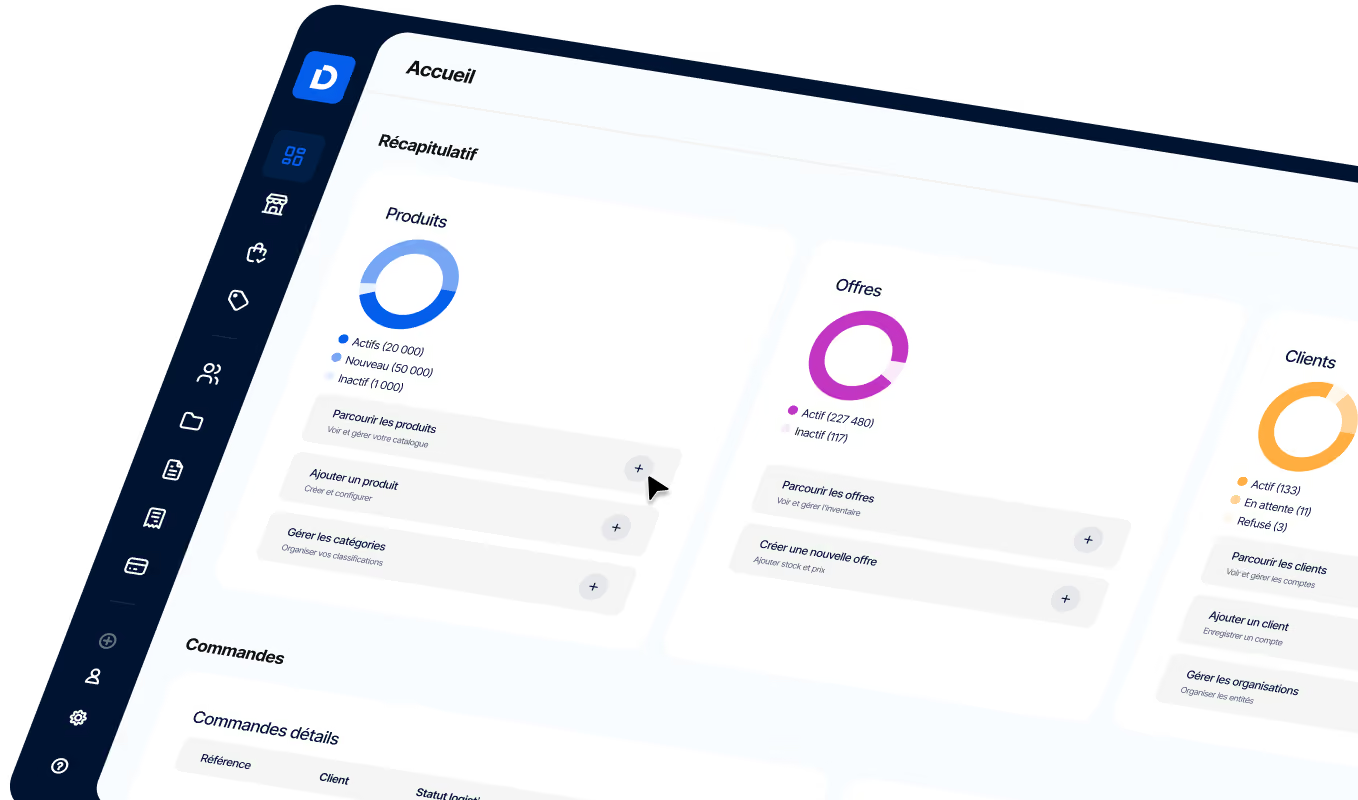
By using a B2B e-commerce platform like DJUST, you can manage all your inventory from a single interface. You can track stock levels in real time and get an accurate view of availability.
The result: you significantly reduce the risk of stockouts and, in turn, customer loss.
How can you limit overstock and dead stock in retail?
Limiting overstock and dead stock relies on four levers:
- Forecasting and planning: based on analysis of sales history, supply constraints, and seasonality.
- Dynamic inventory management: using different KPIs, such as turnover rate, availability rate, reorder point, and supplier lead times.
- Sell-through planning: by alternating promotions, bundles, and supplier returns, depending on the goods.
- Optimizing logistics costs: continuously adjusting order volumes and frequency, replenishment cycles, and more.
Omnichannel management: why is it so complex?
Omnichannel management is currently the best inventory management solution for B2B e-commerce companies.
However, it requires a broad, coordinated approach that comes with its own challenges. Here are the main ones:
- Order platform synchronization: combining multiple sales channels multiplies the risk of bottlenecks that require manual intervention. The result is more order delays and more order errors.
- Decentralized, multi-site management: managing inventory across multiple sites means coordinating several warehouses, which makes flow allocation more complex.
- Inconsistent information across channels: if the prices shown on your different channels don’t match, it can create confusion and reduce customer trust.
- Limited real-time visibility: without real-time inventory updates, your system may accept orders by mistake and increase stockouts.
- Complex technology integration: retailers struggle to integrate their omnichannel management software. They also face resistance from teams and partners who are reluctant to change.
A high-performing omnichannel strategy must rely on tools designed to centralize all data and optimize order flows.
Which methods should you use to optimize inventory management?
ABC analysis: classifying products by turnover
The classic inventory management strategy is ABC analysis. It involves classifying products into three categories: A, B, and C.
Class A includes the inventory that generates 80% of the company’s profit. Class B accounts for 15%, and Class C for 5%.
In practice, management efforts therefore focus on Class A inventory, which should never run out in order to avoid critical stockouts. These items turn over much more frequently to meet steady demand.
By contrast, Class C stock is effectively dead stock and can be discounted or sold in bundles to offset declining sales or increase the share of A and B products.
Smart replenishment: alert thresholds and automation
Effective B2B order management must also include smart replenishment.
This approach is based on automated inventory management. The goal is to adjust quantities in real time based on demand.
From a logistics standpoint, you set an alert threshold by taking into account product turnover speed, lead time, and more.
Then, when a customer places an order in the B2B product catalog, available stock is updated automatically.
The process is fully automated and limits manual intervention to the strict minimum, such as final approval, quality control, and urgent cases.
Inventory technologies: ERP, WMS, RFID, cloud solutions
Several technologies have been developed to help B2B professionals manage inventory and stock:
- ERP (Enterprise Resource Planning): a centralized software system that automates finance, HR, and supply chain processes.
- WMS (Warehouse Management System): dedicated management software for warehouse logistics.
- RFID (Radio Frequency Identification): a technology that uses radio waves to track products in real time. It can store more information than a barcode and read multiple tags simultaneously from a distance.
- Cloud solution: a management platform like DJUST gives you direct access to your multichannel data from any device.
- AI and e-commerce: tools for predicting demand, anticipating stockouts, and optimizing inventory through machine learning models.
Best practices to quickly improve inventory management
Standardize processes and involve teams
At every level of supply chain management, you need to streamline processes. For example, rely on key KPIs to standardize replenishment methods or align alert thresholds.
Then involve teams in rolling out new workflows and stay close to their needs.
What are the daily friction points? The repetitive tasks that cause errors? The missing information?
Strong internal communication will smooth operations and speed up adoption of new tools.
Optimize storage areas and warehouse space
Storage is first and foremost a question of space. To optimize your management, measure the space you have and the layout of your storage area.
Adapt the space accordingly, with accessible storage zones and safety rules that support employee movement.
Create zones for each product type or by turnover frequency, depending on the management method you use.
Automate repetitive tasks and purchasing decisions
To optimize how you allocate human resources, rely on process automation whenever possible.
For repetitive tasks such as order entry, stock level updates, and replenishment threshold checks, automation saves valuable time and prevents human error.
Do the same for purchasing decisions. Set your critical replenishment levels based on demand forecasts. As soon as a threshold is reached, your software schedules the turnover of the relevant product.
What role do data and predictive analytics play?
How can you improve retail forecasting accuracy?
Predictive analytics in supply chain management helps forecast future inventory needs.
To do this, it relies on different data sources such as sales history, seasonal trends, and demand forecasts.
The goal is simple: reduce the risk of stockouts or, on the contrary, overstocking through data. Forecast rather than react.
The concrete benefits for retailers
Retailers benefit greatly from a predictive analytics strategy. It delivers concrete gains such as:
- Higher margins: optimized inventory adjustments increase margins by eliminating the carrying costs of unnecessary goods tied to overstocking.
- Better availability: B2B customers get enough product availability, even during demand spikes.
- Improved turnover: real-time tracking of each product SKU’s performance makes it easier to optimize order flows and product replenishment.
Why does a B2B e-commerce solution like DJUST transform inventory management?
Centralize product, order, and availability data
Our all-in-one B2B platform centralizes all data related to products and their availability. When an order is placed through one of the company’s channels, the transaction is tracked in real time and stock levels are updated immediately. This traceability makes it possible to anticipate needs and adjust replenishment strategies.
Automatically sync inventory across all B2B channels
With omnichannel inventory management, stock levels are synchronized automatically across all channels. This improves communication between sales, logistics, and warehouse teams to ensure an efficient distribution chain.
Manage replenishment and forecasting through a unified platform
The centralized platform is an essential decision-making tool. Based on the data collected, it recommends optimal replenishment thresholds.
Reduce errors and speed up execution through automation
According to a 2024 McKinsey study, adopting automated processes can reduce order errors by 30%. It also tends to speed up execution.
How do you measure results and adjust your inventory strategy?
Dashboard: the essential metrics to track
Data analysis is essential for any automated inventory management strategy. That’s why our B2B marketplace solution includes dashboards with all the key metrics you need to track.
For B2B commerce specifically, the main KPIs are:
- Inventory turnover rate: the number of times inventory is fully replenished over the course of a calendar year.
- Coverage rate: the share of customer demand met by immediate stock availability.
- Availability rate: the percentage of products available to a customer at a given time.
- Safety stock level: the additional inventory held to absorb demand fluctuations.
- Storage cost: the cost of warehouse holding expenses, including energy, labor, maintenance, and more, expressed as a percentage of total inventory value.
- Average replenishment lead time: the time between placing an order with a supplier and putting it into stock.
Targets to aim for: turnover, coverage, availability
Measuring your results lets you continuously adjust and optimize your inventory management strategy.
You can identify inventory anomalies or gaps versus planned thresholds and make the necessary corrections.
The goal is to ensure optimal inventory turnover, coverage, and availability, whatever the context.
With this retail management approach, you reduce operating costs while protecting customers from potential stockouts.
Toward more agile, data-driven inventory management
Data-driven approaches are transforming inventory management. By using data to plan supply chain operations, professionals can better anticipate needs and reduce the risk of stockouts or overstocking.
This approach also ensures better coordination from supplier to consumer through targeted automation.
Our B2B SaaS marketplace solution supports your digital transformation and the evolution of your retail management processes.
Start improving your supply chain performance with DJUST today.
FAQ on inventory management in retail
How can you improve inventory accuracy across warehouses and stores?
Inventory accuracy depends on centralized data that is updated in real time. By bringing product, order, and availability information together in a single environment, discrepancies between warehouses and stores drop significantly. A platform like DJUST ensures this automatic synchronization, which provides reliable visibility across every channel and reduces picking or replenishment errors.
What technologies help reduce stockouts in retail?
Several technology building blocks help limit stockouts:
- Automated replenishment, to trigger orders at the right time;
- Predictive analytics, to anticipate demand fluctuations;
- Omnichannel synchronization, to keep inventory consistent across every touchpoint;
- ERP / WMS / OMS integration, to streamline information flow.
By combining these levers, distributors improve availability and reduce revenue losses caused by insufficient stock.
How can you automate replenishment in a multi-site organization?
Automation relies on defining alert thresholds, safety levels, and ordering rules tailored to each site’s constraints. Once these parameters are set, the management platform automatically triggers replenishment as soon as a threshold is reached. With a unified system like DJUST, stock across all sites is synchronized, which helps avoid duplicates, limit manual intervention, and speed up purchasing decisions.

.jpeg)