AI in B2B E-commerce: Everything You Need to Know
How AI Is Redefining B2B E-Commerce in 2025: Use Cases, Operational Gains, and Customer Experience
Article summary
- AI in B2B e-commerce is no longer optional — 74% of buyers expect seamless, data-driven experiences, and companies using AI-powered pricing see margin improvements of 2% to 7% (McKinsey)
- Six high-impact use cases deliver measurable ROI: dynamic pricing, personalized buying journeys, intelligent search, predictive inventory management, logistics automation, and fraud detection
- AI works best as a business copilot — it handles data analysis at scale and automates routine tasks while teams focus on decisions, relationships, and strategy
- AI readiness rests on four foundations: data excellence across all systems, an API-first modular architecture, an AI culture within teams, and privacy compliance built in from the start

B2B commerce is reaching a turning point.
AI is helping companies reduce manual friction, anticipate demand, and accelerate growth. This isn’t theory — it’s measurable performance gains. From intelligent pricing to real-time personalization, AI in B2B e-commerce is turning complexity into competitive advantage.
What AI in e-commerce really means
AI in e-commerce refers to the use of technologies such as machine learning, natural language processing, and computer vision to improve your company’s commercial performance.
AI in B2B e-commerce: pressure to evolve
B2B commerce is evolving faster than ever.
Buyers now expect the same seamless, data-driven experiences they get as consumers — from real-time order tracking to pricing transparency.
According to Think with Google, a significant share of B2B purchases now happen online before any contact with a sales rep.
This shift exposes the limits of traditional B2B systems built on manual entry and siloed data. The complexity of custom workflows, negotiated pricing, and multi-warehouse logistics makes real-time optimization impossible without automation.
That’s why AI-powered B2B e-commerce is becoming not just an enabler, but a competitive necessity.
AI helps companies move from reactive operations to predictive ones. Instead of analyzing what happened last quarter, they can anticipate buyer needs, optimize inventory and pricing dynamically, and personalize the buying journey at scale.
For B2B leaders, AI is now the foundation of sustainable growth.
From task automation to intelligent commerce
The first wave of B2B digitalization focused on automating repetitive tasks: order entry, product catalog updates, invoicing. Those gains were important, but incremental.
Today, the focus is on intelligent commerce: systems that can interpret data, recognize patterns, and adapt in real time. AI in B2B e-commerce can predict when product demand will rise or when a pricing adjustment will protect margins. In practice, AI doesn’t fix broken processes — it exposes them. When data, pricing rules, or workflows are inconsistent, AI makes those issues visible faster.
The difference lies in learning. Automation executes rules; AI refines them continuously. For B2B organizations managing complex supply chains and multi-level buyers, that intelligence translates into fewer errors, faster response times, and stronger customer satisfaction.
AI doesn’t replace human expertise; it amplifies it. The most advanced companies use AI as a strategic ally to help their teams make better decisions, faster and with more context.
The benefits of AI for B2B e-commerce
AI is reshaping every part of B2B commerce, with measurable impact from pricing to the buying experience. Here’s how.
1. Data-driven decisions
AI turns massive volumes of customer, product, and market data into actionable insights. Companies move from reacting to anticipating — adjusting decisions before issues affect performance.
2. Personalized buying experiences
AI adapts product catalogs, pricing, and recommendations to each buyer’s profile. In B2B, relevance often drives loyalty: personalized journeys increase conversions and long-term retention.
3. Smarter pricing and margin protection
Dynamic pricing engines analyze demand, competition, and cost data to adjust prices automatically. That precision helps protect both profitability and buyer trust.
4. A predictive supply chain
AI improves demand forecasting, helping prevent stockouts and overstocking. According to Accenture, predictive analytics can, in some cases, reduce inventory-related costs by up to 30% and speed up order fulfillment by up to 25%.
5. Scalable operations
By automating repetitive workflows, AI frees teams to focus on strategy and growth. Companies can scale volume and complexity without scaling headcount at the same pace.
In short, AI in B2B e-commerce combines speed, intelligence, and foresight.
The challenges of AI in B2B e-commerce
The benefits are clear, but AI also introduces new challenges that leaders need to manage strategically.
1. Data quality and fragmentation
AI depends on consistent, unified data. Many B2B companies still work with fragmented systems (ERP, CRM, legacy tools) that limit visibility. Building data excellence — clean, connected, and up to date — is the first step.
2. Integration complexity
B2B commerce involves custom workflows and multi-tier pricing structures. Integrating AI requires a modular, API-first architecture to ensure systems communicate without disruption.
3. Costs and resources
AI transformation requires investment in tools and people. ROI is gradual; early gains often show up in process efficiency before automation reaches full maturity. Treating AI as a strategic lever, not a cost center, is essential.
In reality, results are rarely immediate. Some companies see quick efficiency gains, while others need months of iteration before AI delivers measurable business value.
4. Ethics and compliance
The European AI Act (2025) requires transparency and fairness. Models that influence pricing or the customer experience must be auditable and free from bias. Trust, transparency, and accountability are now competitive factors.
5. Skills and culture
Adoption depends on people. Teams need to understand how AI supports their decisions — not fear that it will replace them. Investing in AI literacy builds confidence and cross-functional collaboration.
In B2B environments, the hardest part is often not the model itself, but getting sales, supply chain, and IT teams to trust the outputs.
The main use cases for AI in B2B e-commerce
AI delivers the most value where data volume and decision complexity meet. Here are the six most impactful use cases in B2B today.
Generative AI for product descriptions
Manual content creation becomes a bottleneck as product catalogs grow. Generative AI automates this process while maintaining quality and consistency. Trek Bicycles developed an AI-powered “Bike Finder” to guide customers through product selection, resulting in a 200% increase in conversion rate.
Large language models like ChatGPT, along with specialized tools such as Shopify Magic, allow companies to generate unique, SEO-optimized product descriptions at scale. The technology excels at creating multilingual content for international expansion and maintaining a consistent brand voice across thousands of products.
Dynamic pricing
Static pricing leaves money on the table in competitive markets. AI-driven dynamic pricing continuously analyzes competitor prices, demand signals, inventory levels, and customer data to optimize prices in real time.
Instead of static updates, prices adjust automatically based on demand and margin goals. According to McKinsey, AI pricing can improve profit margins by around 2 to 7 percentage points when deployed effectively.
Amazon famously used dynamic pricing to increase profits by 25%. In B2B, the model becomes more complex with tiered pricing, volume discounts, and contract negotiations — but the upside is even greater. B2B companies can optimize pricing across thousands of custom contracts, automatically adjust volume discounts based on market conditions, and respond to competitor pricing changes in real time while protecting margins.
Personalized buying journeys
AI can tailor catalogs, promotions, and replenishment suggestions for each customer based on contract type, industry, or behavior.
For example, a distributor can automatically highlight relevant assortments or suggest replenishment orders, improving loyalty and operational efficiency.
Intelligent search and recommendations
AI tools for e-commerce, especially AI-powered search, understand buyer intent, not just keywords. They continuously learn from real usage, automatically improving relevance and product discovery. The result: fewer abandoned carts and faster purchases.
After deploying AI search, Zenni Optical saw a 34% increase in revenue generated through search. The system handles typos, interprets complex queries, and continuously learns from user behavior to improve results.
In B2B, intelligent search becomes essential when dealing with technical catalogs containing thousands of SKUs. For example, a technician searching for a “hydraulic seal” will still find the right results even if the official product name is different.
The DJUST platform integrates naturally with AI search tools like Algolia, helping B2B companies deliver consumer-grade search experiences for complex product catalogs.
Predictive inventory management and demand planning
AI connects historical data, seasonality, and market trends to forecast demand more accurately. AI in the supply chain reduces stockouts and overstocking while improving service levels. Deloitte notes that predictive planning can deliver substantial improvements in inventory accuracy.
DJUST AI insights help optimize inventory management by connecting forecast data with real-time order patterns and supplier information, enabling smarter decisions about stock levels and purchasing timing. For B2B companies managing complex supply chains and seasonal demand, that added precision translates directly into competitive advantage.
Logistics and order management
AI in order management can anticipate potential fulfillment issues, prioritize high-value orders, and automate approvals.
That means smoother operations across multi-warehouse networks and shorter delivery times.
Voice commerce (emerging)
Still evolving, voice commerce represents the next frontier of frictionless shopping. The market is expected to grow from $151.39 billion in 2025 to $421.7 billion by 2034, a compound annual growth rate (CAGR) of 29.2%.
Today, voice technology works best for simple, repetitive purchases and hands-free interactions. A warehouse manager can check inventory levels by voice, or a sales rep can update customer records while driving. As natural language processing improves, voice commerce will expand into more complex transactions.
In B2B, voice technology first streamlines internal processes before extending to customer interactions. The key is to integrate voice capabilities into existing workflows, rather than treating them as standalone features.
Secure payments and fraud detection
AI-driven fraud prevention detects anomalies in real time, learning continuously to reduce false positives. According to Stripe Research, machine learning reduces chargeback losses by 25% on average.
In B2B e-commerce, this technology is becoming essential. Higher transaction values in B2B mean that a single successful fraudulent order can be financially devastating. AI fraud detection platforms assess risk at both the transaction and account level, providing critical security for B2B marketplaces and distributors.
In short: taken together, these use cases show how AI is reshaping B2B commerce end to end, from product discovery and pricing to logistics and payments.
The rise of autonomous marketplaces: how AI is redefining B2B e-commerce
B2B marketplaces are evolving from digital platforms into autonomous ecosystems. By 2027, a large majority of B2B commerce environments will rely on AI agents to optimize pricing, procurement, and logistics (Gartner).
These systems don’t just automate — they learn. They analyze product data, buyer behavior, and market signals in real time to decide, predict, and act faster than any manual process.
In these intelligent environments, AI connects every layer of the transaction:
- Prices adjust automatically to market conditions and margin goals.
- Inventory and logistics sync instantly across distributors and warehouses.
- Fraud prevention runs in real time, protecting revenue and trust.
This new generation of AI-powered marketplaces uses generative models and search intelligence to boost product visibility and match buyers with relevant offers instantly.
Human teams still stay in control, but their focus shifts to strategy, partnerships, and innovation.
Autonomous marketplaces aren’t a futuristic concept — they’re the next natural step in intelligent commerce, where human expertise and AI combine to deliver faster, smarter, and more resilient business performance.
AI as assistant or replacement?
In modern B2B commerce, the question isn’t whether AI will replace people — it’s how the two can work together more intelligently.
AI for B2B e-commerce excels as a business copilot. It analyzes data, streamlines workflows, and automates routine tasks so teams can focus on what matters most: decisions, partnerships, and innovation.
In practice, AI supports people where speed and accuracy are critical — order validation, demand forecasting, detection of logistics risks, or customer data analysis. Human intelligence remains vital for empathy, negotiation, and long-term relationships.
AI’s strength lies in its ability to analyze complex product data and deliver clear insights in near real time. Conversational AI adds another layer of speed: teams can access product or customer knowledge instantly through natural interactions, without endless searching.
This collaboration marks a real cultural shift. Leading companies see AI not as a threat, but as a precision tool that improves rigor, coordination, and operational resilience.
The future of B2B commerce isn’t humans versus machines — it’s humans with machines. Used deliberately, AI doesn’t remove human judgment; it multiplies it.
The ideal partnership
The most effective model treats AI-powered B2B e-commerce as a business copilot with defined responsibilities and measurable impact.
Scope and roles: AI handles high-volume, high-complexity processes, while humans make final decisions, negotiate terms, and manage exceptions.
Explainability and reporting: it’s essential to build transparent reporting systems that show what AI decided, why, and what impact it had on costs, margins, or service. Regular reviews help identify optimization opportunities and improve accuracy.
Conversational access to knowledge: equip teams with generative assistants that provide access to trusted information — product data, pricing rules, logistics status — through conversational interfaces. The speed of Google applied to your ERP and CRM.
Workflow orchestration: connect AI to core commerce solutions so it can suggest actions and prioritize tasks: price adjustments, shipment sequencing, marketing campaign suggestions... Teams refine and execute.
Skills and adoption: provide short, clear playbooks so sales, marketing, and distributor teams understand how to work with AI tools.
Value first, then scale. Start small. Choose one high-impact, low-risk AI process, validate ROI within a defined scope, then expand gradually into product management, search, and logistics.
The strongest B2B systems are the ones where human expertise guides what AI executes. Insight becomes action faster, decisions scale consistently, and performance stops depending on guesswork or manual corrections.
Getting ready for AI: what leaders need to do now
Deploying AI in B2B e-commerce is as much a structural transformation as a technical one. Success depends on a company’s ability to align data, systems, and teams around intelligent growth.
Here are the priorities leading companies focus on to stay competitive in digital commerce.
1. Build data excellence
AI starts with high-quality data: clean, unified, and accessible across the organization. Every predictive process depends on reliable product, customer, and distributor data.
That requires strong data governance, connecting ERP, CRM, and logistics systems to ensure insights reflect operations in real time.
2. Build an integration-ready architecture
AI thrives in modular, API-first environments.
Flexible platforms like DJUST make it easy to integrate pricing, inventory management, and marketing automation tools — without disrupting existing workflows.
This architecture turns siloed systems into a connected, AI-powered commerce ecosystem where every process — from product management to logistics — works in sync.
3. Develop AI literacy
Technology only performs if teams understand it.
Training sales, operations, and marketing teams to use AI insights turns resistance into adoption.
AI literacy builds trust, improves performance, and ensures automation enhances — rather than replaces — human decision-making.
4. Build security and privacy in from the start
AI success depends on trust.
GDPR compliance and the European AI Act must be built into every system from the outset. Responsible data management strengthens customer trust and brand reputation — essential assets in long-term B2B partnerships.
Takeaway: getting ready for AI means aligning infrastructure, processes, and teams around data-driven growth. Companies that act now will lead the next wave of digital commerce — faster, smarter, and more resilient.
Ready to use AI in e-commerce? Ask yourself these 5 questions
Before starting your AI rollout, ask yourself the following:
What specific business problem are we trying to solve? (Avoid generic goals like “improve the customer experience.”)
Do we have enough high-quality data to train AI models effectively?
How will this AI application integrate with our B2B e-commerce platform and current workflows?
What baseline metrics will we use to measure success?
Who will be responsible for managing and continuously optimizing the AI system?
Companies that can answer these questions confidently are ready to move into implementation. Those that can’t should first focus on the foundations — data quality and systems integration — before launching AI initiatives.
Where AI is taking B2B next
B2B AI solutions are moving B2B commerce from digital to intelligent. The next generation of platforms will connect every process — sales, product marketing, logistics, finance... — into a single adaptive system.
- From optimization to orchestration: AI will manage value chains end to end.
- From insights to foresight: predictive becomes prescriptive, automatically recommending next actions.
- From data to differentiation: success will depend on how deeply AI is embedded in day-to-day operations.
- For companies ready to embrace this shift, the future includes:
AI-driven supply chain decisions: predictive models will optimize sourcing, logistics, and inventory across global networks while adapting to disruptions in real time. For example, AI can automatically reroute shipments around weather delays or find alternative suppliers when primary vendors hit capacity limits.
Fully predictive customer journeys: AI will anticipate customer needs throughout the buying cycle, suggesting products and solutions before customers even realize they need them. Beyond simple recommendations, this is true business intelligence.
Autonomous commerce workflows: smart contracts and AI agents will handle routine transactions, approvals, and supplier communications with minimal human oversight.
In short, AI will move from competitive advantage to operational standard.
How DJUST supports your AI transformation
At DJUST, we believe AI should simplify, not complicate.
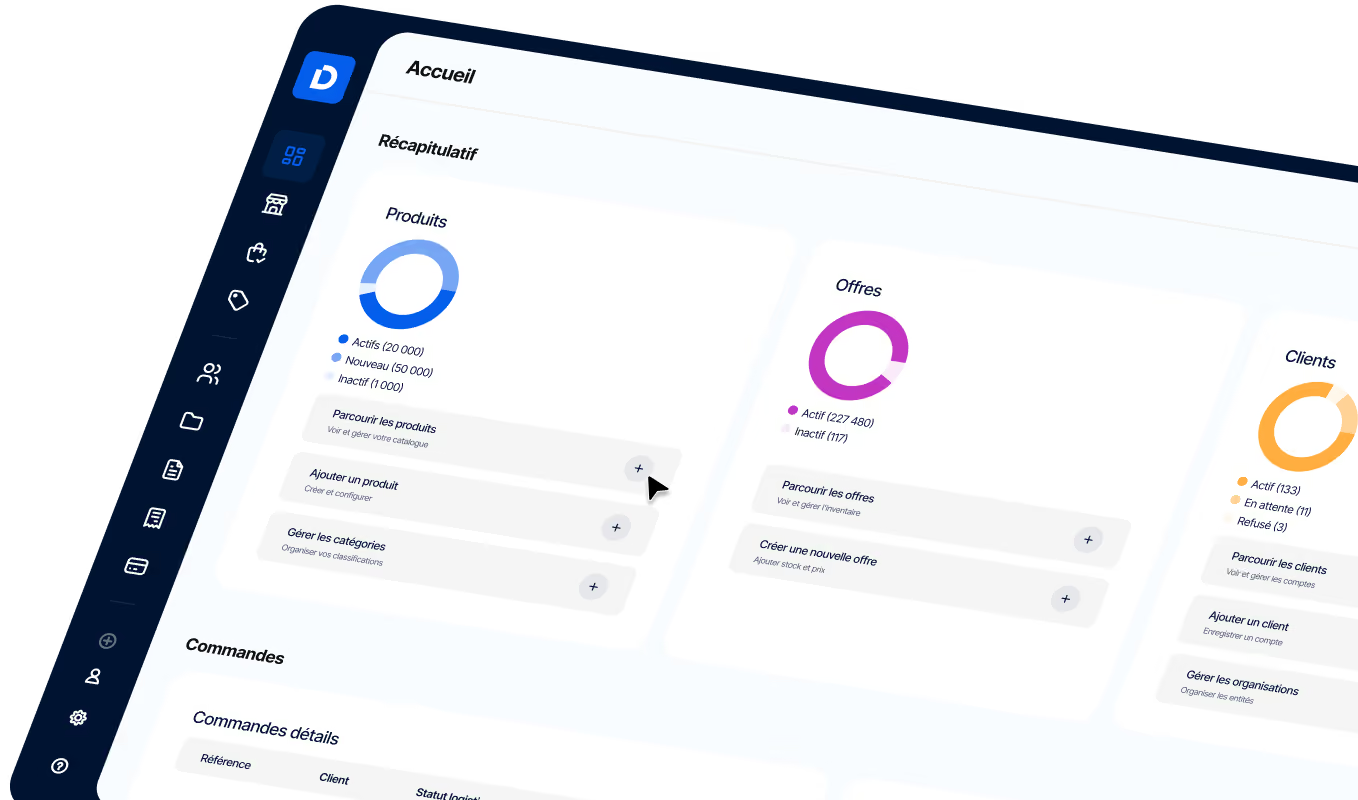
Our modular, headless platform helps B2B companies connect their data, automate key workflows, and integrate AI capabilities seamlessly: from dynamic pricing to demand forecasting and personalization.
With an API-first architecture, DJUST makes it easy to connect AI tools aligned with your strategy while keeping full control over your data and operations.
The result: faster decisions, smarter processes, and measurable growth.
AI is no longer tomorrow’s advantage — it’s today’s reality. DJUST helps companies make it work, at speed and at scale.
Ready to take the next step? Get in touch with our team or book a demo.
Sources:
https://artificialintelligenceact.eu/
https://www.mckinsey.com/featured-insights/week-in-charts/the-ai-price-is-right
https://www.accenture.com/us-en/insights/supply-chain/making-autonomous-supply-chains-real
https://mkto.deloitte.com/rs/712-CNF-326/images/DI_Tech-trends-2026.pdf
https://stripe.com/blog/using-ai-optimize-payments-performance-payments-intelligence-suite


.avif)
.jpeg)