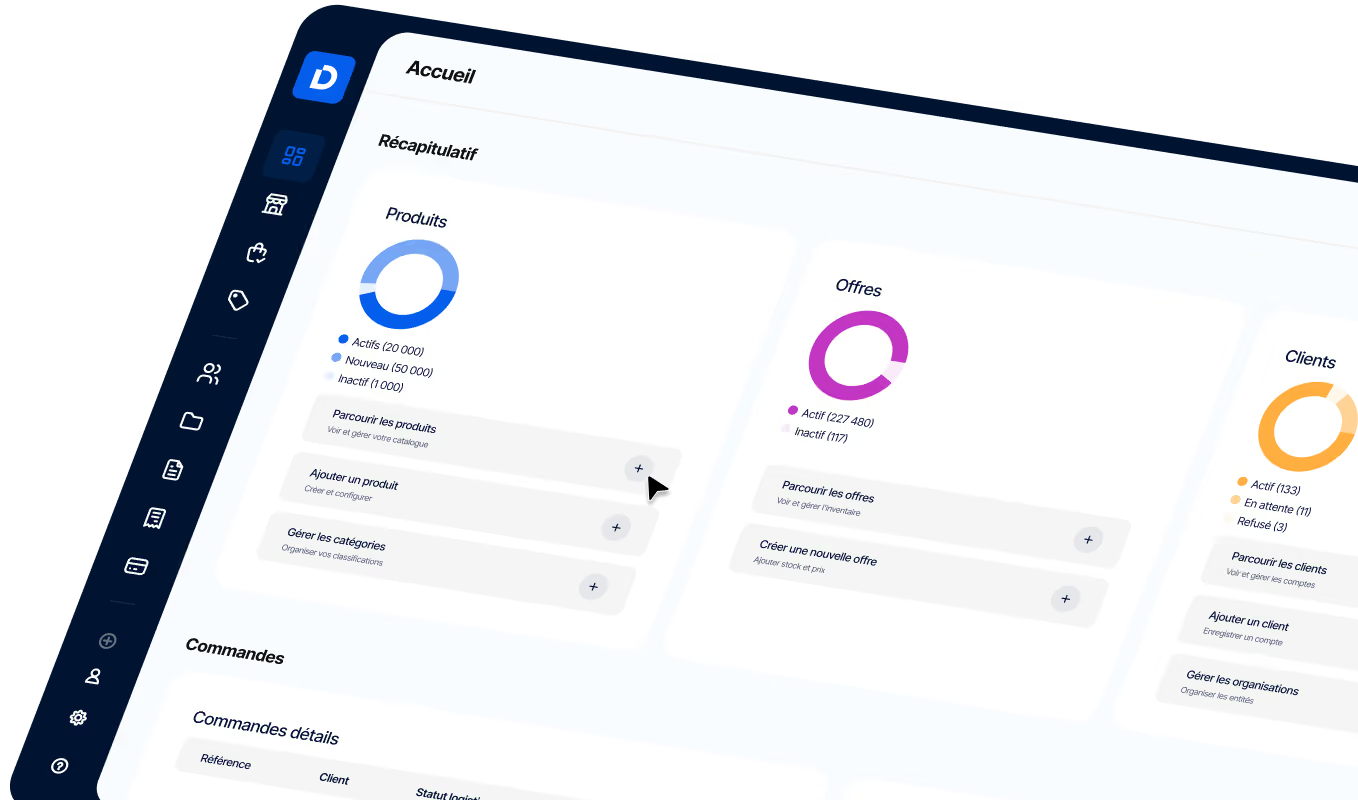
AI and Order Management: Decisions and Outlook
In today’s digital economy, businesses are under increasing pressure to optimize their order management processes. AI-powered analytics play a key role in improving operational efficiency, reducing costs, and increasing customer satisfaction. With machine learning (ML) and predictive analytics, companies can gain deeper insight into order patterns, anticipate demand fluctuations, and optimize fulfillment strategies. This is especially important for B2B e-commerce platforms and enterprise e-commerce platforms looking to improve their order management system (OMS).

AI-Driven Insights and Decision-Making in Order Management
How AI-Powered Analytics Is Transforming Order Management
In today’s digital economy, businesses are under growing pressure to optimize their order management processes. AI-based analytics plays a key role in improving operational efficiency, reducing costs, and increasing customer satisfaction. With machine learning (ML) and predictive analytics, companies can gain deep insight into order patterns, anticipate demand fluctuations, and optimize fulfillment strategies. This is especially important for B2B e-commerce platforms and enterprise e-commerce platforms looking to improve their order management system (OMS).
The Role of AI in Analyzing Order Patterns
AI-based analytics helps businesses identify trends in order history, seasonal demand, and customer preferences. Traditional order management systems (OMS) relied on static rules, while AI enables dynamic, adaptive models that improve continuously. This is crucial for e-commerce automation and supply chain planning.
Example: Demand Forecasting
A retail company using AI-based analytics can predict which products will be in high demand during a specific season. By analyzing historical sales data, AI models can recommend optimal inventory levels, minimizing overstock and reducing stockouts. This strategy aligns with an effective e-commerce growth strategy and e-commerce personalization.
Example: Personalized Order Fulfillment
AI can help e-commerce platforms tailor their order fulfillment strategies based on customer behavior. If a customer frequently orders specific items, AI can suggest bundling options or pre-stock those items in a warehouse close to the customer. This supports B2B e-commerce trends and improves the B2B customer experience.
AI-Optimized Fulfillment Strategies
AI improves order fulfillment by automating decision-making in supply chain management. For example:
- Warehouse optimization: AI algorithms dynamically allocate inventory based on regional demand, which is essential for B2B inventory management.
- Route optimization: AI-powered logistics tools help reduce delivery time and cost by optimizing delivery routes, benefiting B2B shipping and e-procurement software.
- Real-time inventory tracking: AI provides real-time visibility into stock levels, preventing order delays and supporting replenishment software.
AI-based analytics is transforming order management by improving demand forecasting, personalizing the customer experience, and optimizing fulfillment processes. Businesses that adopt AI-driven insights gain a competitive edge in efficiency and customer satisfaction, making it a critical part of a B2B e-commerce strategy.
Automating Order Reconciliation with AI
Financial reconciliation in order management is a complex, time-consuming task that is prone to human error. AI-powered automation streamlines these processes, ensuring accuracy in invoicing, payment processing, and financial recordkeeping. This is especially relevant for B2B payment processing and invoice management systems.
AI in Order Reconciliation
Invoice Matching and Error Detection
AI can automatically compare invoices with purchase orders and delivery receipts, flagging discrepancies in real time. This eliminates manual checks and reduces financial losses caused by errors. For enterprise e-commerce platforms, automating financial reconciliation is essential.
Fraud Detection and Risk Mitigation
Machine learning models can detect anomalies in payment transactions, preventing fraudulent activity. AI can identify patterns of duplicate invoices, unauthorized transactions, and billing errors, making it a major asset for e-commerce security.
Example: AI in Large Enterprises
A multinational company implemented AI for invoice reconciliation, reducing processing time by 60%. By automating invoice matching and discrepancy resolution, the company saved millions in operational costs, illustrating the impact of digital transformation and B2B digital transformation.
AI-Driven Payment Processing
AI improves payment processing efficiency by:
- Automating payment validations based on predefined business rules.
- Predicting payment delays and suggesting corrective actions.
- Integrating with banking systems for real-time transaction verification.
AI streamlines financial reconciliation, ensuring accuracy, reducing manual workload, and mitigating financial risk. Businesses using AI-driven automation in order reconciliation achieve significant efficiency gains and cost savings, putting them ahead of B2B e-commerce trends and B2B wholesale commerce.
AI and OMS: A Competitive Advantage for Growing Businesses
As businesses scale, managing growing order volumes efficiently becomes a challenge. AI-powered order management systems (OMS) provide the agility and intelligence needed to handle growth without compromising service quality, making them essential to B2B sales and B2B e-commerce success.
Case Study 1: E-commerce Scaling with AI-Driven OMS
An online fashion retailer expanded internationally but faced order processing delays. By implementing an AI-driven OMS, the company:
- Automated order routing based on warehouse proximity.
- Reduced order fulfillment time by 40% through predictive inventory allocation.
- Improved customer satisfaction with personalized delivery recommendations, supporting e-commerce personalization and B2B partnerships.
AI in order management helps businesses scale efficiently, optimize costs, and improve service quality, making it a pillar of digital transformation and B2B digital transformation.
References
- Brynjolfsson, E., & McAfee, A. (2017). Machine, Platform, Crowd: Harnessing Our Digital Future. W. W. Norton & Company.
- Davenport, T. H., & Ronanki, R. (2018). "Artificial Intelligence for the Real World." Harvard Business Review.
- Agrawal, A., Gans, J., & Goldfarb, A. (2018). Prediction Machines: The Simple Economics of Artificial Intelligence. Harvard Business Press.
- Gartner. (2023). "AI in Supply Chain and Order Management: Trends and Insights." Retrieved from Gartner.com.
McKinsey & Company. (2023). "The Future of AI in Business Operations." Retrieved from McKinsey.com.


.avif)
.jpeg)