What is a B2B customer portal and how do you deploy it?
Wondering how B2B customer portals can improve your business? Explore the features, benefits, and implementation strategies that create a seamless digital experience.
Article summary
- A B2B customer portal centralizes communications, orders, negotiated pricing, and customer service in a self-service space connected to your back-office.
- It improves the customer experience, reduces manual tasks and operational costs, while accelerating the sales cycle and fostering loyalty.
- Its key features include personalized catalogs and pricing, ERP/CRM/OMS integration, real-time inventory, order tracking, and collaborative tools.
- B2BAI enhances the portal by automating order entry, predictive replenishment, anomaly detection, and product recommendations.
.png)
Wondering how B2B customer portals can improve your business? Explore the features, benefits, and implementation strategies for a seamless digital experience.
To grow a business, it is essential to aim for continuous customer growth. However, companies often neglect relationships with existing clients in the pursuit of rapid new customer acquisition.
The result?
- Reduced customer loyalty
- Customer churn
- Decreased customer lifetime value (CLV) and sales
- Increased acquisition costs
Do your orders arrive via email, in Excel files, or with negotiated pricing that requires manual entry into your ERP? A well-integrated B2B customer portal absorbs this complexity and boosts your sales through a B2B e-commerce platform connected to your systems.
What is a B2B customer portal?
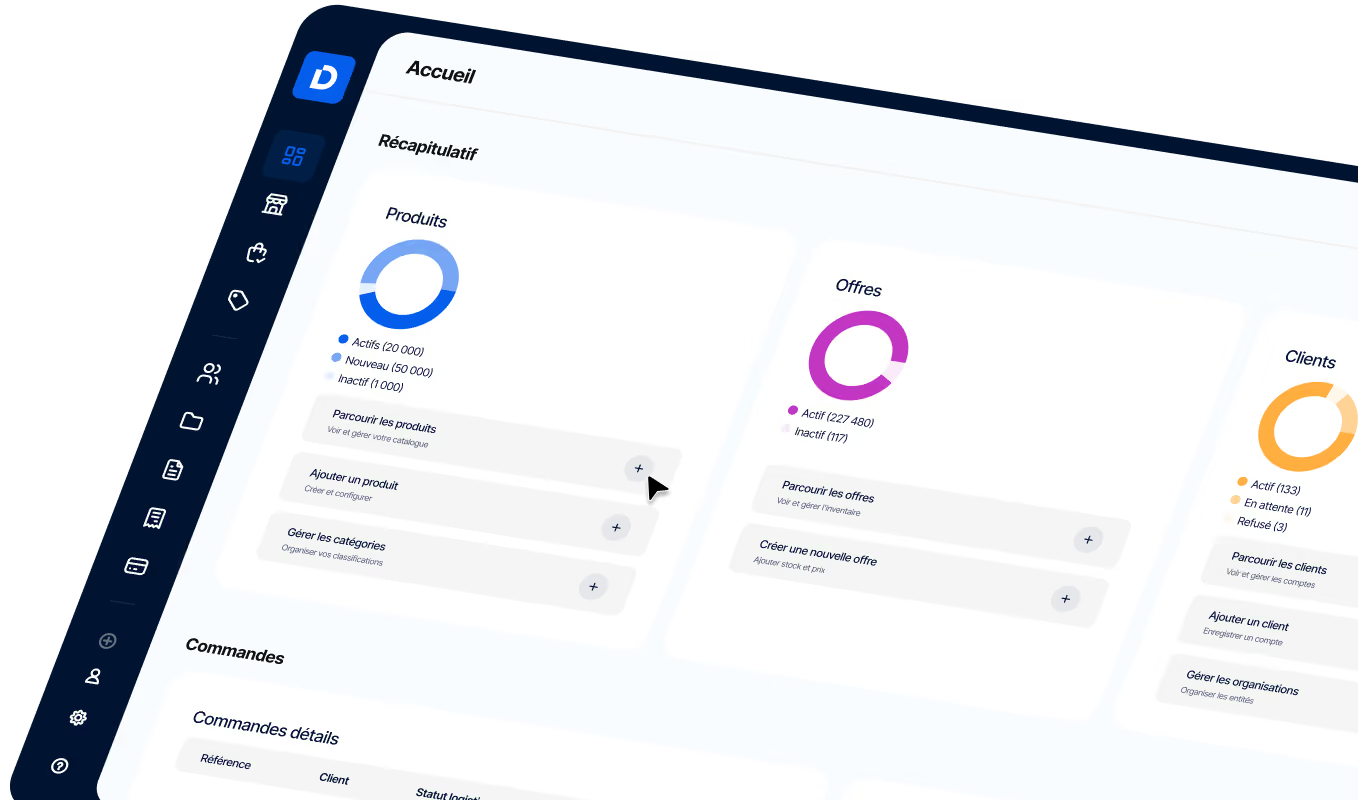
A B2B customer portal is a self-service platform that allows you to interact and transact with your business clients. Unlike B2C portals designed for individual consumers, a B2B portal addresses the specific needs of your professional clients by simplifying all your exchanges. The solution is evolving into a comprehensive customer management tool that covers the entire lifecycle of the business relationship.
The primary goal of implementing a B2B customer portal is to improve client relationships by offering seamless transactions, upgrades, and purchases from a centralized platform. It also gives your busy B2B clients quick access to customer services such as live ticket management, incident tracking, resolution monitoring, and frequently asked questions (FAQs).
Furthermore, B2B customer portals facilitate direct communication between companies and clients through integrated chat systems, notifications, and updates.
A customer portal and a B2B e-commerce site serve distinct functions. The former is a private space connected to back-office systems, where each buyer accesses their negotiated rates, dedicated catalog, and history. The latter displays a public offering with a generic catalog to capture new leads. The two complement each other: the site generates inbound leads, while the portal automates recurring orders for your established clients.
The portal's architecture adapts to your clients' purchasing profiles:
- Key account portal: custom catalogs, multi-level approval workflows, and multi-entity management.
- Distributor portal: inventory tracking, warehouse-specific distribution, and access to negotiated discount terms.
- Industrial client portal:detailed technical specifications, recurring supply management, and precise bill of materials (BOM) handling.
7 concrete benefits of a B2B customer portal for your teams and clients
A B2B portal lightens the daily workload for your sales and administrative teams by absorbing the complexity of order flows. Your clients gain autonomy, and your staff gains valuable time.
A customer portal is important for any growth-oriented B2B company because it:
- Improves the customer experience by allowing them to access product and purchase information, place orders, and manage their accounts easily.
- Reduces the need for manual intervention, decreases errors, and saves time. You no longer have to worry about data loss.
- Reduce operational costs associated with direct customer service and paperwork. You won't need to hire a large internal team; the portal will handle all your customer requests.
- Automate processes like order management, invoice generation, invoice delivery, and support to increase efficiency. For example, if someone places an order, their invoice will be generated instantly without manual intervention.
- Ensure your operations are scalable while maintaining a consistent, brand-aligned experience for every customer.
- Give your customers direct access to your B2B e-commerce catalog and your pricing, thereby reducing inquiry time and accelerating the sales cycle.
- Increase satisfaction and loyalty with the efficiency of a unified commerce platform, allowing customers to choose the products and services they need. For example, they can buy 50 baskets, benefit from one-day delivery, and pay via PayPal with a B2B commerce platform.
Managing pricing complexity: In B2B, every customer benefits from negotiated prices, volume discounts, and specific payment terms. A B2B ordering portal connected to the ERP automatically displays the correct pricing for each account, without manual intervention from the sales team. The impact is measured concretely by an increase in the number of transactions per customer and a reduction in the sales cycle time.
What are the essential features for an innovative B2B ordering portal?
Implementing a B2B customer portal offers numerous benefits. However, you need an innovative platform tailored to your unique business needs.
How? Look for the following features in your B2B e-commerce portal:
- Detailed product catalog: You must be able to configure your B2B store with detailed product lists including high-quality images, specifications, and a price breakdown. Offer product suggestions to encourage upselling and cross-selling. Advanced search and filters are also necessary to simplify the user journey.
- Self-service account management: 60% of software users prefer self-service. Ensure your customers can manage their accounts and B2B carts independently with information on purchase history, billing, real-time stock status, shipping details, order status, stock update notifications, a B2B cart, and more.
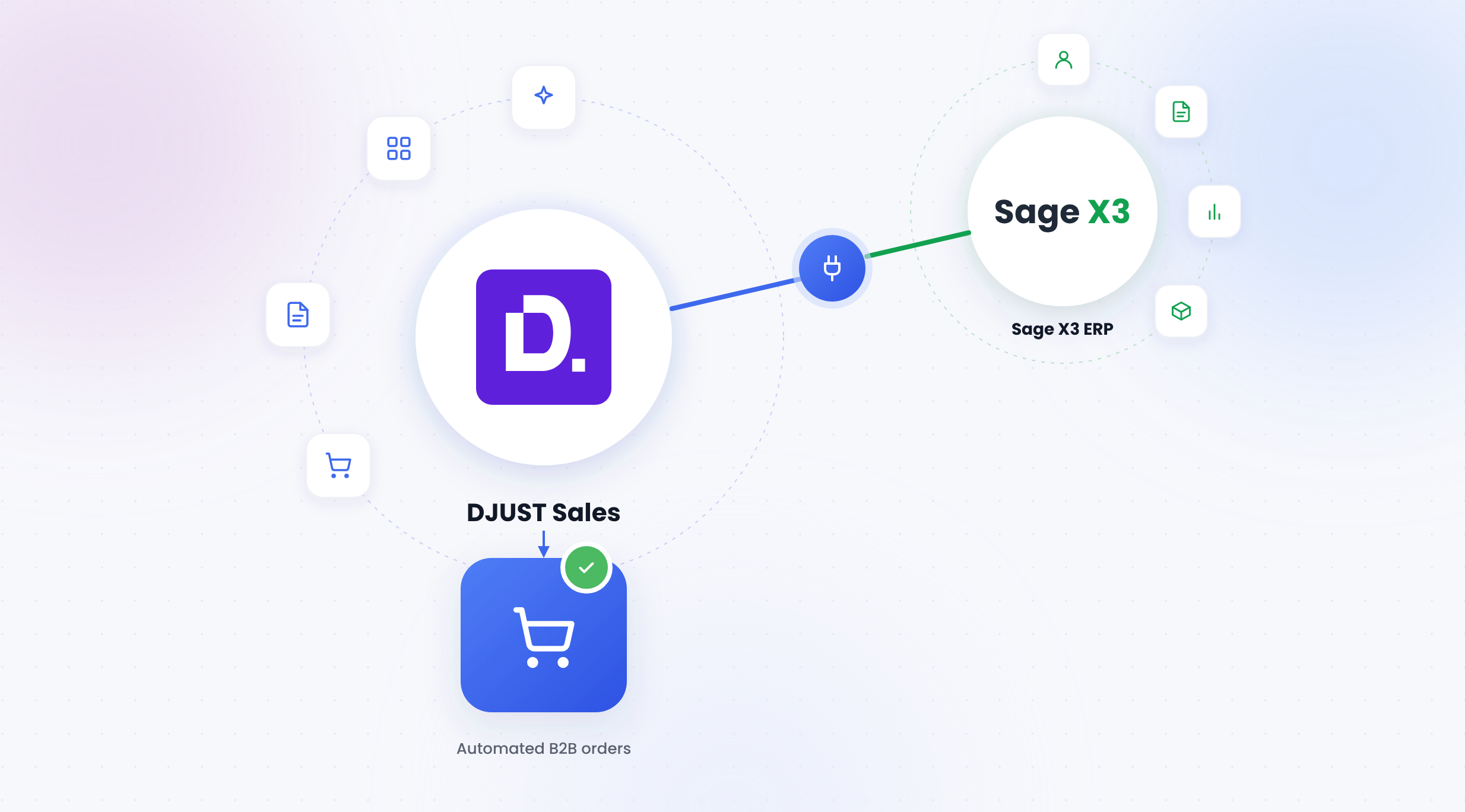
- Native ERP/CRM/OMS integration: Real-time synchronization of inventory, pricing, orders, and invoices between the portal and your existing systems makes the portal a single, back-office-connected entry point. You eliminate manual data entry and pricing discrepancies.
- Collaboration tools: Features such as shared document viewing, collaborative shopping carts, and communication channels are essential for keeping stakeholders at client companies on the same page.
- Real-time inventory management: Visibility into availability, stock-out alerts, and automatic updates prevents broken delivery promises.
- Order and delivery tracking: Enable customers to easily place, track, and manage orders. For example, in the manufacturing sector, a client should be able to log into the portal, view their personalized catalog, place a large order for various components, and then easily track the status of each item from preparation to shipment. This functionality must also integrate with your logistics partners to provide accurate location data, potential delays, and delivery confirmations.
- Incident management: Implement a system to report and resolve issues quickly. For example, if a pharmaceutical distributor receives a damaged shipment, they should be able to immediately report the issue within the portal, upload photos, and track the resolution process.
- Mobile accessibility: Choose a platform with a mobile version of the portal to put all the necessary details at your customer's fingertips.
- Reporting and analytics: Ensure the portal has analytics and reporting features that monitor key metrics such as order volume by quarter, order fulfillment patterns, product usage, and more.
DJUST offers B2B commerce solutions with client portals that integrate with any back-end system. You can configure personalized catalogs and pricing tailored to your customers' needs. They, in turn, control roles, permissions, and track their quotes and orders.
How is AI in B2B transforming client portals?
AI in B2B acts as an agent that queries the catalog, inventory, and pricing terms to prepare an order without manual entry. A prediction only truly adds value if it triggers a replenishment, an alert, or a recommendation.
AI impacts four key areas in a client portal:
- Automated order entry: The buyer states their needs, the AI consults the catalog, inventory, and pricing, then prepares the order without manual entry.
- Predictive replenishment: AI analyzes purchase history and suggests restocking before you run out. To learn more, discover our B2B AI agent dedicated to e-commerce automation.
- Anomaly detection: automated alerts for price discrepancies, unusual orders, and delivery delays. The order management powered by AI allows you to handle high volumes without compromising quality.
- Product recommendations:suggestions based on purchase history and the customer's catalog, integrated into the ordering journey.
These automations deliver results under three conditions: data quality, native integration with your ERP/OMS, and human governance to validate exceptions. The goal is to provide your teams with better signals for decision-making.
DJUST: the B2B customer portal that absorbs your business complexity

At the top of the list is our own headless e-commerce platform, DJUST. From easy account management to an omnichannel customer experience, our platform offers everything you need to set up a B2B store with self-service features.
We enable you to customize your catalogs and implement product recommendations for each customer. Your clients can manage their daily tasks anytime, from anywhere. Plus, you can demonstrate how much you value your customers' time with fast ordering and payment features.
Key features:
- Customized catalogs and pricing: For example, different colors of the same wall paint can have different prices. You can also apply a discount to colors that aren't selling well to clear your stock.
- Automated processes: From order initiation to invoice generation and order approval, you can automate everything with DJUST. Suppose one of your customers places an order. They will first receive an initiation request, then they will need to approve their order, and finally, receive an invoice. All of this will happen without manual intervention.
- Omnichannel customer experience: With DJUST, customers can start their journey in-store, continue browsing on their tablet at home, and finalize their purchase on a computer, all while keeping their data and order information synchronized across all platforms.
- Live order tracking: From packaging to delivery, your customers will be able to check the status of their orders, even from their phones.
- API Integrations: Over 100 API integrations with your PIM (Product Information Management), CRM (Customer Relationship Management), ERP (Enterprise Resource Planning), and other sales and back-end tools. Customize your platform with as many modifications as you like; DJUST makes them easy to integrate. This B2B platform, which can be deployed in under 4 weeks, integrates natively with your existing ecosystem.
Benefits:
- Simplifies complex B2B transactions with end-to-end user automation.
- Streamlines incident management by allowing customers to independently report issues with orders or items from a dedicated portal.
- Centralizes customer accounts, improving order visibility and driving sales growth.
- Features like live tracking and order modifications make life easier for your customers, boosting satisfaction and loyalty.
Pricing: Contact our team to book a demo and receive a personalized quote based on your needs.
What other B2B customer portal platforms should you consider?
Several customer portal platforms stand out depending on company size and the complexity of the workflows to be integrated. Here are four of the best examples of B2B customer portals to consider, beyond DJUST:
1. Copilot

Second on our list of the best B2B customer portal software is Copilot. It offers advanced permission controls, invoice generation, file sharing, contract and form management, and more.
Key features:
- Built-in messaging app and invoicing app
- Dedicated collaborative sections for files and contracts
- Integration with Zapier and Make
Benefits:
- User-friendly interface
- Zapier and Make automation improves workflow efficiency
- Affordable for small B2B businesses
Drawbacks:
- Separate apps for each feature can become confusing
- The features aren’t as advanced as some alternatives
Pricing:
| Starter | Professional | Advanced |
|---|---|---|
| $29/month | $69/month | $119/month |
3. Salesforce Commerce Cloud

Another impressive customer management platform with a B2B customer portal is Salesforce Commerce Cloud.
Suitable for both SMBs and enterprises, this Salesforce customer portal tool lets you launch your digital storefront in just a few steps and automate sales across the customer lifecycle.
Key features:
- Ready-to-use site design
- Merchandising tools
- Einstein Product Recommendations
- Customizable network of more than 8,000 partner apps
Benefits:
- Progressive web app technology supports faster load times and a smoother browsing experience.
- Extensive API integrations make it easy to manage large-scale events such as flash sales and Cyber Week.
Drawbacks:
- Not user-friendly for beginners
- Enterprise-level pricing
Pricing: You can contact their sales team for a custom quote.
4. Moxo

Finally, we have Moxo, which gives you a clear view of every project, contract, and order with its full-featured B2B customer portal.
Key features:
- Automated onboarding
- Content personalization
- Playbook templates
- Integration with tools like HubSpot, Slack, and Zoom
Benefits:
- User-friendly for beginners
- Extensive integrations make collaboration easier
Drawbacks:
- Limited customization
Pricing: Moxo offers one subscription plan for workflows and another for customer portals. Contact their sales team for a custom quote.
| Platform | Key features | ERP/OMS integration | Pricing customization | AI | Target audience |
|---|---|---|---|---|---|
| DJUST | Custom catalog, omnichannel, live tracking | Native (100+ APIs) | By customer, by product variant | B2B AI Agent | B2B Company, Large enterprises, manufacturing, distribution |
| Copilot | Messaging, invoicing, file sharing | Zapier, Make | Limited | Not native | Small B2B businesses |
| Salesforce | Merchandising, PWA, partner applications | Extensive APIs | Standard | Einstein Recommendations | Established businesses |
| Moxo | Onboarding, playbooks, project management | HubSpot, Slack, Zoom | Limited | Not native | B2B project teams |
How to successfully deploy your custom B2B customer portal?
Developing a custom customer portal involves five steps to transform identified friction points into automated, measurable processes. Automate your B2B orders to increase efficiency.
- Map existing workflows: inventory current orders, pricing, stock, and approval processes to identify friction points to eliminate, such as manual data entry or fragmented pricing.
- Define the functional scope: personalized catalog, approval workflows, ERP integration/OMS, incident management.
- Check compatibility with existing systems: ERP, CRM, PIM, OMS, and available APIs. A custom portal doesn't replace your tools; it connects to them.
- Plan for team adoption: training, change management, and a pilot phase with a representative group of customers.
- Measure the gains: time saved on data entry, conversion rates, customer satisfaction, and the number of transactions per customer.
Budget: compare platforms based on the features you actually need, order volume, and the number of active customers. The cost of a customer portal solution depends less on the sticker price than on how well the capabilities align with the complexity of your business workflows.
FAQ
Can a B2B customer portal handle complex pricing structures?
Yes: the portal displays prices negotiated by customer, segment, and volume, including specific discounts and terms. Synchronization with the ERP ensures that pricing remains up to date without manual intervention.

How long does it take to deploy a custom customer portal?
This depends on the complexity of your catalog, the number of customers, the required integrations, and the approval workflows. A platform like DJUST allows for deployment in under 4 weeks for standard configurations. Multi-country or multi-entity projects require a longer integration phase.
Is a B2B customer portal suitable for both SMEs and large accounts?
SMEs benefit from customer self-service and reduced administrative tasks. Large accounts leverage validation workflows, multi-entity catalogs, and ERP/OMS integration. The choice of platform depends on volume, the number of customers, and existing systems.
Is B2B AI essential for a customer portal?
AI automates order entry, predictive restocking, and anomaly detection. It becomes relevant when order volumes and pricing complexity make manual processing costly. Data quality and integration with your ERP/OMS are essential prerequisites.
What is the difference between a B2B client portal and a B2B e-commerce site?
The client portal is a private space, personalized for each client (pricing, catalog, history) and connected to back-office systems. The B2B e-commerce site is a public storefront with a generic catalog. Both can coexist: the site attracts new business, while the portal builds loyalty and automates recurring transactions.


.png)

.jpg)