The 4 Key B2B E-Commerce Features in 2024
SaaS marketplaces can help you grow your B2B sales and streamline your operations. Here, we highlight the 4 best B2B SaaS marketplace providers in 2024.

Short on time? Here’s what matters most
To stay competitive in 2024, B2B companies need robust, customized, omnichannel e-commerce platforms that meet the rising expectations of professional buyers.
Here are the key takeaways from our analysis of the essential B2B e-commerce features in 2024:
- personalized buying experiences : tailor products, pricing, and payment terms to each customer’s specific needs.
- accurate, detailed information : provide high-quality images and complete product data for every item.
- simplified decision-making : deliver intuitive navigation, optimized search, and fast ordering for repeat purchases.
- omnichannel buying experiences : ensure real-time sync, multiple portals, and device flexibility.
The state of B2B e-commerce in 2024
B2B e-commerce continues to grow exponentially, now representing more than €20 trillion in volume — five times more than B2C, according to a Statista study. In addition, a Gartner study found that 80% of professional buyers expect all interactions to happen through digital channels by 2025. In line with this trend, 75% of B2B buyers prefer sales experiences without sales reps.
To capitalize on this shift, companies need to integrate key features that meet the specific needs of B2B buyers and deliver a seamless, personalized buying experience.
4 essential features for B2B e-commerce
1. Personalize the buying experience
Personalization is critical for professional buyers. They expect to find the pricing and payment terms negotiated upfront on the e-commerce platform.
For example, a company like DeSter, a manufacturer of packaging and containers, customizes its products and pricing for each airline or restaurant it works with, delivering a tailored buying experience. Air France and KLM, although part of the same parent company, have different product and pricing needs, and DeSter takes that into account.
To deliver a personalized buying experience, several elements can be considered, such as a customer portal, a product catalog, and tailored pricing.
Here are a few examples of personalization:
- custom products : products should be adapted to each customer’s specific needs. For example, airlines may have different requirements for the same types of products.
- preferred pricing : negotiated pricing terms should be reflected on the platform to encourage buyers to use the online service. A large franchised supermarket chain such as Franprix can display special offers negotiated directly with suppliers for certain food products on its platform. These discounted prices are clearly visible online, encouraging customers to place orders through the chain’s platform to get the best possible savings.
- payment terms : negotiated payment methods should also be available online to make transactions easier. If a customer wants to pay by SEPA bank transfer, the required details for this type of payment (IBAN, BIC, etc.) should be clearly displayed.
This personalized buying experience is designed to improve customer satisfaction and build loyalty. Understanding the customer’s expectations and needs is therefore essential, especially when they are used to manual purchasing processes.
2. Display accurate, detailed information
Professional buyers need all the information they need to place an order independently. That includes high-quality images, as well as complete technical and environmental data. For example, for a complex product like a heat pump, all features and compatibility details must be clearly stated to avoid disappointment and improve conversion rates.
Yack, a specialist in the manufacturing and import of air-conditioning equipment, makes sure installers have all the information they need for a correct installation, which is critical to customer satisfaction.
To do this, integrating a PIM (Product Information Management) system to create detailed product pages is essential. These pages should include, among other things:
- high-quality images : images should be clear and detailed so buyers can visualize the product and know what to expect when it arrives.
- technical documentation : technical specifications, installation manuals, and compatibility sheets should be easy to access.
- environmental information : more and more customers care about environmental impact, and this information should be available. As part of its environmental commitment, Eiffage, a construction giant, is launching a sustainable e-commerce project through its new BlueOn platform, aimed at improving transparency around carbon emissions while presenting a compelling commercial proposition in terms of profitability.
By taking these elements into account and implementing them, the goal is to improve customer conversion rates while reducing support requests for the team.
3. Simplify decision-making
Professional buyers, often working under tight deadlines, need intuitive navigation and a powerful search engine. Fast ordering is also essential for repeat purchases.
For example, a clothing retailer enables its sales reps to place orders quickly for their customers, making the buying process easier.
Here are a few examples of how to simplify decision-making:
- intuitive navigation : products should be well categorized for easy, intuitive searching. An e-commerce site for mass retail should ideally organize products into clear, detailed categories such as "Fruits and Vegetables," "Dairy Products," and "Cleaning Products." This helps buyers find what they need easily without getting lost in a sea of uncategorized products.
- optimized search : buyers should be able to quickly find products by entering references or keywords. A wholesale clothing brand can set up an advanced search bar where customers can quickly find products by entering specific references, styles, or keywords like "denim skirt" or "striped sweater."
- fast ordering : for repeat purchases, placing orders in just a few clicks is essential. An online sales platform for food packaging supplies, like deSter, offers a "Buy Again" feature for regular customers. This option lets users reorder frequently purchased items in just a few clicks, making the ordering process fast and efficient.
To increase average order value and reduce errors as well as ordering time, simplifying the buying decision is an essential feature for any B2B e-commerce platform.
4. Offer an omnichannel buying experience
A unified customer experience across channels is essential. Buyers need to be able to start their purchasing journey on one channel and finish it on another without interruption. For example, a major sustainable footwear manufacturer uses two separate portals for end customers and sales reps, enabling smooth quote and order management. Sales reps can create quotes in the field, which customers can then approve and pay online.
In B2B e-commerce, it is crucial to offer customers an omnichannel buying experience, which requires a reliable order management system (OMS) and a simplified payment process. This makes it possible to:
- real-time sync. Information must be updated in real time across all channels. An automotive parts supplier updates stock levels and pricing in real time on its website and mobile app. This allows customers to see part availability instantly and avoid stockouts, ensuring a smoother, more reliable buying experience.
- multiple portals. Different portals for different user types (end customers, sales reps) enable more tailored management. A furniture brand creates separate portals for its different national markets and user types: one portal for customers based in France and another for those in Germany, for example. By adapting its portals to each country and user type, the brand ensures a smooth, efficient user experience that meets the specific needs of each segment of its global market.
- connected buying channels. Buyers must be able to use different channels (mobile, desktop) without losing information. A construction company offers an online purchasing platform accessible from any device. Customers can start an order on their office computer, then complete it on their smartphone in the field, without losing any information or having to start over.
An effective omnichannel buying experience leads to higher customer satisfaction and more efficient order management.
To deliver a successful omnichannel experience, it is essential to integrate the right technologies and ensure perfect synchronization of information across all the channels customers use.
Adopt technologies built for B2B requirements
1. A technology architecture that fits
It is crucial to have a headless architecture that consolidates data from multiple sources (ERP, CRM, etc.) and makes it accessible across different channels (mobile, desktop, etc.). This approach enables smooth, real-time communication of customer information.
An omnichannel approach should translate into:
- a headless architecture that consolidates data from different sources.
- APIs that make integration with other systems and applications easier.
- real-time communication to ensure information is always up to date.
2. B2B-specific solutions
Solutions need to be designed for B2B, with features tailored to the needs of professional buyers, such as customer-specific pricing and personalized catalogs. Generic solutions often fall short when it comes to performance and complexity. For example, some solutions have added B2B features to their platform, but they still remain limited compared with the complex needs of businesses.
Here are a few examples showing why B2C solutions are not a fit, because they often lack B2B-specific features such as:
- customer-specific pricing to define pricing for each customer.
- customized catalogs with available products that can vary by customer.
- performance and scalability to handle complex, high-volume orders.
3. Scalability and modularity
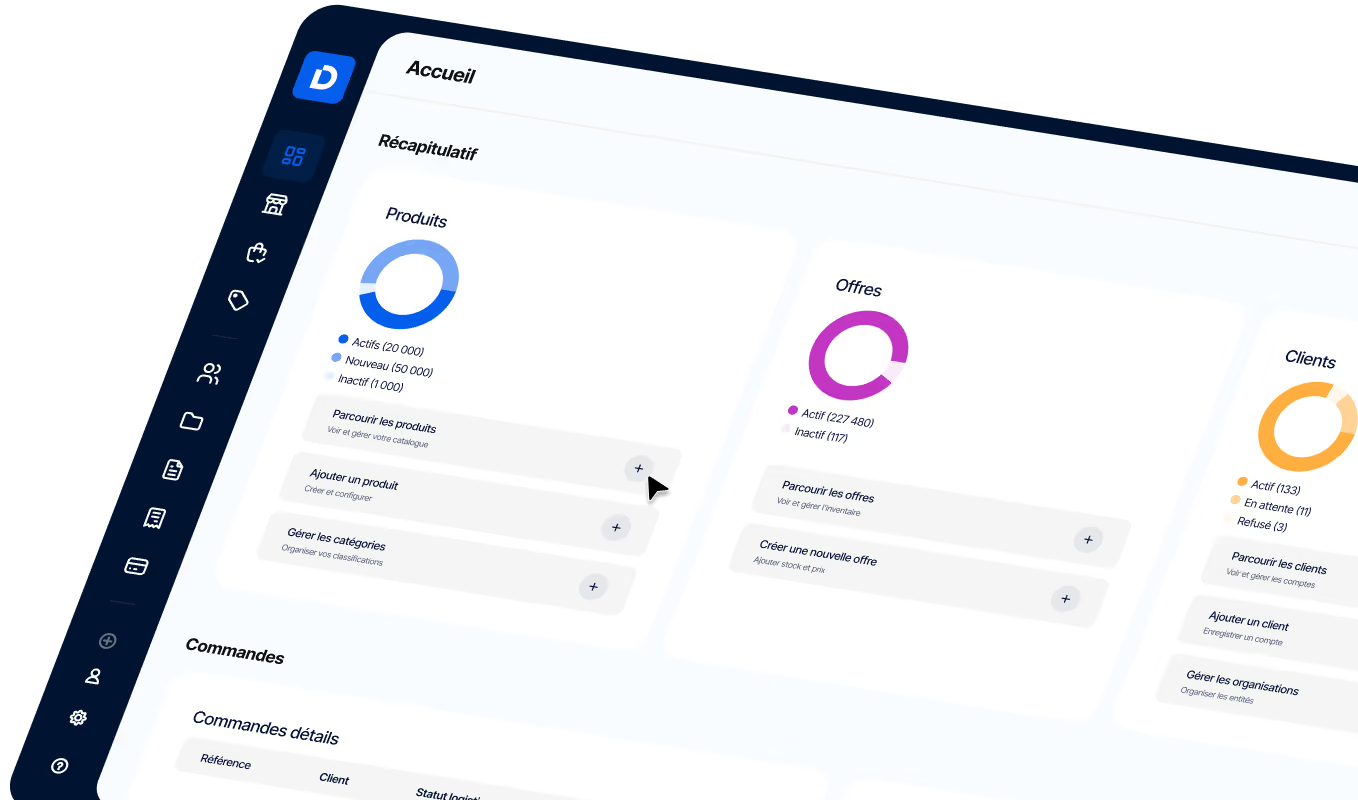
B2B e-commerce platforms must be modular and scalable to keep pace with constant changes in the market and technology. A SaaS architecture gives you access to the latest technological advances while providing the flexibility needed to integrate specific modules. DJUST offers a modular platform that lets companies keep certain strategic modules in-house while benefiting from a flexible digital backbone.
The key points to ensure this scalability:
- a modular architecture that makes it possible to add or remove modules based on your needs.
- a SaaS environment that ensures the platform benefits from the latest technological innovations.
- flexibility: to customize the platform based on the company’s specific needs.
Why choose DJUST?
DJUST is a unified B2B commerce platform used by more than forty customers, including Socoda, Auchan, and Bouygues, and supported by around twenty global integration partners such as e2y, Smartshift, and Clever Age.
DJUST offers a 100% B2B solution, automatic platform updates, fast deployment, and flexible, modular technology:
- dedicated B2B features. All the native B2B capabilities built into the solution, with a roadmap focused 100% on B2B.
- SaaS solution. DJUST is a ready-to-use B2B solution that is hosted, maintained, and secured.
- fast deployment (an average project time of just 4 months). Projects are delivered quickly with a ready-to-use back office and a front-end template.
- scalable platform. DJUST stays by your side to ensure project success, during and after implementation. The flexibility of our solution creates future growth opportunities thanks to its modularity and its ability to connect with other tools and support additional use cases.
In conclusion
In 2024, B2B e-commerce demands high-performing, flexible SaaS platforms that help accelerate business growth and unlock new market opportunities at a lower cost. It is crucial to invest in technologies that meet the rising expectations of professional buyers, especially by improving the user experience to give them greater autonomy when placing orders, bringing the online experience in line with B2C standards. This approach is essential for building loyalty in a highly competitive environment where needs are constantly evolving, especially with the arrival of younger generations in the professional market.



.jpeg)