Next-Gen B2B: Digitize and Take Control of Your Sales
What Is a B2B Platform? Models, Features, Benefits, and Deployment Approach. Discover how to digitize your sales.
Article summary
- A B2B platform is a digital tool that centralizes product catalogs, pricing, customer accounts, and order flows between businesses.
- There are five main models: brochure site, catalog + lead generation, B2B e-commerce, replenishment, and marketplace.
- The essential building blocks are personalized pricing, customer account management, approval workflows, B2B payments, and ERP/CRM integration.
- Companies that use them cut order processing time by up to 60% and improve pricing consistency.
- The B2B platforms of tomorrow will be AI-native: easier to design, with AI-guided buying journeys.

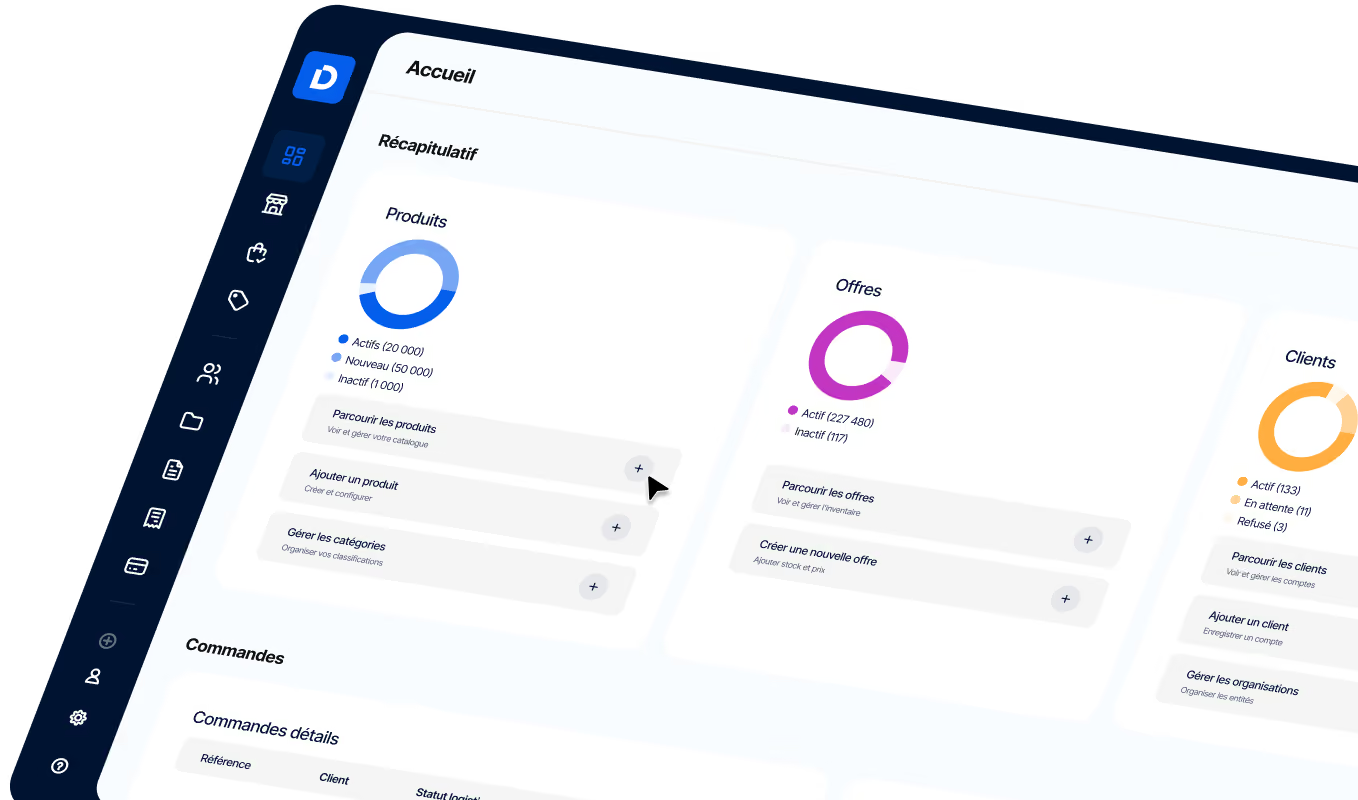
A B2B platform is a digital tool that enables companies to sell, buy, and manage commercial transactions with other businesses through a centralized online environment. It connects product offerings, pricing terms, customer accounts, and order flows in a single interface, accessible 24/7.
The term “B2B platform” may sound straightforward, but it actually covers very different realities. Depending on the business, it can refer to a simple showcase website, a lead generation tool, an online ordering platform, or even a multi-vendor marketplace. This variety reflects the complexity of B2B models, the diversity of sales cycles, and the uneven level of digital maturity across organizations.
Where taking orders by phone, email, or Excel files reaches its limits, a B2B platform industrializes and secures the sales process. This guide breaks down the different models available, the must-have features, the measurable benefits, and the method for choosing the solution best suited to your business. For a complete view of the end-to-end B2B sales process, this article is the right starting point.
What is a B2B platform, and why deploy one?
In its simplest form, a B2B platform is an online software solution that connects businesses and makes commercial transactions easier. Unlike B2C tools built for consumers, it includes specific capabilities: customer accounts with roles and permissions, contract pricing and tiered price lists by segment, recurring orders, internal approval workflows, and multi-entity management (subsidiaries, branches, buyers). These requirements make a simple consumer-style online store insufficient for business-to-business commerce.
The main goal of a B2B platform is to standardize sales processes to improve productivity, protect margins, and give business customers the autonomy they now expect: 24/7 availability, accessible order history, and replenishment in just a few clicks. For companies still handling sales by email or phone, moving to a digital platform is a major digital transformation lever, with a direct impact on the sales cycle and customer satisfaction.
Definition and role of a B2B platform
In practical terms, a B2B platform brings together four core pillars: the product catalog (SKUs, product sheets, technical documents), commercial terms (customer-specific pricing, volume discounts, promotions), customer account management (rights, roles, legal entities), and the order flow (cart, approval, payment, invoicing). It differs from a simple showcase website by adding a transactional layer or, at minimum, advanced lead qualification. Take this example: a building materials distributor managing 3,000 SKUs with different prices for each customer. Without a platform, every quote requires back-and-forth with the sales operations team. With a B2B platform, the customer logs in, finds their negotiated terms, and places an order independently.
5 B2B platform models explained
Unlike B2C, where the platform is almost always tied to the act of buying online, B2B is defined by a wide range of models. There are two broad groups: non-transactional platforms, focused on relationships and pre-sales, and transactional platforms, which digitize all or part of the buying process. Here are the 5 maturity levels:
| Model | Type | Main use | Limitations |
|---|---|---|---|
| B2B showcase website | Non-transactional | Online presence, credibility, contact generation | No scalability, limited actionable data |
| Catalog + leads | Non-transactional | Product sheets, quote requests, sales qualification | Depends on human intervention to close |
| B2B e-commerce | Transactional | Self-service ordering, custom pricing, recurring purchases | Requires organizational and technical maturity |
| Replenishment | Transactional (supply chain) | Restocking for networks, franchisees, and stores (e.g., Franprix, Jeff de Bruges) | B2B2C logic, strong logistics constraints |
| B2B marketplace | Transactional (ecosystem) | Multi-vendor, network effects, broader offer | Governance, quality, value sharing |
So there isn’t just one B2B platform, but several platform types, each serving different goals and use cases. This maturity-based view also opens up a path for evolution: a B2B platform is not fixed and can gradually expand, add new use cases, or even change role over time.
🎯Assess your B2B digital maturity
| Criterion | Score /5 | Comment |
|---|---|---|
| Digital order capture | 100% manual / partial / automated | |
| Centralized product catalog | Scattered files / PIM / integrated into the platform | |
| Structured B2B pricing | Fixed prices / segment-based price lists / dynamic | |
| ERP/CRM integration | None / CSV export / real-time API | |
| Customer self-service online | None / view only / order + tracking |
Score ≤ 10: prioritize a catalog + leads model. Score 11-18: B2B e-commerce. Score ≥ 19: unified platform or marketplace.
How does a B2B platform work?
A B2B platform architecture is built on a set of interconnected functional blocks. Each one covers a step in the sales journey, from catalog presentation to payment and after-sales service. The strength of the solution depends on its ability to orchestrate these blocks seamlessly while integrating with existing IT infrastructure (ERP, CRM, PIM, WMS). A common mistake is choosing a solution that handles the front end well but ignores back-office processes. The result: online orders are then manually re-entered into the ERP, wiping out any productivity gains. End-to-end B2B order management is the ultimate test of a truly operational platform.
The essential functional building blocks
Eight building blocks form the foundation of a complete B2B platform.
- The catalog (product management, technical sheets, packaging) powers everything.
- B2B customer accounts manage roles (buyer, approver, administrator), legal entities, and access rights.
- B2B pricing applies contract pricing, volume discounts, promotions, and special terms.
- The cart and order flow handle minimum order quantities (MOQs), sales units, and packaging rules.
- Approval workflows let you configure approval chains (spending limits, hierarchical approval).
- The B2B payment module supports payment terms, deposits, SEPA bank transfers, and credit cards.
- Customer service (after-sales support, returns, disputes) and analytics (revenue, average order value, conversion rate, repeat purchase rate) round out the setup.
Concrete example: an industrial supplies company configures its workflow so that any order above €5,000 triggers approval from the customer’s purchasing manager directly on the platform — no email exchange needed.
Key integrations: ERP, CRM, OMS, payment
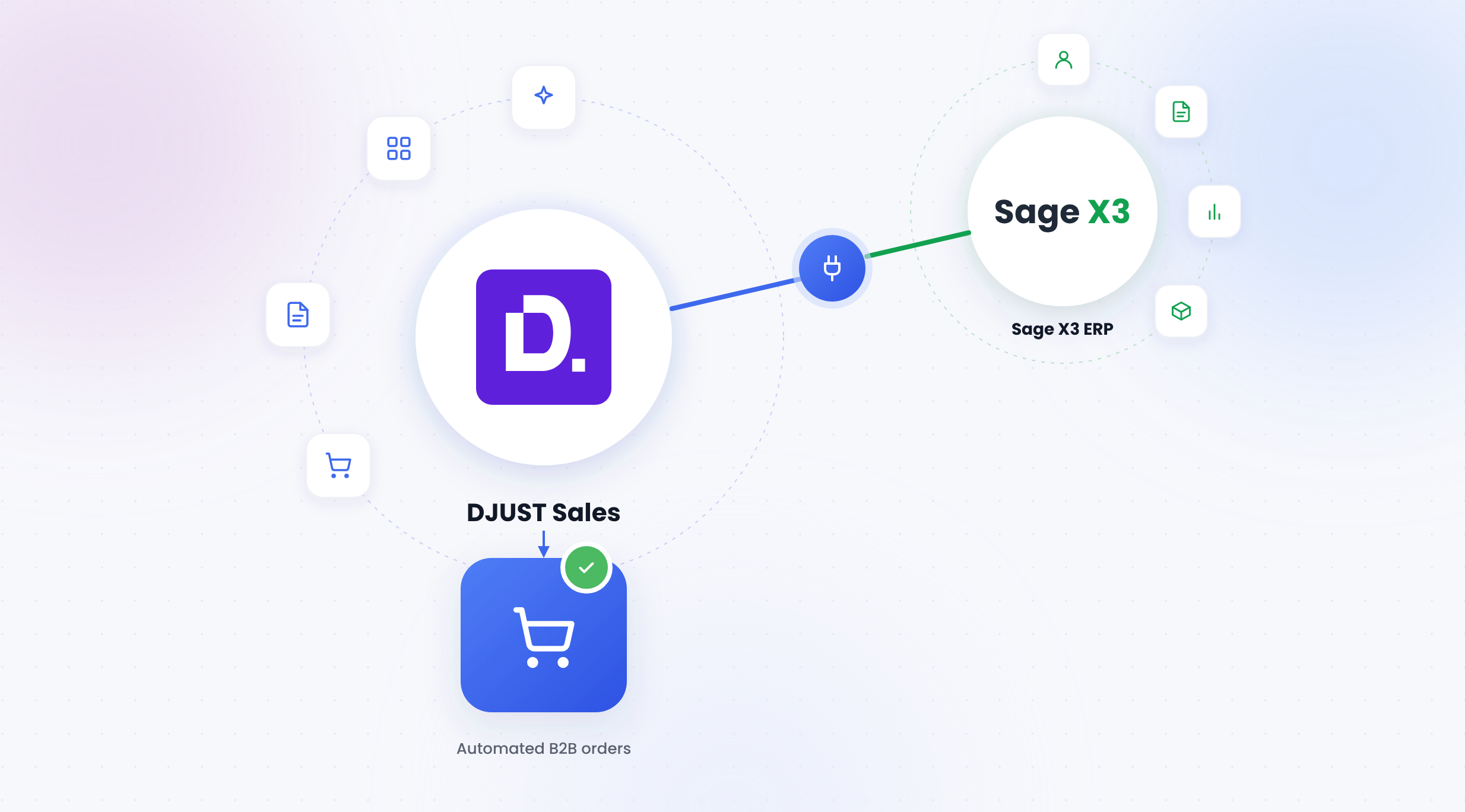
The value of a B2B platform also depends on how well it integrates with the IT stack. The ERP (SAP, Sage, Cegid…) provides inventory data and reference pricing, and receives approved orders. The CRM (Salesforce, HubSpot…) syncs customer accounts, interaction history, and sales opportunities. The OMS/WMS manages picking and delivery. Payment and invoicing tools (B2B payment solution, Stripe, Adyen) automate collections and accounting reconciliation. Finally, customer support (ticketing, chat, help center) is integrated to provide full visibility. Before any rollout, mapping the data flows between the platform and each third-party tool is essential to avoid duplicates and stock issues.
🔧 Integration mapping
| System | Incoming data | Outgoing data | Sync mode |
|---|---|---|---|
| ERP | Inventory, pricing, customers | Approved orders | Real-time API / daily batch |
| CRM | Accounts, contacts | Order history | Webhook / API |
| OMS / WMS | Delivery statuses | Orders to prepare | Real-time API |
| Payment | Confirmations, reconciliation | Invoices, due dates | API / secure SFTP |
6 measurable benefits of a B2B platform
Deploying a B2B platform is no small technology project. To justify the investment to leadership, you need to measure the results. Here are the 6 benefits most often seen by companies that have made the move, illustrated with concrete metrics. The most advanced B2B e-commerce features solutions can unlock these gains within the first few months.
Time savings and fewer errors
Digitizing order capture eliminates manual re-entry, the main source of errors in B2B (pricing, SKUs, quantities, delivery addresses). Sales teams save an average of 40% to 60% of the time spent on administrative order processing, time that can be redirected toward prospecting and high-value customer relationships. For a team of 10 sales reps, that represents several hundred hours per month redistributed. Automating order approval workflows also removes bottlenecks: no more orders stuck waiting for an internal confirmation email.
A better customer experience and stronger loyalty
Business buyers now expect the same level of ease they get in their personal purchases: 24/7 self-service access, viewable order history, one-click replenishment, and real-time delivery tracking. A well-designed B2B platform meets these expectations and reduces the burden on the sales team. AI applied to the customer experience goes further by personalizing product recommendations and anticipating replenishment needs. The result: repeat purchase rates increase by 15% to 25% for companies offering a complete digital B2B customer journey.
Sales visibility and scalability
Centralizing data in a single platform gives you real-time visibility into the sales pipeline: most-ordered products, active and inactive accounts, average order value by segment, and quote-to-order conversion rates. This sales intelligence helps you refine the offer, identify customers at risk of churn, and spot cross-sell opportunities. In terms of scalability, a B2B platform is the only lever that lets you open new countries, connect new sales channels (distributors, marketplaces, stores), or onboard new partners without multiplying headcount. B2B e-commerce trends confirm this shift toward multi-channel, multi-country platforms.
📊 KPI: measuring platform impact
| KPI | Before | After | 12-month target |
|---|---|---|---|
| Order processing time | 45 min | 12 min | -60 % |
| Pricing error rate | 8 % | 0,5 % | <1 % |
| Customer adoption rate | 0 % | 65 % | >70 % |
| Average order value | €1,200 | €1,450 | +20 % |
| Repeat purchase rate | 52 % | 68 % | >65 % |
| Deployment time | n/a | 4 months | <6 months |
Choosing the right B2B platform model: the decision framework
Choosing a B2B platform doesn’t start with a feature comparison. It starts with a clear diagnosis of the current situation:
- What volume of orders is still handled manually?
- How many catalog items does the company manage?
- How complex are the pricing terms?
- How many sales channels are active?
This diagnosis helps identify the target model (see the 5-level table above) and assess the gap between current maturity and ambition. A common mistake is aiming straight for a B2B marketplace when internal processes (catalog management, pricing rules, ERP integration) are not yet stable.
It’s better to secure the foundations with a B2B e-commerce platform, then gradually open it to third-party sellers.
Comparison by digital maturity
The table below summarizes typical use cases based on company profile. A manufacturer selling directly with 200 SKUs doesn’t have the same needs as a multi-site distributor with 50,000 SKUs and 15 price lists. The question which B2B e-commerce platform to choose comes up again and again among B2B decision-makers. The answer always depends on the combination of maturity and complexity.
| Company profile | Recommended model | Functional priority | Estimated timeline |
|---|---|---|---|
| SMB, <500 SKUs, direct sales | B2B e-commerce | Catalog, pricing, ordering | 2-4 months |
| Mid-sized company, multi-site, franchise network | Replenishment | Restocking, logistics, multi-entity accounts | 3-5 months |
| Large enterprise, partner ecosystem | B2B marketplace | Seller onboarding, third-party payments, governance | 6-12 months |
| Multi-channel, multi-country, high maturity | Unified platform | Commerce + operations + AI + payments | 4-8 months |
4 criteria for evaluating a solution
1. Native B2B functional coverage. Does the solution natively handle multi-entity accounts, contract pricing, MOQs, and approval workflows? A platform built for B2C with a B2B layer added on top creates technical debt. Test it with a real use case: configure a customer with 3 entities, 2 price lists, and a 2-level approval chain.
2. Integration capability. Number of available ERP and CRM connectors, quality of API documentation, and real-time sync options. Ask for an integration POC with the main ERP before committing.
3. Modularity and scalability. Can the platform activate new building blocks (payment, marketplace, replenishment) without a rebuild? Headless and modular logic ensures that flexibility.
4. Time to value. What is the real delay between signature and the first online order? B2B-native SaaS solutions typically deliver in 2 to 4 months, compared with 8 to 18 months for legacy on-premise platforms. Require a detailed rollout plan with measurable milestones.
Why tomorrow’s B2B platforms won’t look like e-commerce anymore
Future B2B platforms will above all be faster and easier to implement, especially thanks to AI. Where traditional B2B e-commerce platforms require highly structured data models, complex rules, and perfectly normalized catalogs, AI makes it possible to work with more heterogeneous and less rigid data. Value no longer depends only on structure, but on the ability to interpret, enrich, and contextualize information. For companies investing in their B2B eCommerce, this changes the game: implementation cost and complexity drop significantly.
AI is reshaping buying journeys
On the buyer side, usage is changing dramatically. Tomorrow’s B2B journeys will be simpler, more direct, and less dependent on traditional catalog and menu navigation. Conversational search, contextual recommendations, and AI-assisted or AI-guided ordering will gradually replace classic browsing logic. The goal is no longer to explore, but to move fast, get guidance, and reduce cognitive effort. AI is becoming a true buying assistant, able to guide decisions, secure choices, and streamline ordering. B2B artificial intelligence modules are already changing the way professionals interact with platforms.
Toward a unified digital foundation: e-commerce, CRM, and AI
These shifts reinforce a broader trend: the convergence of B2B e-commerce, CRM, and AI within a shared digital foundation. Future platforms won’t be designed by channel anymore, but as a single core capable of supporting multiple sales modes — online, offline, assisted, automated — all brought together at the same level. AI will play a key role in this convergence, especially by turning offline orders (email, phone, PDF, Excel) into digital orders that can be used, tracked, and analyzed.
Tomorrow’s B2B platforms won’t just be digital tools, but true intelligent systems, able to adapt to usage patterns, organizations, and sales channels. AI doesn’t add another layer of complexity; it removes one. In the long run, the very notion of a channel could disappear. Orders, quotes, replenishment, and recommendations won’t depend on a specific entry point anymore, but on a unified digital foundation capable of orchestrating every commercial interaction. That’s the direction outlined by the latest B2B eCommerce trends.
✅ Checklist: is your platform ready for the AI era?
| Headless / API-first architecture | Enables AI modules to be integrated without rebuilding the front end |
|---|---|
| Structured, centralized product data | Powers recommendations and conversational search |
| Usable order history | Training base for replenishment predictions |
| Enriched customer accounts (behavior, preferences) | Real-time journey personalization |
| Operational ERP/CRM connectors | Data → AI → sales action feedback loop |
FAQ
What Is a B2B E-Commerce Platform For?
It gives business customers a way to browse the catalog, access their negotiated terms, and place orders independently, 24/7. It reduces manual work for sales teams — re-entering data, follow-ups, and checks — while improving the customer experience. The goal is to speed up the sales cycle, protect margins, and free up sales time for higher-value work.

-modified.avif)

.png)
.jpg)