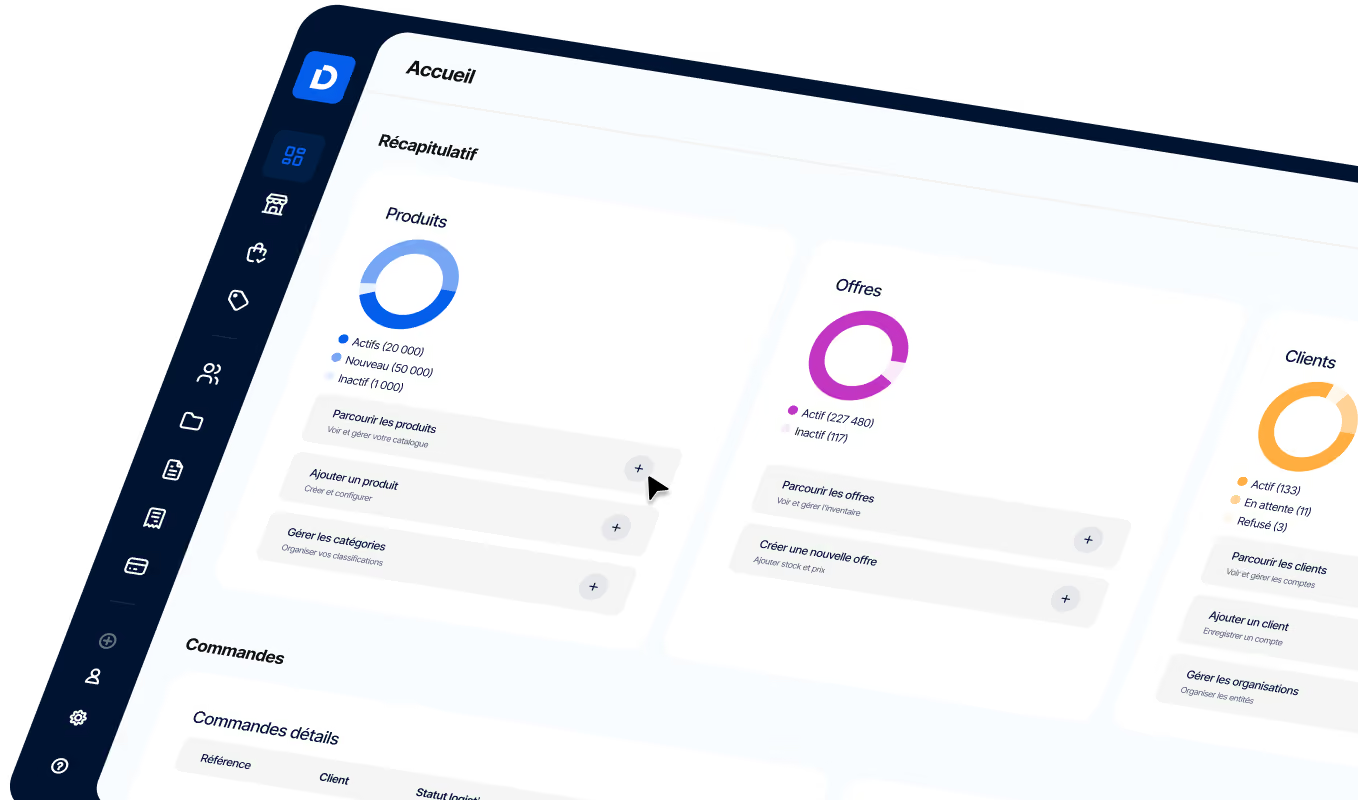
4 Best B2B Marketplace SaaS Providers in 2024
SaaS marketplaces can help grow your B2B sales and streamline your operations. Here are the 4 best B2B SaaS marketplace providers in 2024.

SaaS marketplace providers don’t just give you software to sell your products. They also act as strategic partners, helping you grow your B2B sales and unlock your company’s operational capabilities.
Investing in a B2B SaaS marketplace is an even bigger decision. That’s why it’s essential to choose a provider that truly fits your business needs and can scale with you over time.
At DJUST, we know exactly what to look for in a B2B SaaS marketplace provider, which questions to ask potential vendors, and the best options to consider in 2024. This guide covers all of that and more.
Ready to get started? Let’s go!
Why choose a SaaS provider instead of an on-premise provider?
SaaS marketplaces offer several major advantages over on-premise marketplaces, for three key reasons:
They simplify integration and management
SaaS marketplace providers offer prebuilt connectors and APIs to make it easier to integrate with your existing software systems, such as ERP or PIM software. With on-premise systems, you’re much more likely to need custom integrations, which is a time-consuming and expensive process.
Another advantage of SaaS platforms is that they run in the cloud, which means your employees can access essential tools and features from anywhere, on any device. That’s often not possible with on-premise systems, which usually require employees to be in the office and connected to the company network. Worse still, if an employee’s device is lost or stolen, they lose access to everything on it.
They are cost-effective and scalable
SaaS marketplaces are more cost-effective than on-premise marketplaces because they eliminate upfront infrastructure investments and maintenance costs. You can reduce IT overhead and plan for predictable subscription pricing.
Plus, without having to invest in on-premise IT infrastructure, you can easily scale your B2B SaaS marketplace as your business grows. Your software provider handles the capital costs of new servers needed to manage more traffic or data. If you need additional features, your SaaS provider can roll them out as updates to your existing platform.
By contrast, with an on-premise system, scaling would require additional — and very costly — investments in new servers and other IT equipment. If you need new software features, you’ll have to build them yourself or move to a completely new version of your existing software.
They require no maintenance
Finally, SaaS marketplace providers automatically handle product updates, patches, and maintenance, so you don’t have to. On-premise platforms, on the other hand, require you to invest in dedicated IT staff to keep your marketplace up to date.
The lack of maintenance is crucial because it means SaaS marketplaces always have access to the latest features and security improvements. They’re also less prone to downtime. That lets you focus on growing your business instead of maintaining your software.
Expert tip : You might think building a custom marketplace is the right move if your needs are truly complex. While that does allow for full customization, it’s a massive and expensive commitment that will require a lot of maintenance once it’s live. You’ll also need to stay on top of the latest technical and security updates, which adds more effort and cost.
The 4 best SaaS marketplace providers in 2024
Now that you know more about the benefits of SaaS marketplaces, let’s take a closer look at the four best B2B SaaS marketplace providers your business can start using today.
Expert tip: Watch out for what we call “fake SaaS.” Some companies (we won’t name names 😉) call themselves SaaS providers when they’re really just cloud-based solutions. Many of these solutions are simply on-premise platforms that have been moved to the cloud, but aren’t true SaaS.
DJUST x Mirakl
DJUST and Mirakl have partnered to create one of the most unique and scalable B2B marketplace solutions available today.
Together, we offer a B2B marketplace solution built for businesses of all sizes. Since DJUST launched in 2020, you could think of us as the new kid on the block. But since then, we’ve built partnerships with major companies such as Adore Me, deSter, Monoprix, Naturalia, Franprix, Jeff de Bruges, and many others.
For its part, Mirakl is a B2C marketplace that offers solutions for seller networks, dropshipping, real-time order tracking, and more. When Mirakl is paired with DJUST, the result is a powerful, highly flexible SaaS platform with B2B-specific features for customer management, omnichannel selling, and more.
You can use DJUST and Mirakl together to build complex sales channels involving customer-specific catalogs, international sales, and multiple delivery options. You can also create custom order approval workflows and give your customers real-time visibility into order fulfillment and deliveries. Customers can also split their orders, making it easy for businesses to order what they need across multiple locations.
You can manage all of this through a comprehensive analytics dashboard. It’s a great way to monitor your marketplace KPIs and identify growth opportunities.
At DJUST, we have a long-standing partnership with Mirakl and can deliver integrated B2B marketplace solutions tailored to your business needs in just a few months. Our solution works with all existing systems and is designed to help your business succeed.
What’s more, our team will be by your side from day one, giving you the support of a true partner throughout a process we know can feel daunting.
Salesforce
Salesforce Commerce Cloud is a SaaS marketplace provider that supports both B2C and B2B sales. It lets you create a digital storefront, track customer journeys, and manage your fulfillment process.
Salesforce Commerce Cloud is a leader in bringing AI into its marketplace. Customers can chat with a conversational bot to find products and place orders. Your sales and marketing teams can use AI to instantly generate product descriptions and landing pages. While AI isn’t perfect, it’s a polished tool with the potential to boost conversions.
Salesforce Commerce Cloud is especially powerful when used alongside other Salesforce tools, such as Sales Cloud, Marketing Cloud, or Data Cloud.
However, it doesn’t offer strong support for legacy systems or a broad range of integrations. That means if your business doesn’t already rely heavily on Salesforce products, implementing a marketplace with Commerce Cloud can be challenging.
VTEX
VTEX is a SaaS marketplace provider that lets you sell third-party products. Sellers can set up storefronts on your platform, and you earn revenue every time they make a sale.
What’s interesting about VTEX is that you can onboard sellers from the more than 2,400 vendors already working with this marketplace. (These seller networks have become increasingly common over the past two years.) With VTEX, you decide whether sellers should manage their own products, pricing, and orders, or whether you want to handle fulfillment for all sales on your marketplace.
The downside of VTEX is that it isn’t a dedicated B2B solution — the company also supports B2C. While that may sound like an advantage, we’ve found that marketplaces serving both types of sales often devote a lot of resources to B2C and not as much to B2B. As a result, VTEX could fall behind on innovative B2B features in the future and leave your business at a disadvantage versus the competition.
Spryker
Spryker is an enterprise marketplace provider that lets you manage a digital storefront with products from multiple vendors. You can also onboard third-party merchants and let them sell directly to your customers.
One of the unique aspects of Spryker’s marketplace is the Spryker State Machine. This workflow automation tool lets you manage which products third-party sellers can offer, inventory management, order fulfillment, and more. It’s customizable and requires no coding, even for advanced workflows.
Spryker is highly scalable and offers key B2B features such as contract-specific pricing, order approval, and omnichannel selling.
However, like VTEX, Spryker spreads itself thin by supporting both B2B and B2C marketplaces. That has already led to one major gap in the platform: it doesn’t offer back-end functions for sales and marketing. That can be a real constraint if you want to grow your company’s customer base.
5 key questions to ask your marketplace provider before buying
DJUST’s golden rule for finding the right B2B SaaS marketplace provider? Start by asking these five questions.
How does your platform integrate with my existing technology?
It’s essential to understand how a SaaS marketplace will integrate with your existing systems, such as ERP or PIM software. This helps you anticipate potential roadblocks, assess the provider’s flexibility, and decide whether it fits your business needs.
On average, how long does it take to implement your platform?
This question helps you set expectations and plan resources effectively during the transition to a SaaS marketplace. The more you know about the implementation timeline, the better you can coordinate internal processes, minimize disruption, and ensure a smooth transition.
What’s the roadmap for the next 12 months?
Asking a potential SaaS marketplace provider about its roadmap gives you insight into upcoming updates, features, and improvements. It also helps you understand whether the marketplace provider’s strategy aligns with your needs. Finally, it shows whether the provider is truly committed to a long-term partnership.
If a provider supports both B2B and B2C sales, ask about its specific B2B roadmap. If it doesn’t have a B2B-specific roadmap, that can be a sign the company is more focused on B2C sales — a major red flag!
Who are your platform’s technology partners?
This question helps you assess a SaaS marketplace provider’s stability, reliability, and innovation potential. You can gauge how resilient it is to disruption and see what it plans to introduce in the future.
It can also reveal how committed a provider is to improving its platform capabilities through strategic partnerships.
What’s the pricing structure?
Since most SaaS marketplace providers offer quote-based pricing only, discussing the pricing model helps you clarify the total investment and understand what you need to budget for. Knowing about royalties or usage-based fees also helps you assess affordability, scalability, and long-term value.
In conclusion
SaaS software is more cost-effective, easier to manage, and requires less maintenance than on-premise marketplace solutions. However, it’s important to choose the right B2B SaaS marketplace provider to achieve your business goals and scale as your order volume grows.
There are many SaaS marketplace providers to choose from, including DJUST, Salesforce, VTEX, and Spryker. DJUST stands out as a top choice because it is dedicated exclusively to building B2B marketplaces and offers a wide range of innovative features.
FAQ
Imported item 193
A SaaS marketplace provider offers cloud-based software on a subscription basis, while a traditional provider offers on-premise solutions. SaaS emphasizes scalability and accessibility, while traditional solutions often prioritize customization and control.

Imported item 230
The leading B2B SaaS marketplace providers in 2024 are DJUST, Salesforce, VTEX, and Spryker. DJUST can be implemented in four months or less and offers a wide range of essential B2B sales features


.png)

.jpg)