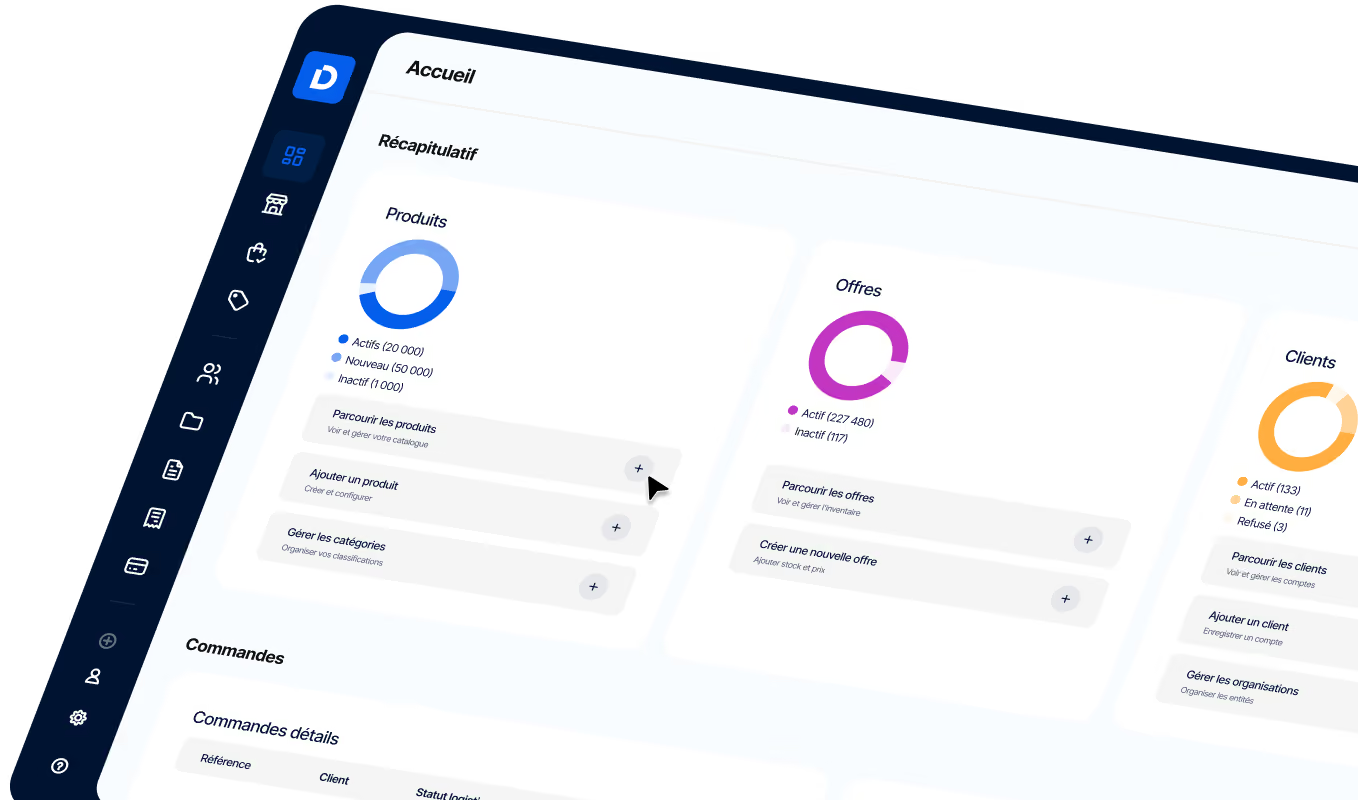
B2B Order Management Software: How to Choose
Transform your B2B business with software that makes order management easier. Simplify processes and automate workflows to improve profitability.
Article summary
- B2B order management covers the full order-to-cash cycle: order capture, validation, processing, shipping, invoicing, and after-sales support. A dedicated OMS centralizes these flows in a single tool.
- A B2B OMS differs from an ERP in its ability to provide a buying interface for business customers and orchestrate multichannel orders (e-commerce, email, EDI, marketplace).
- The key selection criteria are ERP/CRM integrations, customizable approval workflows, customer-specific pricing management, real-time tracking, and scalability.
- A successful rollout starts with a clearly defined scope, a pilot with 10 customer accounts, and then a gradual scale-up.

What Is a B2B Order Management System?
A B2B order management system, also known as an OMS (Order Management System), is a solution that centralizes order capture, validation, processing, shipping, and invoicing for business-to-business transactions in a single interface. It connects to the different channels where orders come in — e-commerce portal, email, phone, EDI, marketplace — and feeds them into one unified workflow, regardless of their original format.
What sets a B2B OMS apart from a basic sales management tool is the complexity of intercompany transactions: multi-line orders with hundreds of SKUs, customer-specific or contract-based pricing, multi-level internal approval workflows, net payment terms (30, 60, 90 days), and two-way integrations with the buyer’s ERP and CRM. Software built for B2C can’t handle these use cases without heavy customization, which is why specialized solutions have emerged.
The goal of this kind of software is twofold: on the operations side, it reduces manual tasks — rekeying data, stock checks, payment reminders — and lowers input errors. On the customer side, it delivers a smooth buying experience with real-time order tracking, self-service (changes, cancellations, replenishment), and full visibility into order history and pricing terms.
B2B order management refers to the full set of processes and tools used to manage the lifecycle of a business order, from order capture through delivery, invoicing, and after-sales service. Unlike B2C, B2B involves multi-line orders with customer-specific pricing, internal approval workflows, net payment terms, and integrations with the buyer’s ERP and CRM.
A B2B order management system (often called an OMS, for Order Management System) centralizes these flows in a single interface, no matter where the order comes from: e-commerce portal, email, phone call, EDI, or marketplace.
The goal is twofold: reduce manual tasks — rekeying, checks, reminders — and give business customers a smooth buying experience, with real-time tracking and self-service.
B2B OMS vs. ERP — What Each One Covers
To go deeper into the role of artificial intelligence in order orchestration, read the dedicated article on AI in B2B order management.
As online B2B orders become more frequent and more complex, having a best-in-class order management system isn’t just a smart move for your business — it’s a necessity.
Order management software doesn’t just handle traditional B2B orders, which have long lead times and predefined fulfillment processes. It also helps you accept and manage short-lead-time orders that look more like B2C purchases. According to Gartner, 50% of B2B customers say their expectations for speed and delivery options have increased over the past 12 months. That pressure is forcing companies to rethink the entire B2B sales process and add high-performing orchestration tools.
In this guide, we’ll walk you through everything you need to know about B2B order management software. You’ll learn how it can help your business, the key features to look for, and the three leading platforms to consider.
5 Reasons Your Business Needs a B2B Order Management System
Implementing a B2B order management system is one of the best decisions your company can make, for five key reasons.
Streamline Your Sales Channels
Managing multiple sales channels can be challenging, especially if your business relies on manual processes to bring orders in. It’s all too easy for orders to be duplicated or missed, creating headaches for you and your customers.
But with a digital order management platform, all your order data is brought together in one place, helping you avoid costly confusion and missed orders. For example, if a customer places an order online and then through a sales rep, your team can see both orders together and spot any issues quickly. This centralization becomes even more critical when the business sells through a B2B marketplace in addition to its e-commerce site and field sales team.
It Reduces Order Processing Time
In a traditional sales process, sales reps usually have to transcribe phone calls and exchange emails with customers to confirm order details. That back-and-forth alone can extend order processing time, and if a rep is on vacation or out sick, it can delay the sale even longer.
A B2B customer order management system can help your organization avoid delays. Within the platform, customers can quickly place orders themselves, without waiting to speak with a sales rep. Companies that move to B2B order automation reduce processing time by 50% to 80% on average, freeing up customer service teams to focus on the customer relationship.
It Helps You Scale
Without an order management system, the only way to grow your business is to hire more sales reps, which is expensive and time-consuming.
Order management software lets you handle more orders without increasing the workload on your sales team. That means that instead of spending time processing orders and replenishment requests, your sales force can focus its energy on what it does best: winning new customers.
It Makes Inventory Management Easier
A B2B order management system can also help you avoid stockouts — and the panic that comes with them. The software shows you how much of any product you have in stock and automatically updates inventory levels after each new order. You can even set alerts when stock drops below a certain threshold. With this added visibility, you can proactively replenish key products so they’re always available to your customers.
It Delivers a Better Customer Experience
According to Gartner, 75% of B2B customers prefer sales processes that don’t require speaking with sales reps. By adopting a digital ordering system, you’re not just improving your company’s fulfillment process — you’re also aligning with customer preferences.
In addition, B2B supply chain software can deliver a better end-to-end experience for your customers. It makes it easier for them to place orders and use different payment methods at checkout. On top of that, the software gives end users better visibility, allowing customers to track orders and make returns.
Assess the Potential Impact of an OMS on Your Business
What to Consider Before Choosing a B2B Order Management System
Before choosing the first B2B order management software you see, it’s essential to think about how a platform will work for your business. Here’s what to keep in mind before you buy.
Integrations With Other Systems
Your new software should integrate with the tools you already use, such as:
- Customer relationship management (CRM) software
- Supply chain and warehouse management software
- Enterprise resource planning (ERP) software
- Product information management (PIM) software
- Accounting software
- Marketing software
For example, if your order management system integrates with your CRM platform, your sales team can see at a glance whether a customer has recently placed an order and whether it has been fulfilled.
In addition, integrating your order management software with your accounting software makes it easier to track company revenue and spot sales trends over time. For companies managing both sales and purchasing, the question of which B2B e-commerce platform to choose deserves a structured benchmark that includes the OMS dimension.
Expert tip: To organize order data, many companies choose between two types of software:
- Traditional order management software (OMS) — a standalone system with tools for order processing, inventory management, shipping, and returns.
- Enterprise resource planning (ERP) software — an all-in-one business management solution that includes order management tools and covers CRM, accounting, supply chain management, marketing, and more.
If you already use separate CRM and accounting software, you may save time and money by choosing a traditional OMS platform. On the other hand, if you want to digitize several parts of your business at once, ERP software may be the better choice.
That said, OMS and ERP software share one drawback: they don’t let customers place orders. That’s why we recommend using a unified, customer-facing commerce platform like DJUST. Our software lets customers place orders, track open orders, make returns, and more.
Customization and Flexibility
Most platforms include a standard set of features that everyone can benefit from. But the only ones worth using are the ones that let you adapt features and functionality to your needs. For example, you may need an online B2B order management system that lets you quickly adjust order volumes, customize delivery schedules, or offer priority order pickup at your warehouse for faster fulfillment.
Expert tip: Your business has probably spent years building an order management process tailored to your products and your customers’ specific needs. So be wary of software that forces you to follow its standardized processes. That’s an important rule of thumb when buying software: the platform you choose should fit your needs, not the other way around.
Also, look for software that can scale with your business. That lets you adjust and adapt your order management process as future needs evolve. For example, if you currently offer fixed pricing but want to move toward customer-specific pricing in the future, look for software that lets you create account-specific price lists. The ability to manage automated quotes while carrying over negotiated pricing is an often-overlooked capability that directly affects customer satisfaction and sales cycle speed.
Security and Data Protection
Ransomware and other digital attacks are becoming more common, which is why your B2B order management software needs to protect customer data effectively. Look for security features such as multi-factor authentication, user access roles, and data encryption. Some platforms also support single sign-on.
Implementation Timeline
The last thing to consider is how long it will take to transition to a business-to-business order processing system. Implementation or replatforming can take time, cost money, and require buy-in from many stakeholders across the company.
Make sure you get a clear onboarding timeline from any software vendor you’re considering. DJUST, for example, can build a new order management system for your business or digitize your existing ordering process in four months or less.
Key Features of a B2B Order Management System
Let’s look at the must-have features of online customer order management systems to help you choose the one that’s right for you.
Order Management
- Order approval: Set automated rules to approve orders before they’re processed. These rules can require a sales rep to review orders that exceed a certain threshold.
- Quote management: Create, track, and deliver quotes to your customers. The best platforms let you customize quote approval rules.
- Order processing and tracking: Control your fulfillment process by tracking every step, from approval to shipping, in one place.
- Real-time order status updates: Keep customers informed at every stage of the delivery process.
- Cancellation or modification: Let customers cancel or change orders that haven’t shipped yet.
Customer Management
- Business accounts: Create customer profiles that include contract details, shipping preferences, and order history.
- Customer groups: Group customers for product catalogs, pricing, and sales analysis.
- Reordering: Let customers quickly reorder items they’ve purchased before.
Inventory Management
- Centralized inventory management: Track stock for all your products in a single database accessible to all your teams.
- Barcode scanning: Adding scannable barcodes to your products makes warehouse management easier.
Payments
Finally, don’t forget integrations with payment service providers (PSPs) such as Djust, Stripe, Lemonway, and Mangopay. These PSPs let you accept B2B-friendly payment methods, including purchasing cards, bank transfers, and checks.
How to Deploy a B2B OMS: A 4-Step Approach
Choosing a B2B order management system is only the first step. Deployment determines the project’s real success. Failures rarely come from the technology itself, but from an ill-defined scope or resistance to change that wasn’t anticipated.
B2B OMS Deployment Plan
The scoping phase is often underestimated. The goal is to map the channels through which orders come in — portal, email, phone, EDI — measure volume by channel, and identify the top three pain points. A two-hour workshop with customer service, sales, and logistics teams is usually enough. A concrete example: a building materials distributor discovers that 60% of its orders arrive by email as PDFs, making that the priority channel to automate.
The pilot with 10 volunteer customer accounts is the decisive step. Measure 3 KPIs: adoption rate (orders placed through the new system vs. email/phone), average processing time, and error count. If adoption exceeds 50% within 4 weeks, the pilot is validated and rollout can begin. Companies that follow the latest B2B e-commerce trends find that customer self-service is the first adoption accelerator.
The 3 Best B2B Order Management Software Solutions
To save you time and effort, we’ve done the heavy lifting and identified three order management systems that can help transform your B2B strategy.
DJUST
DJUST is a robust, unified B2B e-commerce platform. Our software offers a range of features to manage every part of your ordering process, from customer onboarding and order fulfillment to payment acceptance and after-sales service.
With DJUST, you can build flexible order approval workflows and monitor your entire fulfillment process in one place. Our platform also supports omnichannel sales and order splitting.
DJUST also helps you retain customers with features like real-time order tracking and contract-specific customer service levels.
Importantly, the move to DJUST is seamless. You can implement our software in less than four months, and it works with any existing ordering system.
SAP Commerce Cloud
SAP Commerce Cloud is one of the most popular enterprise e-commerce platforms. It supports custom catalogs, online quotes, omnichannel sales, and more. It also lets you track inventory and accurately forecast when items will be delivered to customers.
SAP Commerce Cloud is a good option if you want to connect your order management system to an ERP platform in the future. It integrates smoothly with SAP ERP.
However, getting used to SAP Commerce Cloud can take some time because it’s so feature-rich.
Salesforce Commerce Cloud
Salesforce is best known as a customer relationship management (CRM) platform, but it also has a B2B component you can use for order management: Salesforce Commerce Cloud.
Salesforce Commerce Cloud lets you build complex fulfillment workflows and supports omnichannel sales through order splitting.
The downside is that the Salesforce ecosystem is huge, and only a small part of that ecosystem is focused on B2B e-commerce order management software. For companies looking for a solution that is 100% dedicated to B2B, a specialized platform like DJUST offers deeper functional coverage and faster deployment.
Expert tip: be careful when using vendors that offer both B2B and B2C solutions. While a hybrid vendor may seem like a good idea at first glance, B2B and B2C order requirements are very different. It’s usually better to have separate order management systems for your B2B and B2C sales.
In Conclusion
B2B order management software can help your business streamline sales channels, reduce order processing time, improve inventory management, and enhance the customer experience. When choosing software, look for features such as integrations, customization, and security, as well as tools that make order, customer, and payment management more seamless.
Choosing the right tool starts with auditing your current flows, evaluating solutions in a structured way (using the scorecard above), and rolling out the platform gradually with a pilot. Companies that get this transition right see an average 50% to 80% reduction in processing time and an error rate below 1%. For organizations exploring B2B e-commerce as a complementary channel, the OMS is the essential technical foundation for end-to-end order orchestration.
At DJUST, we’ve developed a powerful B2B order management solution that can connect to any existing ordering system.
-modified.avif)


.png)
.jpeg)