SaaS vs. IaaS: Choosing the Right Option for Your B2B E-Commerce Business
Discover the differences between SaaS (software as a service) and IaaS (infrastructure as a service), and which one best fits your B2B e-commerce strategy.
Article summary
Let’s take a quick look at the key differences between SaaS and IaaS platforms.
- SaaS platforms are ready to go and easy to use, while IaaS solutions require a high level of technical expertise to build and operate.
- Both SaaS and IaaS solutions are highly scalable, making it easy to add or remove resources and additional services.
- SaaS platforms have a fixed monthly cost, while IaaS platforms use a variable, pay-as-you-go model that requires close billing oversight.
.avif)
Global spending on cloud IT infrastructure reached $93.7 billion in 2023. That figure is expected to hit $110.5 billion this year and $133.7 billion in 2026. This includes the three main cloud computing models for B2B eCommerce: SaaS, PaaS, and IaaS.
With the right B2B eCommerce platform, you can reach more customers and grow revenue. To build a strong, sustainable B2B eCommerce strategy, you need to choose between a SaaS or IaaS solution.
It’s an important decision, but DJUST is here to guide you through the differences between the two.
Short on time? Here’s what you need to know:
Let’s take a quick look at the main differences between SaaS and IaaS platforms.
- SaaS platforms are plug-and-play, with low setup and usage complexity, while IaaS solutions require a high level of technical expertise to build and run.
- Both SaaS and IaaS solutions are highly scalable, making it easy to add or remove resources and services as needed.
- SaaS platforms come with a fixed monthly cost, while IaaS platforms use variable pay-as-you-go pricing models that require close billing oversight.

SaaS solutions: Software as a Service
SaaS solutions are the most common choice for businesses that need powerful software managed and maintained by service providers rather than their own IT teams. The right SaaS solution can help you launch and scale your B2B eCommerce site with minimal technical overhead.
Key features
From a business perspective, a SaaS product is a bit like Facebook or YouTube: you can use it without downloading any software. All you need is an internet connection and valid credentials to access the SaaS platform. The software provider owns and maintains all the technical infrastructure needed to run your eCommerce platform, handling everything from security to error detection.
Many SaaS providers offer their products on a monthly subscription basis. There are no license fees or extra costs unless you decide to move to a higher-tier plan, which naturally gives you access to more features.
In addition, SaaS platforms support single sign-on. You can use the same set of credentials across every SaaS solution, eliminating the need to remember multiple accounts and passwords.
Benefits
Getting started with a new B2B eCommerce platform can feel daunting, but with SaaS, it doesn’t have to be. Setup is straightforward, and many SaaS solutions are quick to configure and launch. As mentioned above, with SaaS, you don’t need to download or install software on your computer, which means you can get started as soon as you open your browser and log in. With DJUST, your new B2B eCommerce platform can be up and running in less than four months.
Fast setup also applies to your team, who will have personal logins tailored to their access levels. And your IT team won’t have to worry about downloading and updating software across office computers. In short, IT won’t need to spend significant time implementing and maintaining your eCommerce software.
In today’s market, your eCommerce business needs to scale quickly when required. If your business grows fast, you can easily switch to a different plan. As customer traffic increases, your service provider automatically adjusts its IT infrastructure and allocates more server resources to your eCommerce site, which is ideal for sustainable commerce because you won’t be left with oversized servers. The flexibility offered by SaaS solutions is a major advantage, especially in B2B sales, and ensures your business has everything it needs to grow and succeed.
Limitations
While a SaaS solution can be a great option for your eCommerce business, there are a few limitations to keep in mind. First, with SaaS, you hand over control to a third-party service provider, which means they hold the keys to functionality, performance, and your data.
Because they control your sensitive business and customer data, which is stored on external servers, security can be a concern. However, most reputable SaaS providers have strong cybersecurity measures in place, including data encryption and 24/7 network monitoring. In addition, most experienced providers automatically back up your data and have recovery plans to help you if a cyberattack occurs.
Many smaller SaaS solutions offer fewer integrations and don’t always work with legacy software. That’s not the case with DJUST. We have a sophisticated integration process, and most of our software is highly customizable. Solutions like DJUST support the unique needs of every industry, including B2B construction and B2B retail.
Examples of SaaS solutions
There are many SaaS products for eCommerce businesses, including Salesforce, Shopify, HubSpot, Mailchimp, OpenCart, and Squarespace. And while it’s an enterprise platform, DJUST is another great example of a SaaS solution. We’re proud of our platform’s ability to be customized and deliver a dynamic user interface.
What this means in an eCommerce context
With a SaaS solution, your eCommerce business will be highly scalable and high-performing. As your online sales grow and you reach new customers, you can buy add-ons that give you access to more specialized features, such as stronger customer, catalog, and order management capabilities. You’ll also be able to update your customer interface and order flows, create different product catalogs for different markets, and more.
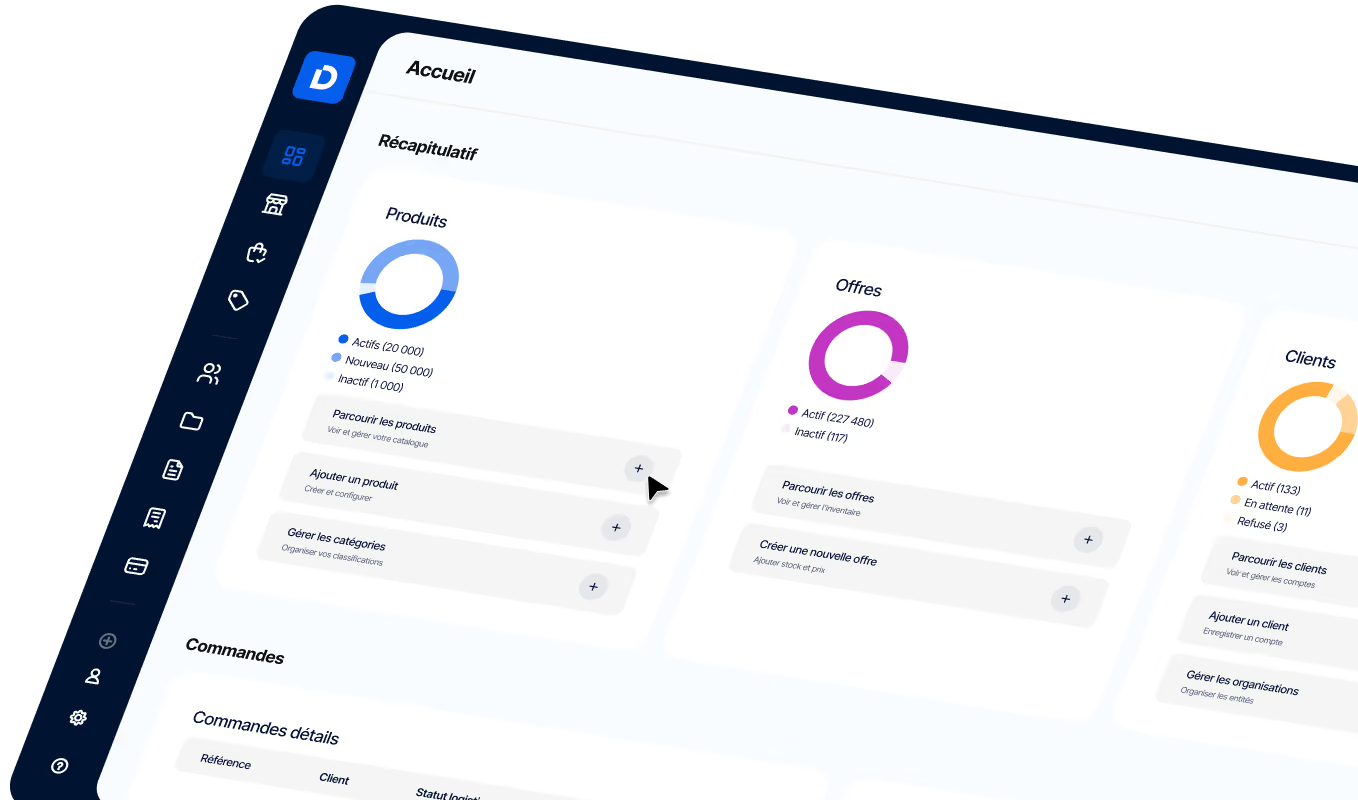
To run your B2B eCommerce site effectively, you need tools and analytics that help you stay in control. With DJUST, our back-end dashboard lets you monitor your business and sales. You can easily add products, manage inventory, accept payments, review key performance indicators (KPIs), track supplies and orders, monitor customer data, and much more.
Expert tip: Be careful. Some companies describe themselves as SaaS providers when they’re really just cloud-based solutions and not fully SaaS. Many of these “fake SaaS” solutions are simply on-premise platforms that have moved to the cloud.
IaaS solutions: Infrastructure as a Service
Infrastructure as a Service (IaaS) is the first form of cloud computing. Providers give customers access to hardware such as servers, storage capacity, and network resources. It’s a great option for businesses that want to save on maintenance costs and hardware purchases.
Key features
IaaS lets you use servers over an internet connection, but it doesn’t provide ready-to-use eCommerce software. The provider manages the network, storage, servers, and virtualization, while you deploy the eCommerce software of your choice. Each server is a separate resource with its own storage capacity. IaaS subscriptions do exist, but they’re usually based on a pay-as-you-go model.
Customers can usually choose to rent virtual machines or physical servers. These are controlled over the internet using a graphical user interface (GUI) or an application programming interface (API). You get full administrative rights to install software and more when you rent them.
Benefits
Renting servers from IaaS providers reduces the cost of building on-premise infrastructure and the time needed to install software. The provider manages all physical components and their security. This service is also highly flexible because IaaS infrastructure can be configured for any programming language or data processing framework.
In addition to encrypting servers, IaaS providers own the data centers, which allows them to increase physical security when needed. If the provider has a strong reputation in the industry, your company’s data is in good hands. It also lets you quickly add more resources if you find the setup isn’t enough.
Limitations
The biggest limitation of IaaS solutions is that you need someone who can manage your software. That responsibility falls to developers, and while your company may have large dedicated teams, you’d still need more expert staff for the solution you choose. In short, additional training is required if you decide to move forward with IaaS.
In addition, older systems may not integrate well with the new infrastructure. Any legacy technology should be reviewed for compatibility before a full cloud migration.
IaaS is secure, but because you may be using a public cloud and you’re not responsible for the servers, there can still be security risks. The software is your responsibility, so you need to make sure the software layer is protected.
Examples of IaaS solutions
Some examples of IaaS solutions in eCommerce include Amazon Web Services (AWS), Google Compute Engine (GCE), and Rackspace. Microsoft Azure, Dropbox, and IBM Cloud are other available IaaS solutions.
What this means in an eCommerce context
With IaaS, your online store can scale quickly. For example, if you need more storage to handle a traffic spike, you can easily adjust and increase your storage space. This scalability ensures your site is ready for growth.
In addition, IaaS providers manage site storage, servers, and networking, giving your team more time to focus on data, fulfillment, and operating systems. That means you gain more flexibility and control over how you run your eCommerce site.
However, because there are no built-in eCommerce capabilities, you’ll need to build your own custom eCommerce platform. To do that, you’ll need a development team that can start from scratch and build one for you.
In conclusion
Choosing between SaaS and IaaS is an important decision, and your eCommerce business plan could depend on it. But the truth is that some businesses don’t need IaaS because it’s better suited to software development.
In addition, SaaS is highly flexible and always available without requiring heavy backend work. Still, you should consider your business’s unique needs before making a final decision.
-modified.avif)
.png)
.avif)
.jpg)