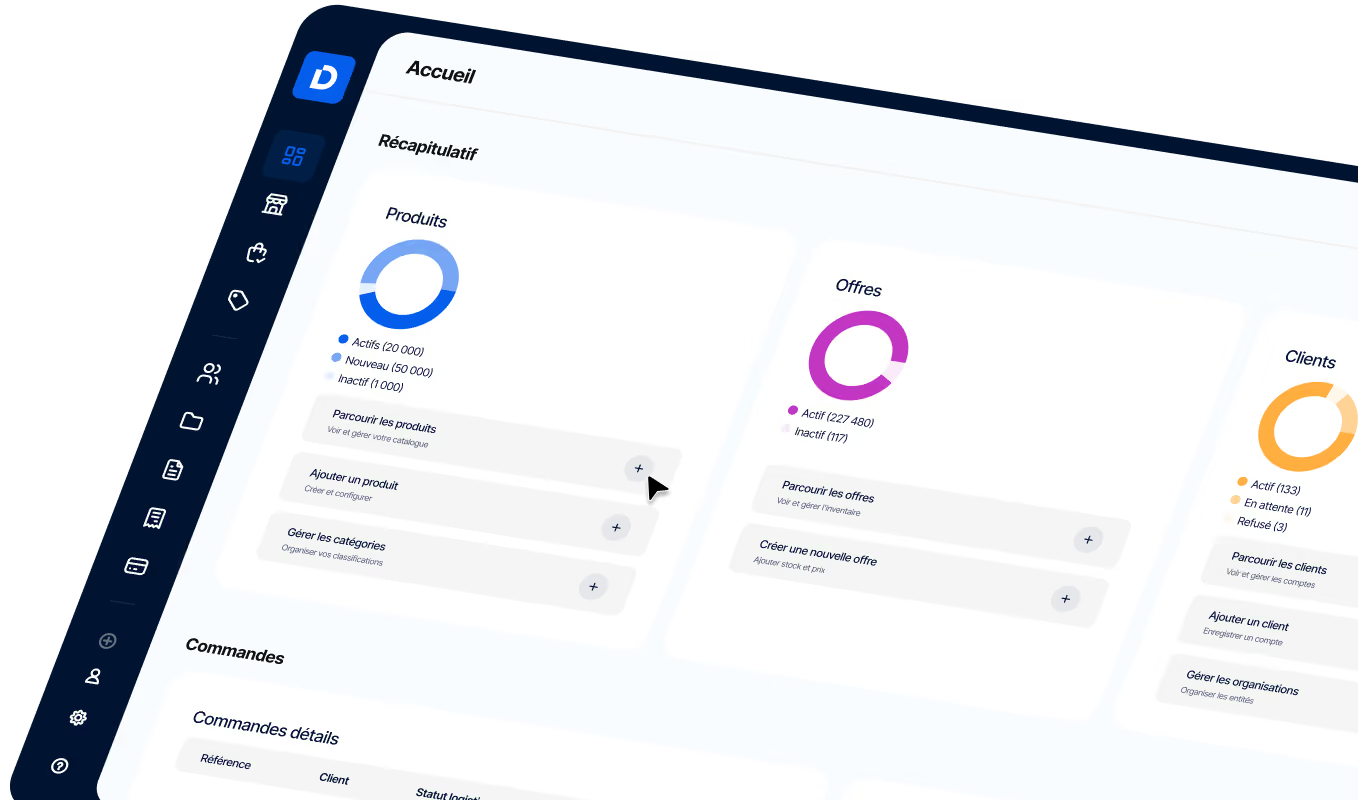
B2B E-commerce Business Plan: Building a Plan in 11 Steps
Understanding the nuances of B2B e-commerce, whether you’re a beginner or an expert, is essential to building a compelling business plan that addresses the unique challenges and opportunities of the digital market. In this article, we share practical e-commerce tips for creating a step-by-step business plan that covers the most important aspects of your B2B operations.
Article summary
- A B2B e-commerce business plan helps define the market, the offering, the commercial strategy, operations, and multi-year financial forecasts.
- The 11 key steps include market research, customer segmentation, competitive analysis, marketing strategy, the operational plan, financial projections, and risk management.
- B2B specifics must be quantified : average order value, order frequency, digital channel adoption, ERP/CRM integration, payment terms, logistics costs, and pricing conditions.
- A useful business plan is based on verifiable assumptions and should serve as a roadmap, including KPIs, financial scenarios, and regular monitoring of variances between forecasts and actual results.
A e-commerce business plan is a document that demonstrates, with supporting figures, that an online sales project can achieve its goals: it describes the target market, the offering, the commercial strategy, the operational organization, and three-year financial forecasts. In B2B, it is used both to launch an online business and to convince management to open a digital ordering channel for professional clients.
For both beginners and experts, it is essential to understand the nuances of B2B e-commerce to develop a compelling business plan that addresses the unique challenges and opportunities of the digital market. In this article, we offer essential e-commerce tips on how to write a step-by-step business plan that covers the most important aspects of your B2B business activities.
Why create a B2B e-commerce business plan?
Whether you are entering the world of B2B e-commerce for the first time or expanding your existing operations, it is important to have a business plan that takes into account the unique challenges and opportunities presented by this constantly evolving sector. The document reduces measurable risk: according to INSEE, 69% of companies created in 2018 (excluding micro-entrepreneurs) were still active five years later, but only 64% in retail, the lowest rate of all sectors. For an established company, the challenge is to prove that the online channel will generate more than it costs. The demand exists: 67% of B2B buyers prefer to purchase without interacting with a sales representative (Gartner, 2026), and e-commerce accounts for 34% of revenue for B2B companies that offer it (McKinsey, 2024).
An effective B2B e-commerce business plan stands out from others through a number of essential points that must be translated into concrete evidence:
| Key differentiator | What the business plan should cover | Evidence to include |
|---|---|---|
| Focus on B2B customers | You will need to address the specific needs of B2B customers, such as bulk orders, longer sales cycles, higher order values, contractual purchasing, etc. | Average order value and order frequency by segment |
| Accounting for complex sales processes | The complexity of B2B sales, with its negotiation and complex procurement processes, requires a sophisticated e-commerce platform. | Target journey: automated quotes, approval, payment terms |
| Integrates with existing business systems | Seamless integration between e-commerce platforms and internal business systems such as ERP and CRM is crucial for operational efficiency. Using API-based platforms that enable real-time data exchange is essential. | List of ERP and CRM flows to connect, CRM/ERP integration costs |
| Legal and compliance requirements | Navigating the B2B e-commerce legal landscape goes beyond data protection; it also encompasses international trade laws and industry-specific regulations. | Terms and conditions, payment terms, electronic invoicing |
Two audiences, two perspectives. Banks or investors look first at the financing plan and the break-even point. A management committee reviewing an internal business case looks at integration costs, the impact on existing sales, and productivity gains for teams.
Common pitfall : presenting a startup business plan to management without quantifying the impact on existing sales teams. The B2B e-commerce strategy sets the course; the business plan provides the numbers.
The 11 elements of a B2B e-commerce business plan
The key elements of a B2B e-commerce plan for an online business do not differ significantly in format or number from a traditional business plan. However, each section of your plan must address the challenges mentioned above and offer practical, appropriate solutions. Bpifrance Création recommends a document of 10 to 30 pages excluding appendices, with three-year forecasts and a 12-month cash flow plan.
1. E-commerce business plan executive summary
The executive summary must communicate the unique value proposition your company offers the B2B market, along with a concise overview of your e-commerce business model.
Start by highlighting the digital solutions you will provide to streamline complex sales processes, improve customer personalization, and integrate seamlessly with existing enterprise systems.
Next, explain how your company is uniquely positioned to facilitate efficient, scalable, and flexible B2B transactions. Be sure to mention your target market segments, your competitive advantage, and how you plan to capture and grow your market share.
For example, if your platform specializes in providing comprehensive digital procurement solutions for construction companies, detail how it simplifies online sourcing, ordering, and supply management, much like BlueOn, Eiffage's marketplace, which recorded 970,000 euros in orders within three months.
2. Company description
The "Company Description" section should succinctly describe the nature of your business, including a brief history and current market position.
It is essential to include a strong mission statement. It should summarize your company's purpose, its commitment to existing or potential B2B customers, and explain how you intend to revolutionize B2B transactions through digital solutions.
3. Mission and vision statement
Mission and vision statements define the core ethics and objectives of your B2B e-commerce strategy.
Your mission statement will succinctly define the purpose of your B2B e-commerce activities, explaining their rationale and how you intend to serve the B2B market. In contrast, a vision statement outlines your company's future aspirations for these activities, with the goal of inspiring and providing direction.
Expert tip: while the company description outlines operational and commercial specifics and grounds the business in the present, mission and vision statements define your fundamental purpose and future aspirations, guiding your team and stakeholders toward a shared future.
4. Overview of products and services
This section details the offerings you plan to bring to the B2B market, both in terms of the products and services themselves, as in a standard product business plan, and regarding the platform that B2B customers will use to place orders.
For example: Acme offers a comprehensive selection of high-quality steel automotive parts, meeting the specific needs of manufacturers and automakers. This platform is designed to simplify the procurement and supply chain process for B2B customers, with detailed specifications for each part, simple online ordering, and efficient logistics management. Key offerings include custom part manufacturing to meet precise specifications, volume discount pricing to encourage bulk purchases, and advanced order tracking for transparent supply chain management.
This section also specifies the business model: direct sales, subscription, marketplace, or a hybrid model. The B2B e-commerce revenue models do not have the same margin profile or inventory requirements, which changes the entire financial outlook. Finally, it describes the structure of the B2B product catalog : number of SKUs, variations, and pricing per customer.
5. Market analysis and research
To succeed in B2B e-commerce, market analysis must go beyond basic demographics and delve into the specific behaviors, preferences, and needs of business clients. Consider techniques such as:
- Segmentation analysis : allows you to identify and categorize potential professional clients by industry, size, and purchasing behavior.
- Competitive intelligence : helps you understand your competitors' strategies, pricing, and customer engagement, which is essential for finding opportunities for differentiation.
- Customer feedback : helps gather direct insights from your clients regarding their needs and preferences.
- Data analysis and BI : allows for the analysis of customer behavior, sales trends, and operational efficiency, right up to predictive demand analysis .
- Industry reports and publications : provide insights into market trends and forecasts, such as B2B e-commerce trends.
This section of the business plan should not only provide a snapshot of the current market but also forecast future trends and identify potential areas for growth.
6. Customer segmentation and target market
As with B2C e-commerce and retail in general, succeeding in B2B e-commerce requires recognizing that your customer base is not monolithic. It consists of various segments with distinct needs, behaviors, and purchasing processes.
Using CRM data analysis and market research, you can segment your customers into meaningful groups based on factors such as industry, company size, geographic location, purchase frequency, and order volume.
For example, a B2B e-commerce platform for wholesale auto parts might identify key segments such as small independent repair shops, mid-sized automotive manufacturers, and large multinational automotive corporations. Each segment requires a different approach:
- Small independent repair shops may prioritize fast delivery and flexible order quantities.
- Mid-sized manufacturers may look for bulk purchase discounts and custom parts manufacturing services.
- Large multinational corporations may seek long-term contracts and supply chain integration solutions.
By identifying these segments, your e-commerce business plan can present targeted strategies to attract and serve each one, including personalized marketing messages, tailored product recommendations, and custom pricing models. Furthermore, this section should analyze the potential market size and growth opportunities within each segment.
7. Competitive Analysis
Essential for any B2B e-commerce business plan, competitive analysis begins by identifying direct competitors (those offering similar products or services in the same market) and indirect competitors (companies offering alternative solutions to the same customer problems).
Expert tip: conduct a SWOT analysis (strengths, weaknesses, opportunities, threats) for each of your main competitors to understand their market position and identify gaps in their offerings. Then, determine your unique selling proposition (USP) by highlighting what sets your product and platform apart. For example, in addition to offering a superior product, you could provide your B2B customers with a more efficient, convenient, faster, or more comprehensive e-commerce experience.
This USP and the competitive advantages you have identified form the cornerstone of your go-to-market strategy.
8. Marketing and Sales Strategy
As with any business plan, this section focuses on defining a clear path to market and customer acquisition, building on the foundations laid in the Target Market Analysis and Competitive Analysis sections. Your strategy should outline how you will effectively reach, retain, and convert the target market segments you have identified. Be sure to address the following points:
- Marketing strategies : detail the digital and traditional marketing tactics chosen for the B2B sector, with a focus on omnichannel e-commerce. This approach could include a specialized content marketing aimed at decision-makers, B2B keyword SEO strategies, targeted email campaigns, high-quality product photography and a strong presence on professional social networks like LinkedIn.
- Customer relationship management : outline strategies to deepen B2B client relationships through effective account management, personalized customer service, and tailored loyalty programs.
- Metrics and key performance indicators (KPIs) : specify the essential indicators for evaluating the success of your marketing and sales efforts, adapted to B2B e-commerce goals, such as conversion rates, customer acquisition costs, retention rates, and return on investment, or the KPIs for a B2B marketplace for this model.
| KPI | Formula | Benchmark or use |
|---|---|---|
| Conversion rate | Orders / sessions | 3.4% on desktop and 1.6% on mobile in 2025, across all sectors combined (Contentsquare); recalculate using your own data |
| Channel adoption rate | Accounts that ordered online / active accounts | Key indicator for a B2B business case |
| Customer acquisition cost | Marketing and sales expenses / new customers | Compare with the annual margin per customer |
| Customer lifetime value | Annual margin per customer × average relationship duration | See customer lifetime value |
| Churn rate | Lost customers / customers at the beginning of the period | Link: B2B churn rate |
9. Operational Plan
In this section of your B2B e-commerce business plan, you will want to focus on your plans for a robust supply chain and inventory management system, which are essential for handling the complexities of B2B transactions. Be sure to address the following areas:
- Highlight your strategy for ensuring fast and cost-effective delivery through optimized distribution networks and strategic logistics partnerships, while quantifying B2B logistics costs.
- Detail your approach to inventory management for B2B clients, focusing on technological solutions for demand forecasting, real-time tracking, and maintaining optimal stock levels to avoid overstocking and stockouts.
- Address operational efficiency questions, focusing on e-commerce scalability and performance, to ensure your business can adapt to increased volumes or market expansion without compromising speed or the customer experience.
- Consider adopting sustainable e-commerce practices, such as eco-friendly packaging and energy-efficient logistics, to meet the growing demand for responsible businesses.
- Finally, emphasize technology integration for seamless operations, from order processing to delivery.
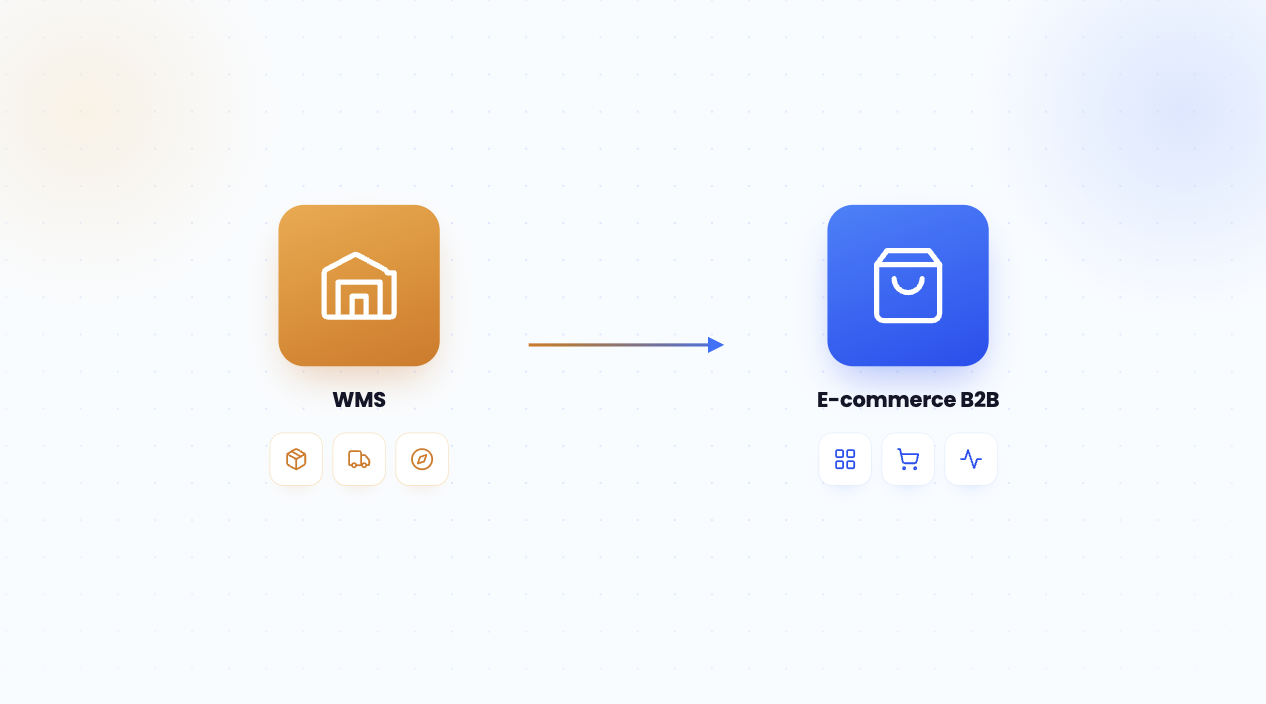
Expert advice : DJUST is a unified B2B commerce platform, specifically designed and developed to meet the unique needs and operations of B2B commerce. DJUST allows companies to combine all their B2B channels, including direct links to your ERP, PIM, CRM, and inventory management systems in one unified platform. Franprix illustrates this with its 1,200 stores, which place 140,000 orders per month on a replenishment platform.
10. Financial projections and forecasts
The "Financial projections and forecasts" section is a vital component of any B2B eCommerce business plan, as it provides quantifiable insights into the company's financial health and growth potential over a given period.
Here is how you can approach this section:
- Historical data: Start with a summary of financial data from the last two or three years to support your projections, if available.
- Sales projections: Forecast sales for the next 3 to 5 years, broken down by product/service line. Take into account contract lengths, bulk discounts, and seasonal trends specific to B2B sales.
- Cost analysis: Detail projected costs, including cost of goods sold, operating expenses, and marketing costs, while noting any significant future investments.
- Cash flow projections: Show the company's cash inflows and outflows, highlighting the importance of liquidity, especially given the extended payment terms in B2B commerce.
- Profit and loss (P&L): Provide a forecasted income statement to project profitability over the forecast period, in order to clarify financial viability.
- Break-even analysis: Identify the point at which the business is expected to become profitable, which is essential for early-stage companies.
- Sensitivity analysis and scenario planning: Present how changes in assumptions, such as sales volume or costs, affect financial results, which is crucial for the dynamics of large contracts in the B2B sector.
- Realistic assumptions: Use defensible assumptions for market growth and customer acquisition, explaining their relevance to B2B eCommerce.
- Scenario planning: Include various financial scenarios to demonstrate that the company is prepared to handle market changes.
Forecasting B2B revenue. The B2C e-commerce formula (sessions × conversion rate × average order value) is suitable for a site that acquires unknown customers.
To digitize an existing portfolio, an account-based formula is more reliable: active accounts × channel adoption rate × orders per month × average order value
Incorporate payment terms into working capital requirements. In France, the agreed-upon payment period between professionals cannot exceed 60 days after the invoice date, or 45 days end-of-month (Article L441-10 of the Commercial Code). In this example, a 45-day customer payment term ties up approximately 357,000 euros in receivables.
Payment delays widen the gap: the Banque de France estimates that they deprive SMEs and micro-enterprises of 15 billion euros in cash flow. The cash flow forecast therefore uses the actual observed payment times, which the payment strategy of CFOs seeks to reduce, particularly through the choice of B2B payment methods.
Break-even point and taxation. Break-even point = fixed costs / variable cost margin rate.
Net income is subject to corporate tax at 25%, or 15% on profits up to 42,500 euros for eligible SMEs (turnover under 10 million euros, with at least 75% of capital held by individuals). The platform budget depends on the type of solution: the ebook on the cost of a B2B e-commerce platform compares three categories of solutions, and the SaaS vs. on-premise comparison helps you decide.
This section should not only present a clear and realistic financial picture of your B2B eCommerce business, but also demonstrate an understanding of the unique financial dynamics at play in B2B transactions, such as longer sales cycles and the potential for larger, yet less frequent, orders.
11. Risk assessment and contingency plan
In this section, you will start by identifying the specific risks associated with your B2B eCommerce operations, then develop a contingency plan for each one.
Below are some examples of risks that can arise when launching into B2B eCommerce, along with solutions a company can explore in this section of the business plan.
- Supply chain disruptions
The problem: B2B commerce relies on large-scale, often complex, and timely deliveries.
The solution: Outline supplier diversification strategies and logistics options to mitigate potential disruptions. For example, by implementing flexible inventory management and establishing alternative supply chain routes.
- Technological risks
The problem: reliance on digital infrastructure and the need for advanced cybersecurity protocols, regular system updates, and robust data protection measures.
The solution: Detail a plan to prioritize technological resilience through IT contingency plans to ensure minimal operational disruption.
When migrating from an existing solution, the mistakes to avoid in B2B replatforming complete this plan
- Risks related to customer concentration
The problem: B2B commerce often deals with a smaller customer base making large transactions.
The solution: Discuss market diversification plans and customer engagement improvements to reduce the impact of losing key accounts. For example, by cultivating a broad customer base and developing strong relationships to mitigate customer concentration risks.
- Risks related to regulation and compliance
The problem: the complexity of operating in various jurisdictions, planning for ongoing legal review, and compliance training to navigate an ever-changing regulatory landscape.
The solution: Define a plan to stay informed about regulatory changes and invest in compliance management systems.
Two obligations must be factored into the business plan: providing your General Terms and Conditions of Sale (price lists, discounts, payment terms) to any professional buyer who requests them, under penalty of an administrative fine of up to 375,000 euros for a legal entity (Article L441-1 of the Commercial Code), and the ability to receive electronic invoices as of September 1, 2026, with issuance becoming mandatory for SMEs and micro-enterprises on September 1, 2027 (Article 289 bis of the General Tax Code).
For a project involving international e-commerce, the list grows country by country.
- Cash flow risks.
The problem : large orders paid at 45 or 60 days, compounded by payment delays.
The solution : set credit limits per client, require payment upon ordering for new accounts, use credit insurance or factoring, and automate payment reminders. Our guide on B2B payment delays details these levers.
Scenario planning is essential. Make sure you are prepared for a range of economic conditions, technological shifts, and market changes.
4 tips for writing a compelling e-commerce business plan
Developing a B2B eCommerce business plan that stands out requires clear, persuasive communication and meticulous organization.
The following tips are designed to improve your business plan, ensuring it not only captures the essence of your B2B eCommerce project but also attracts and convinces your audience of its viability and potential for success.
- Use clear and concise language: Communicate your strategy clearly and directly: avoid industry jargon and complex terms that may obscure your message. Instead, aim for simple, accessible language to ensure your plan is understandable to investors, stakeholders, and non-specialist readers.
- Organize your content: Start with a summary of your vision, including your eCommerce goals, then logically structure your plan into sections on market analysis, operations, and more, improving readability with clear headings.
- Incorporate visual elements: Use charts and infographics to break up text and summarize complex information, making it easier to present your data and financial insights.
- Proofread and edit: Rigorously review and edit your plan to eliminate errors and improve clarity, ensuring it reflects your professionalism and attention to detail.
In conclusion: from business plan to roadmap
Developing an exceptional B2B eCommerce business plan relies on strategic insights, tailored solutions, and a deep understanding of the digital market.
From adapting to digital transformation to designing a robust operational system, every section of your plan must address the unique challenges of B2B eCommerce to ensure your business doesn't just survive, but thrives in this competitive landscape.
By focusing on clear communication, logical organization, impactful visuals, and meticulous writing, your business plan becomes more than just a document—it is your roadmap for success in the fast-paced world of B2B eCommerce.
Remember that the success of your business depends on the clarity, precision, and adaptability of your plan. Make it count.
FAQ
What is an e-commerce business plan?
This document outlines an online sales project and demonstrates its viability, covering the target market, product offering, marketing strategy, logistics, and three-year financial projections. It is used to secure funding, convince partners or management, and guide the launch by comparing actual results against initial assumptions.

What are the steps for an e-commerce business plan?
Describe the company and its mission, define the offering and business model, analyze the market and competition, segment target customers, build the marketing and sales strategy, organize operations, establish financial forecasts, assess risks, and write the executive summary last. In B2B, the operational plan also includes ERP integration and the management of customer-specific pricing terms.
What is the difference between a business plan and a business model?
The business model describes how a company makes money: through direct sales, subscriptions, a marketplace, or commissions. The business plan is broader: it incorporates this model, places it within a market context, details the human, technical, and logistical resources required, and provides financial projections over several years. The model must therefore be chosen before writing the plan, as it dictates the financial strategy.
Is a business plan mandatory?
There is no legal requirement to write a business plan to start a company or launch an e-commerce site. However, it is generally requested by banks, investors, and funding organizations, and a steering committee will expect an equivalent business case before committing a budget. Bpifrance Création recommends a 10 to 30-page document with three-year projections.
What budget should you plan for launching a B2B e-commerce site?
The budget depends on the type of platform (custom, licensed, or SaaS), the number of integrations with your ERP, PIM, and CRM, the size of your catalog, and the internal resources involved. The business plan separates implementation costs (integration, design, data migration) from recurring costs (subscriptions, maintenance, marketing, logistics). Obtaining at least two detailed quotes will help ensure a reliable estimate.
Which metrics should you track in a B2B e-commerce business plan?
Five key metrics structure the monitoring process: channel adoption rate among existing accounts, average order value, order frequency, customer acquisition cost, and average payment delay. These are supplemented by gross margin per order and churn rate. The business plan sets targets for each at three months, one year, and three years, then compares actual performance against these goals.
Can you write an e-commerce business plan using ChatGPT?
An AI assistant can help structure your outline, rephrase your summary, or list potential risks. It does not replace actual data: market size, average basket value, payment terms, and costs must come from your ERP, quotes, and verifiable sources. Every figure suggested by the AI must be verified, as models can generate data that sounds plausible but is factually incorrect.
-modified.avif)
.png)
.avif)
.jpg)