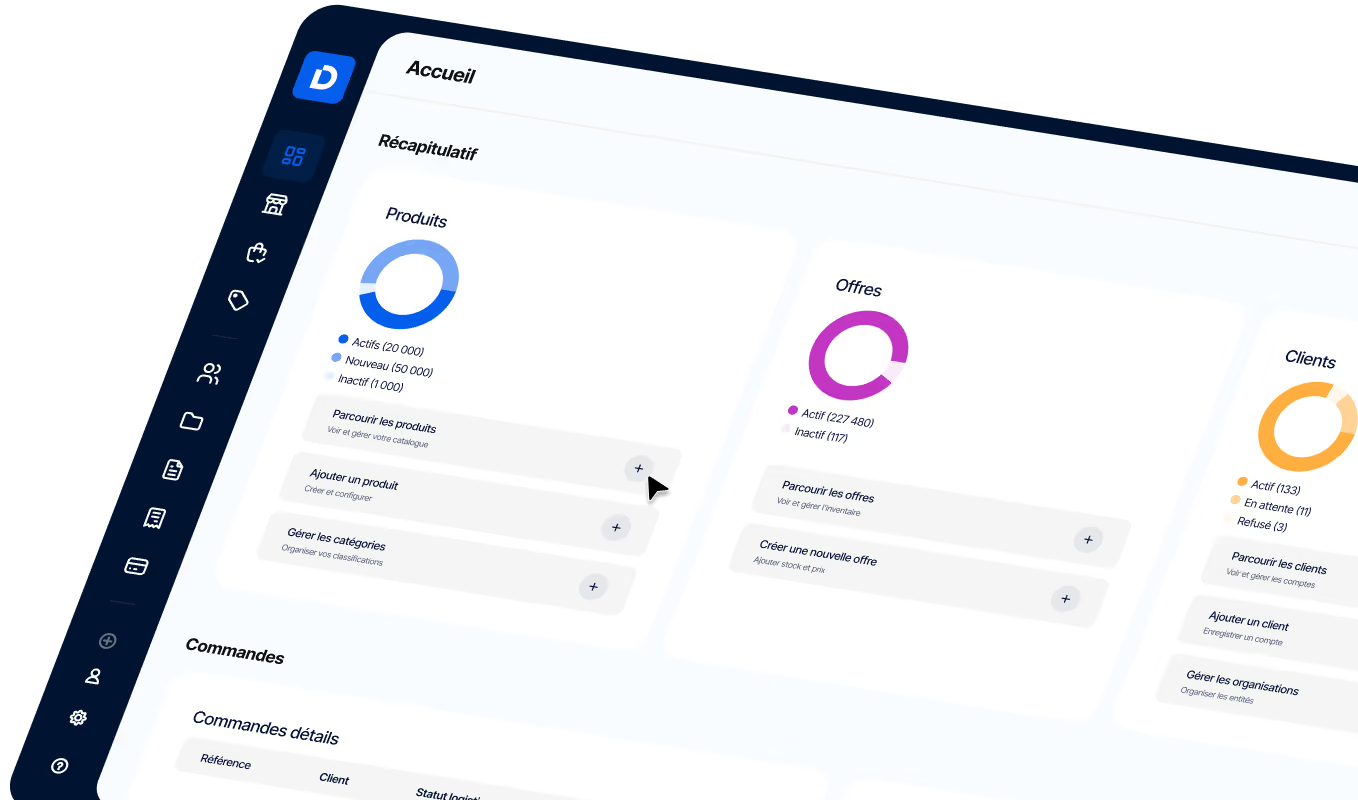
Automated B2B Quotes: The Guide to Accelerating Sales
How to Generate Automated B2B Quotes, Reduce Errors, and Speed Up the Sales Cycle. A complete guide with methods and tools.
Article summary
- An automated B2B quote is generated without manual input, using a centralized product catalog and predefined pricing rules.
- It reduces pricing errors by more than 90% and speeds up the sales cycle by 30% to 50%.
- Automation is delivered through software or a platform integrated with your CRM and ERP.
- Key features include customer-specific pricing, volume discounts, electronic signature, and automated follow-ups.
- A full deployment takes an average of 8 weeks, from the initial audit to go-live.
.avif)
In B2B, creating a quote is still often a slow, error-prone process. In 2026, sales teams have to manage multiple communication channels at once — phone, email, instant messaging, web forms, video calls — and every exchange generates key information that needs to be centralized. Between shared Excel files, back-and-forth emails, and manually copied pricing, sales teams lose a significant amount of time on low-value tasks. Even with strong tools and well-trained teams, creating a quote can take several hours and become a real drag on sales performance.
Automated quoting solves this problem. It’s a document generated by software or a digital platform, directly from a product catalog and configured commercial terms. No more re-entry, no more manual VAT calculations: the company produces a personalized offer in just a few clicks, with the right prices, the right quantities, and the right discounts. Combined with artificial intelligence, automated quoting goes even further: it understands the customer request, regardless of the entry channel, and significantly speeds up the sales cycle.
What Is Automated Quoting and Why Adopt It in B2B?
Automated quoting is a commercial document generated by a digital tool without manual entry of product lines, prices, or customer information. The software pulls from a centralized database — catalog, price list, customer record — and produces a PDF or electronic document ready to send in seconds. Unlike an Excel or Word template filled out by hand, automated quoting ensures consistency across prices, VAT rates, and payment terms.
In B2B, this shift to digital is even more critical because catalogs often contain thousands of SKUs, with customer-specific pricing, volume discounts, and market-specific terms. Managing all of that in a spreadsheet means accepting a high risk of errors and response times that no longer match the expectations of today’s professional buyers.
Manual vs. Automated Quotes: 3 Levels of Maturity
To assess where a company stands, it helps to distinguish three quote-creation models. The table below summarizes the differences across the criteria that matter most to a B2B sales team: speed, pricing accuracy, and integration with existing tools.
| Criteria | Manual quote (Excel/Word) | Standard quoting tool | B2B automated quote generator |
|---|---|---|---|
| Creation time | 15 to 45 min | 5 to 15 min | Less than 2 min |
| Pricing error risk | High (copy-paste, broken formula) | Moderate | Almost zero (centralized data) |
| Custom B2B pricing | Manual, not reliable | Partial | Automated by customer rules |
| CRM / ERP integration | None | Limited | Full (two-way) |
| Tracking and follow-up | Manual | Basic | Automated (statuses, alerts) |
The Strategic Impact on Sales Teams
When a sales rep spends 30 minutes producing a quote in Excel, that’s 30 minutes not spent on customer relationships or negotiation. In a B2B environment where sales cycles are already long (3 to 6 months on average), every extra day of delay increases the risk of losing the opportunity.
Take a concrete example: an industrial distributor receives 40 quote requests per week. With a manual process, that adds up to 20 hours of administrative work every week. An automated quote generator cuts that down to about 3 hours, freeing up 17 hours for selling each week.
The issue goes beyond time savings. By standardizing pricing terms, the company protects its margins and eliminates “off-book quotes” where a sales rep grants an unauthorized discount. Centralized product and pricing data ensures every offer sent reflects the current commercial policy. To go deeper into optimizing the entire B2B sales process, it’s essential to treat quoting as a core part of the digital buying journey.
📊 Scorecard: Assess Your Quoting Process Maturity
| Criteria | Score (1 to 5) |
|---|---|
| Average quote creation time | __ / 5 |
| Error rate on pricing and VAT | __ / 5 |
| Ability to customize pricing by customer | __ / 5 |
| CRM and ERP integration | __ / 5 |
Total score interpretation: < 15: moving to automated quoting is a priority. 15-20: quick wins are possible through integration. > 20: mature process, focus on AI.
How Does an Automated B2B Quoting Solution Work?
A B2B quoting solution is more than a simple PDF generator. It relies on three technical pillars: a centralized product catalog, configured commercial rules (discounts, payment terms, approval thresholds), and two-way integrations with the CRM, ERP, and billing system. When a sales rep or online buyer selects products, the software automatically applies negotiated pricing, calculates VAT, includes delivery terms, and generates a personalized document ready to sign.
In practice, the flow happens in four steps:
- Selecting products from the catalog (with filters by SKU, category, or supplier),
- Automatically applying the relevant customer pricing terms,
- Generating the quote in PDF or electronic format with built-in signature,
- Sending and automating follow-up (open, reminder, acceptance).
Each step runs without re-entry, which eliminates copy-paste errors and inconsistencies between teams.
The Role of AI in Quote Generation
AI-powered automated quoting goes beyond simple calculation automation. Artificial intelligence analyzes the customer’s purchase history to suggest complementary products, recommend optimized pricing based on order volume, and even anticipate pricing objections. For example, if a customer regularly orders 500 units of a component, AI can directly suggest the discount tied to the 1,000-unit tier to encourage higher volume. This AI sales optimization logic turns the quote into a true business development tool. Companies that integrate a B2B artificial intelligence module into their quoting process see average order value increase by 10 to 20%.
But AI’s role doesn’t stop at pricing and cross-sell. Thanks to advances in natural language processing (NLP), a dedicated AI quoting agent can now understand a customer request written in plain language, whether it comes from an email, an online form, or even a phone call transcript. AI analyzes the context to identify the customer’s exact needs, constraints, and priorities, then proposes a quote structure that is relevant and aligned with the company’s offer. Prices, options, and lead times are adjusted automatically. The result: faster, more accurate quotes that are better aligned with customer expectations, whatever communication channel is used.
When properly configured, this AI agent can reduce the manual workload by up to 70% linked to quote creation. It also uses historical data stored in the CRM and ERP to continuously refine its recommendations: pricing models improve, product suggestions become more relevant, and quote conversion rates increase over time.
The Essential Integrations
An isolated automated quote generator isn’t enough. Its value comes from connecting it to the tools the company already uses. Integration with the CRM links every quote to an opportunity and feeds the sales pipeline with up-to-date data. Connection to the ERP synchronizes prices, available stock, and delivery lead times in real time. Finally, the link to the billing system turns an accepted quote into an invoice in one click, with no double entry.
For companies managing integrated B2B payments, the quote → order → invoice → payment chain is fully automated. The professional buyer receives the quote, approves it online, and payment is processed according to the negotiated terms (bank transfer, direct debit, deferred payment). All without manual intervention.
B2B Automated Quoting Integration Checklist
☐ Connected product catalog (SKUs, descriptions, images)
☐ Configurable price list by customer or segment
☐ Automated discount rules and commercial terms
☐ Two-way CRM connection (Salesforce, HubSpot…)
☐ ERP sync (stock, prices, lead times)
☐ PDF generation with e-signature
☐ Status tracking and automated reminders
☐ Integrated B2B payment gateway
6 Measurable Benefits of Quote Automation
Moving from a manual process to automated quoting isn’t just a technology upgrade. It’s a direct driver of sales performance, measurable in days saved, errors eliminated, and revenue generated. Here are the six most tangible benefits companies see when they digitize B2B quote creation.
Time Savings and Sales Productivity
Switching to automated quoting frees up an average of 30% of sales reps’ administrative time. Instead of searching for a template, checking prices in an Excel tab, and recalculating the total including tax, the sales team generates a quote in just a few clicks from the CRM customer record. That time is redirected to prospecting, negotiation, and following up with strategic accounts. For a sales team of 10, that’s about 200 hours a month shifted to high-value work.
With an AI agent that can understand multichannel requests and pre-configure quotes, that gain reaches up to 70% less manual workload, making it possible to go from several hours to just a few minutes to produce a complete commercial proposal.
Fewer Errors and Protected Margins
Data-entry errors in a B2B quote have a direct cost: a price that’s too low eats into margin, while a price that’s too high drives the customer away. By automating the calculation of prices, discounts, and VAT from centralized data, the risk of error drops to almost zero. A distributor that manually handled quotes in Excel saw an 8% error rate. After deploying quoting software connected to its ERP, that rate fell below 0.5%. Standardizing commercial terms also prevents “off-the-record discounts” that erode profitability.
Faster Sales Cycles
In B2B, the time between a customer request and quote delivery is a decisive factor. A professional buyer who receives a proposal within an hour is far more likely to convert than if they wait 48 hours. Automated sending, combined with e-signature and automated reminders, compresses the full cycle. Equipped companies reduce the time between the first request and the approved order by an average of 30 to 50%.
Better B2B Customer Experience
A professional buyer who can view their quote online, approve it, and pay through a dedicated portal gets a smooth, modern buying experience. That strengthens the company’s credibility and builds loyalty among buyers. B2B e-commerce platforms that integrate quote generation into the online buying journey deliver an experience comparable to B2C, which is now the standard expected by digital-native buyers.
Pipeline Visibility and Sales Management
Every automatically generated quote is tracked: send date, view date, acceptance or rejection date. This data feeds directly into the sales dashboard and makes it possible to measure quote conversion rate, average response time, or the total value of the active pipeline. Without this tool, these KPIs are either approximate or nonexistent. B2B order management benefits directly from this visibility: sales leaders can identify blocked offers in real time and prioritize follow-ups.
Compliance and Document Traceability
With mandatory e-invoicing coming into force in France (2026-2027), traceability of commercial documents is becoming a legal requirement. An automated quoting system archives every version of the document, timestamps exchanges, and keeps a complete history that can be used in the event of an audit or dispute. Companies that get ahead of this requirement gain a decisive advantage by structuring their document chain now.
5 Steps to Deploy Automated Quoting in Your Company
Deploying an automated quoting system doesn’t happen with the push of a button. It requires methodical preparation to ensure the software reflects the company’s commercial policy exactly. Companies that succeed in this transition usually follow five steps, from the initial audit to post-launch monitoring. This sequence is the same whether it’s an SMB with 200 SKUs or a group with 50,000 products and multi-currency pricing.
Step 1: Audit the Existing Quoting Process
Before choosing a tool, you need to map the current process: who creates the quotes? How long does each step take? Where are the product data and price lists? What are the internal approval points? An audit carried out over 2 weeks, by interviewing sales and sales operations teams, usually reveals 3 to 5 bottlenecks (hierarchical approval, price lookup, manual follow-up). This diagnosis determines the automation priorities.
Step 2: Structure the Catalog and Pricing Rules
The quality of automated quoting depends directly on the quality of the input data. The company must centralize its product catalog with, for each SKU: description, base price, applicable VAT rate, and discount terms by volume and customer segment. A common pitfall is neglecting price updates: if the database contains outdated prices, automated quoting will spread the error at scale. Setting up a monthly or quarterly pricing review process is essential.
Step 3: Select and Configure the Solution
The software choice depends on catalog size, the number of sales channels, and the level of integration required. A unified platform such as a modular B2B commerce solution makes it possible to manage quoting, ordering, invoicing, and payment in one tool, without multiplying connectors. The configuration phase includes setting up document templates (logo, legal notices, custom fields), approval workflows, and automated reminder rules. Allowing 2 to 4 weeks for configuration, depending on complexity, is realistic.
Step 4: Train Teams and Test
A tool that teams don’t adopt is a useless tool. Running 2 training sessions of 2 hours each, one for sales reps (quote creation and sending) and one for sales operations (tracking, reminders, reporting), ensures quick adoption. Testing the system for 2 weeks in parallel with the existing process makes it possible to identify the necessary adjustments before the full switch. AI-powered decision support can also guide sales reps in choosing the products and terms to propose.
Step 5: Measure, Iterate, Optimize
From the first month, measure the key KPIs (creation time, conversion rate, approval time) and compare them with the baseline values from the initial audit. If the conversion rate stalls, analyze the quotes that didn’t convert: pricing issue, timing issue, presentation issue? Adjust reminder rules, commercial terms, or document templates accordingly. Automation isn’t a one-shot project but a continuous improvement process that gets sharper with collected data. Using a B2B AI agent helps speed up this optimization loop by automatically detecting anomalies.
A key principle for making this iteration phase work: start with simple, well-defined customer journeys. Prioritizing the automation of standardized requests (catalog products, fixed pricing, standard terms) helps secure results, limit error risk, and make adoption easier for sales teams. This gradual approach provides a solid foundation for training the AI, refining business rules, and quickly demonstrating the value of the system before expanding automation to custom or complex multi-product quotes.
Finally, systematically using the historical data stored in the CRM and ERP is a major accelerator. The AI agent relies on past quotes (accepted, rejected, modified) to continuously improve performance: pricing recommendations are adjusted, high-potential cross-sell products are identified, and recurring rejection reasons are detected. This feedback loop turns every quote sent into training data for the next one.
🎯 8-Week Deployment Plan
| Week | Action | Deliverable / Milestone |
|---|---|---|
| 1–2 | Process audit and data mapping | Audit report + bottleneck list |
| 3 | Solution selection and project kickoff | Signed contract + kick-off |
| 4–5 | Configuration (catalog, pricing, workflows) | Test environment ready |
| 6 | Team training (2 x 2h sessions) | 100% of users trained |
| 7 | Testing phase in parallel with the existing process | Error rate < 1% validated |
| 8 | Full switch + KPI tracking setup | Go-live + active KPI dashboard |
Validation milestone : the pricing error rate must be below 1% before the switch in week 8.
Companies that want to go further in centralizing their operations can combine automated quoting with a replenishment platform to synchronize purchasing and sales flows. The Socoda case, a network of 200 independent distributors, shows how the digital centralization of a B2B network transforms sales management at scale.
For organizations operating across multiple distribution channels, setting up a B2B marketplace makes it possible to extend automated quoting logic across the entire network of partners and suppliers. The digital transformation of B2B commerce depends on this end-to-end integration, from the initial quote to final delivery.
Sources:
- Coover — https://www.coover.fr/outils/modele-devis
- HubSpot — https://www.hubspot.fr/products/commerce/quotes
- Softyflow — https://www.softyflow.io/devis-automatique
- The Assistant — https://www.theassistant.com/news-posts/devis-automatise-excel
- Estimaker — https://estimaker.io/fr/blog/automatisation-des-
- Lapala — https://lapala.io/devis-automatise
- Sparkyflow — https://sparkyflow.com/generation-de-devis-automatise/
- Devis En Automatique — https://devis-en-automatique.com/
- Kizeo Forms — https://www.kizeo-forms.com/fr/actualites/avantages-devis-automatise/
- Boby — https://boby.net/comment-faire-ses-devis-et-factures-grace-a-lia/

.png)
.avif)

.jpg)