What is the best B2B sales management tool?
One order arrives by email, another in an Excel file, and a third requires manually checking the negotiated price in the ERP. For many B2B teams, the problem isn't selling, but everything that happens between the customer's request and the order being correctly recorded. Prices differ by account, catalogs are massive, and approvals get bogged down in email threads. Choosing the best sales management tool means starting with these real-world frictions, then evaluating each solution on its ability to address them. Here is our 2027 comparison of B2B platforms, the decisive criteria, and the concrete impact on your team's time.
Article summary
- A B2B sales management tool must handle account-specific negotiated pricing, massive catalogs, and approval workflows—things a B2C tool cannot do.
- The decisive criteria: management of business rules, integration with existing ERP and CRM systems, and the level of automation for data entry and quotes.
- A free tool is fine for getting started with simple pricing. It becomes a bottleneck as soon as pricing, ordering channels, or integration needs multiply.
- AI is already operational for extracting orders from emails, detecting anomalies, and preparing quotes, provided you have clean data and connected systems.

What is a modern B2B sales management tool?
A B2B sales management tool centralizes quotes, orders, invoices, catalogs, customer-specific pricing, and approval workflows in a unified environment. The difference from a B2C solution is structural: in B2B, every account has negotiated terms, buyer hierarchies, specific payment rules, and volumes that require contractual handling. A single price and a standard shopping cart are not enough.
In 2027, B2B teams expect a platform to integrate with existing systems (ERP, CRM) and automate repetitive tasks, not replace the entire information system. The market is shifting from monolithic ERPs to specialized B2B platforms connected via API. This evolution meets a specific need: keeping the systems that work while adding a specialized layer for the sales cycle.
The convergence between sales management and marketing management tools is also accelerating. Teams expect a unified view of the customer journey, from prospecting to ordering, without data silos between tools.
From spreadsheets to automation: the frictions holding your teams back
The scenario is familiar: an order arrives by email, a sales rep re-enters it into the ERP, checks the price in a spreadsheet, and verifies stock in another tool. Each step consumes time that should be spent on selling. This fragmentation has a measurable cost: several hours per week lost to administrative data entry per sales rep, a significant rate of manual entry errors, and longer response times for the customer.
Recurring B2B friction points are easy to identify. Customer-specific pricing is not synchronized across systems. Massive catalogs are difficult for buyers to navigate. Order approvals remain stuck in email threads. Reconciliation between the ERP and sales tools is done manually.
Moving from chaos to control requires a unified business management tool eliminates manual data entry, synchronizes data in real time, and leaves only essential human intervention. When administrative tasks are automated, sales teams can return to their core role: selling. The goal isn't to add another tool, but to reduce the stack of manual steps between a request and a validated order.
What criteria should you use to choose the best sales management tool?
Choosing a B2B sales management tool differs from selecting a generic solution based on three categories of criteria: the ability to handle business rules, integration with existing systems, and the level of automation. Your priority depends on your digital maturity, order volume, number of active clients, and pricing complexity.
Negotiated rates, complex catalogs, and business rules
A B2B tool must manage pricing grids by client, contract, and volume, rather than a single price. This capability is what separates a true B2B platform from a standard e-commerce tool. Ensure the solution handles product variations, options, bundles, and discount terms without requiring manual configuration for every order.
The validation workflows are equally critical. An order exceeding a certain amount or involving a sensitive product category must follow an automated approval path. The tool must apply these rules without manual intervention.
Buyer autonomy is a strong differentiator. Your B2B clients should be able to order on their own, with their specific rates and terms applied automatically. This autonomy reduces the burden on your teams and accelerates the sales cycle.
ERP and CRM integration and API connectivity
The sales management tool must connect to your existing ERP to synchronize inventory, pricing, and orders. It is not about replacing the ERP, but adding a specialized layer. Integration with the CRM aligns client data and the sales journey. Without this connectivity, you create fragmentation.
Open APIs and native connectors are non-negotiable criteria for your IT teams. Real-time synchronization is essential: your data should not live in two parallel systems. Integrating with your existing ERP and CRM systems allows you to protect your investments while adding the B2B capabilities you are missing.
Automation and AI: changing a salesperson's day
Automating order entry is the first practical use case. Does an order arrive via email, PDF, or portal? The tool extracts the line items, applies negotiated rates, and creates the order. Anomaly detection then kicks in: inconsistent pricing, insufficient stock, or unmet commercial terms. The tool alerts you instead of letting errors slip through. The automatic generation of quotes based on business rules and the catalog completes this setup.
The impact is measurable: time saved per sales representative, reduced error rates, and faster order cycles. Order automation via AI agents takes this logic further: a buyer states their requirements, the agent queries the catalog, stock, and pricing, and then prepares the order.
However, AI requires high-quality data and robust integration to produce reliable results. Without clean data and connected systems, automation simply reproduces existing errors—only faster.
Comparison of the best B2B sales management tools in 2027
This comparison evaluates each solution based on its ability to handle B2B complexity, rather than a flat list of features. The criteria used: management of negotiated pricing, ERP/CRM integration, automation, buyer autonomy, and scalability. Each tool addresses a specific use case.
DJUST
DJUST is a native B2B platform designed for complex business rules: customer-specific pricing, large catalogs, and approval workflows. Order automation works end-to-end: entry, price application, quote generation, and synchronization with the ERP. The platform acts as an orchestration layer connected to your existing systems via API, rather than a replacement.
AI agents for B2B order automation illustrate this approach: a buyer states their requirements, the agent queries the catalog, stock, and pricing, and then prepares the order. The impact is direct: freeing up sales time, reducing manual re-entry, and increasing B2B buyer autonomy.
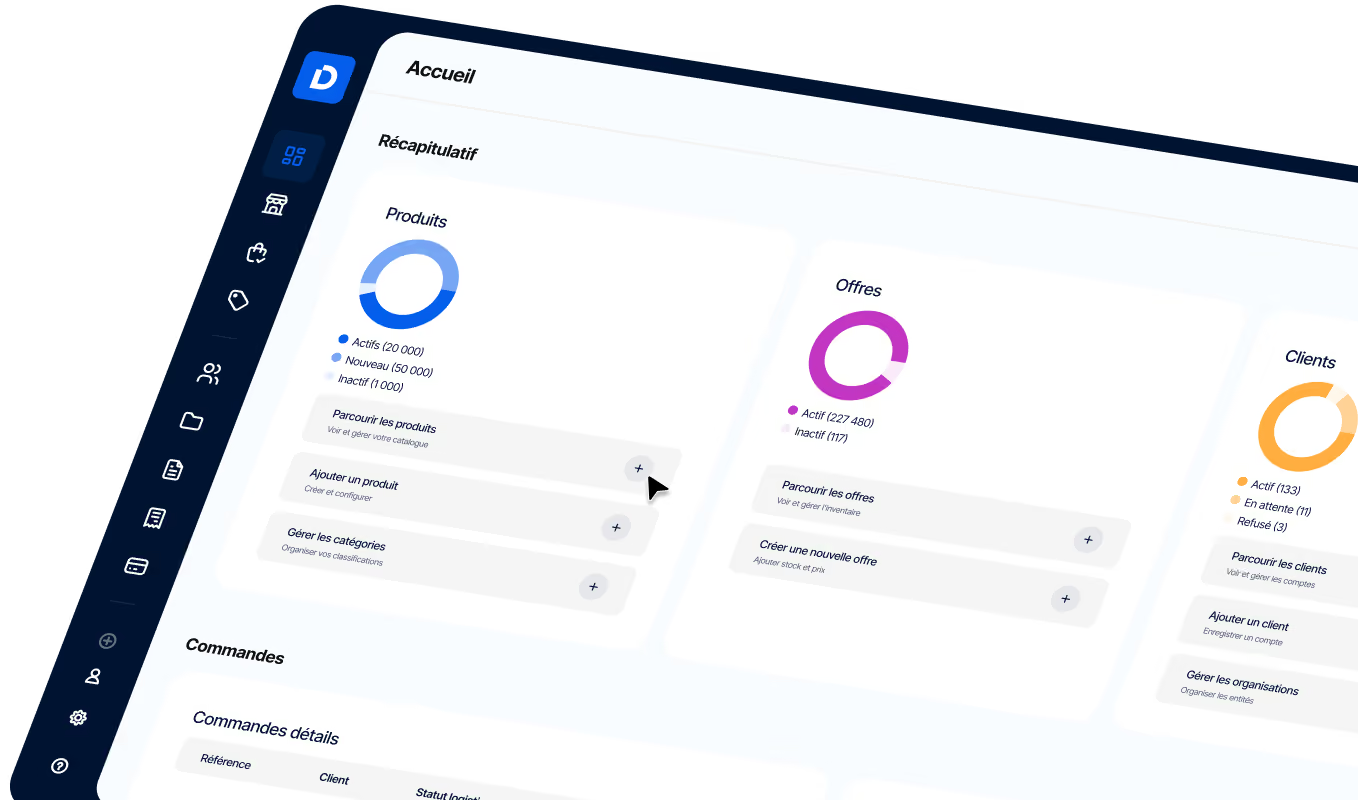
- Key features: Customer-, contract- and volume-based pricing grids, account-specific catalogues, quotes, approval workflows and a B2B ordering portal. DJUST Sales uses AI to automate the entry of orders received by email, while DJUST OMS manages high-volume orders, with API connectivity to ERP and CRM systems.
- Pricing: DJUST Sales starts at €29/month (1 user, 30 orders or quotes per month).
- The Business plan costs €79/month (3 users, 150 orders or quotes).
- The Scale plan is available on request.
- The B2B e-commerce platform starts at €500/month, with Advanced and Enterprise plans available on request.
- Who it's for: B2B SMEs, mid-sized companies and large enterprises (manufacturers, distributors and brands) managing negotiated pricing, extensive catalogues and multiple ordering channels.
Order1
Order1 positions itself as a B2B order-taking solution. The platform covers catalog management and order entry, with integration possible depending on the configuration of the existing environment. Its strength lies in the simplicity of the ordering workflow for standard volumes.
The depth of management for negotiated pricing and complex business rules remains more limited than that of a native B2B platform. The ideal use case is for SMEs with a structured order flow but without multi-level pricing hierarchies.
- Key features: Three modules. Order Scan, an AI agent that reads purchase orders received by email (PDF, Excel, Word) and imports them into the ERP; OrderDirect, a white-label B2B ordering application with customer- or group-specific pricing; and OrderCRM, which manages sales routes, visit reports and shelf audits. Connectors are available for Sage, SAP, Microsoft Dynamics, Divalto, Cegid and Clipper, via API or SFTP.
- Pricing: Available on request. OrderDirect comes with a fixed monthly subscription, OrderScan is billed according to order volume, and OrderCRM is priced according to the number of users. No setup fees or long-term commitment.
- Who it's for: SMEs and mid-sized companies whose sales administration teams receive a large proportion of orders by email.
Choco
Choco is a B2B ordering platform dedicated to the restaurant and food industry. Its strength is the simplicity of order placement for restaurateurs with their suppliers. The interface is designed for a fast, repetitive workflow.
Its sector specialization is also its limitation: managing complex negotiated pricing and multi-category catalogs outside of the foodservice sector is not the core of the system. The relevant use case remains small to medium-sized businesses in the foodservice sector with simple order flows.
- Key features: An ordering app connecting restaurants and suppliers, supplier catalogues, frequently ordered product lists, team access management and multi-location management. On the supplier side, Choco AI digitises orders received by phone, SMS or email and imports them into the ERP, generating purchase orders and invoices.
- Pricing: Free application for restaurants; paid plans for suppliers and distributors, with pricing not publicly available.
- Who it's for: Restaurants, suppliers and distributors in the foodservice industry.
Volta
Volta presents itself as a sales management solution for SMEs. Features cover order management and sales tracking, with basic automation. The primary target is the company looking to structure its sales activity without deploying a complex platform.
Based on the defined B2B criteria, integration capacity and the depth of pricing management depend on the company's configuration and ecosystem. Scalability is suited for medium volumes.
- Key features: Converts orders received via email, PDF, Excel or WhatsApp into pre-filled orders in the ERP (SAP, Sage, Cegid, NetSuite), with checks on pricing, stock availability and delivery dates. The platform also includes a B2B customer portal, quotes, customer-specific pricing and AI-powered sales recommendations.
- Pricing: Available on request.
- Who it's for: B2B distributors, wholesalers and brands, primarily targeting companies with 20 to 250 employees.
MyWay
MyWay targets field sales teams and SMEs that need mobile order-taking tools. The solution covers basic pricing management and order entry in the field. Connectivity depends on the configuration of the existing environment.
The positioning is suited for mobile sales teams with a need for rapid order submission. Managing large catalogs and complex approval workflows is not the primary scenario.
- Key features: An AI-powered copilot for field sales representatives, including account and visit prioritisation, action recommendations based on sales history and CRM data, route planning, a voice agent, product catalogue and order-taking capabilities, and dashboards.
- Pricing: Per-user subscription, based on the number of licences and selected modules. Pricing available on request.
- Who it's for: B2B field sales teams, particularly in specialist distribution, from SMEs to large enterprises.
Free sales management tools: how far can they go?
Free solutions are attractive when starting out: testing needs, low volume, small team. A free sales management tool can be sufficient for a business with simple pricing and a limited number of customers. The appeal is real and legitimate at this stage.
Concrete limitations appear quickly in B2B. The inability to manage pricing per customer, the lack of approval workflows, the absence of ERP integration, and capped volumes turn a free tool into a bottleneck. The tipping point occurs when orders arrive through multiple channels, when pricing becomes complex per customer, or when an ERP needs to be connected.
A free tool is not inherently a bad choice. It should be evaluated on its ability to absorb growth and complexity, not just on its price. Before deciding, map out your actual needs: number of active customers, order volume, and pricing rules. If these parameters are stable and simple, a free tool may suffice. If they evolve, switching to a dedicated platform becomes necessary.
For companies considering autonomous B2B marketplaces, complexity increases further and free tools do not cover this scope.
DJUST: absorbing B2B complexity to free up your teams
DJUST handles B2B complexity behind the scenes: negotiated pricing, large catalogs, approval workflows, and ERP/CRM integration. Everything is managed natively, without your teams having to configure workarounds. The platform connects to your ERP and CRM without replacing them. Your data remains synchronized in real time.
DJUST Sales automates orders, generates quotes, and applies business rules. Your sales team gains more time for selling. The B2B sales automation solution covers the entire cycle, from customer request to processed order.
DJUST Order Management manages complex order flows, synchronizes data in real time, and lets your teams handle exceptions. The AI-driven order management revolution follows this logic: AI agents automate data entry, detect anomalies, and prepare recommendations, with human governance over critical decisions.
The targeted gains include time returned to teams, a reduction in data entry errors, and a shorter sales cycle. Integrating AI into the supply chain extends this logic beyond the order, into logistics and replenishment.
Sources
[1] Direction générale desFinances publiques (DGFiP), https://impots.gouv.fr, 2026-07-05
[2] Ministère de l'Économie, https://www.economie.gouv.fr/tout-savoir-sur-la-facturation-electronique-pour-les-entreprises,2026-11-19
[3] Service-Public.fr(Entreprendre), https://entreprendre.service-public.fr/vosdroits/F10029,2026-11-19
FAQ
What is a B2B sales management tool?
A B2B sales management tool centralizes quotes, orders, invoices, catalogs, and customer-specific pricing into a unified platform designed for the business rules of corporate trade: negotiated rates, approval workflows, and ERP integration. It differs from a B2C solution in its ability to handle contractual complexity and high transaction volumes. Mandatory electronic invoicing further underscores the need for a compliant tool: as of September 1, 2026, all companies must be able to receive electronic invoices, and large companies and mid-sized enterprises must issue them; SMEs and micro-enterprises will be required to issue them starting September 1, 2027 [1][2].

How do you choose the best sales management software for your business?
The choice depends on four criteria: the ability to manage negotiated rates and complex catalogs, integration with existing ERP and CRM systems, the level of automation for repetitive tasks (data entry, quotes, approvals), and scalability to handle growing order volumes. The priority is to eliminate manual re-entry and data fragmentation. Also, verify regulatory compliance, particularly regarding electronic invoicing [2] and the retention of commercial documents (10 years for invoices and accounting records, starting from the end of the fiscal year) [3].
Is a free sales management tool enough for a B2B SME?
A free tool may be enough to get started with a low volume of orders and simple pricing. As soon as pricing becomes more complex per client, orders arrive through multiple channels, or your ERP needs to be connected, the limitations become clear: no approval workflows, lack of integration, and capped volume. Switching to a dedicated platform then becomes necessary.
What is the difference between a sales management tool and an ERP?
An ERP manages all company processes (accounting, HR, production, inventory). A sales management tool focuses on the sales cycle (quotes, orders, invoices, pricing, catalogs) and integrates with the ERP to synchronize data. In B2B, a sales management tool provides a specialized layer that an ERP does not cover: buyer autonomy, customer-specific pricing, and order automation.
Is AI already operational in sales management tools?
Yes, AI is already operational for real-world use cases: automatic order extraction from emails, application of negotiated rates, anomaly detection (inconsistent pricing, insufficient stock), and quote generation based on your catalog. AI agents can query your catalog, inventory, and pricing terms to prepare an order from a natural language request. Data quality and system integration remain the essential prerequisites.