E-commerce features: what a B2B site must offer
SaaS marketplaces can help you grow your B2B sales and streamline your operations. Here, we highlight the 4 best B2B SaaS marketplace providers in 2024.
Article summary
- A B2B e-commerce site must first master its core functionality: catalog, search, product pages, cart, ordering, payment, delivery, and customer account.
- B2B features add specific requirements: negotiated pricing, personalized catalogs, quick ordering, multi-user accounts, omnichannel capabilities, and tailored payment options.
- Choosing a platform also depends on technical criteria: headless architecture, APIs, ERP/CRM/WMS integrations, modularity, performance, security, and scalability.
- To prioritize features, you must link them to concrete KPIs such as online order rate, order processing time, error rate, or customer service inquiries.
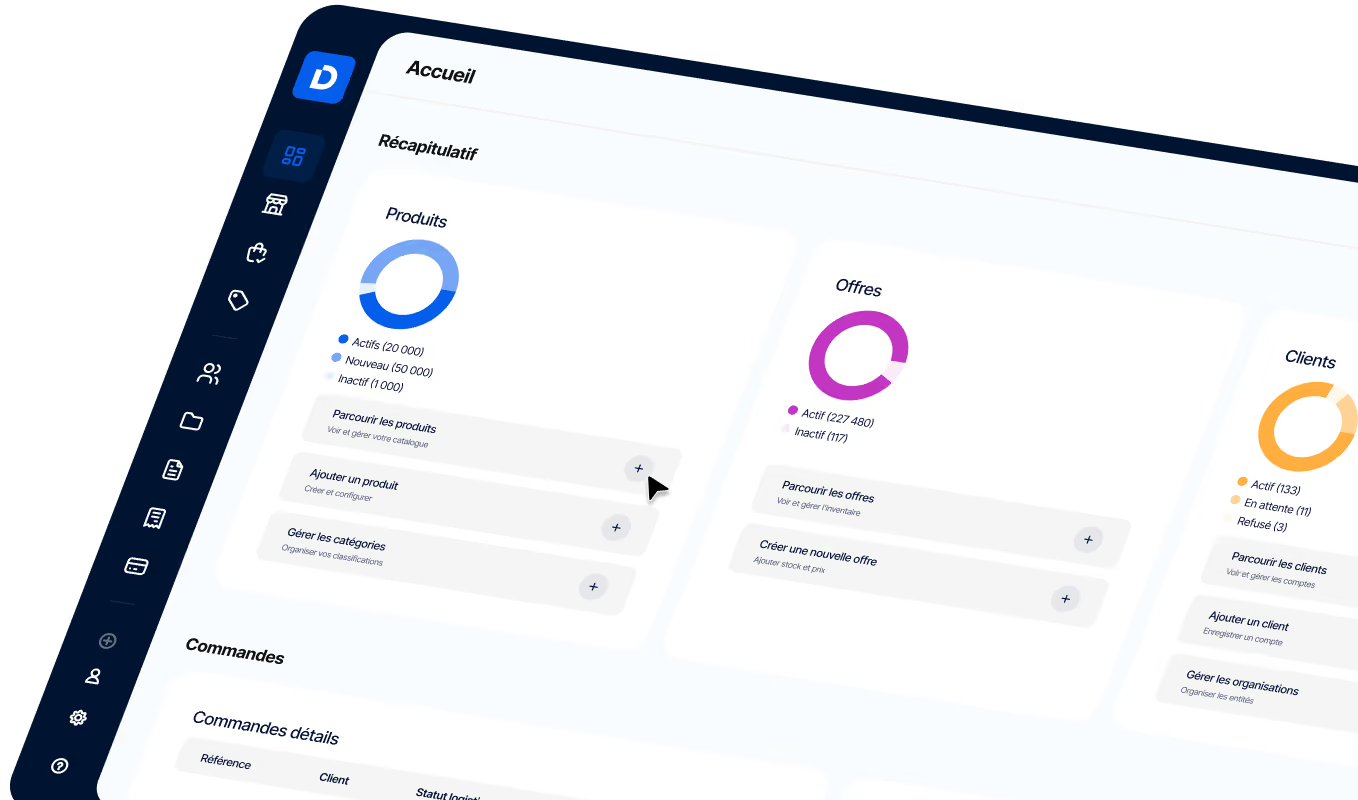
The e-commerce features refer to the set of tools that allow a merchant site to present an offer, take an order, process a payment, and track the process through to delivery. For a consumer site, the foundation consists of a few blocks: catalog, search, cart, secure payment, delivery, and customer account. On a B2B e-commercesite, this foundation is not enough: professional buyers expect their negotiated rates, payment terms, quick ordering for recurring items, and data synchronized with the supplier's ERP.
State of B2B e-commerce in 2024
B2B e-commerce continues to grow and is establishing itself as a full-fledged sales channel. According to the McKinsey B2B Pulse 2024, conducted among nearly 4,000 decision-makers, e-commerce accounts for 34% of revenue for companies that offer it, ahead of face-to-face sales. Buyers now use an average of ten interaction channels throughout their journey, compared to five in 2016, which requires a rethink of how we coordinate B2B sales channels.
Following this trend, 67% of B2B buyers prefer rep-free purchasing experiences, according to a Gartner survey published in March 2026. In that same group, 45% have already used AI during a recent purchase: the role of AI in B2B e-commerce is no longer a future-looking topic.
On the consumer side, the Fevad estimates French online spending at 196.4 billion euros in 2025 (+7%): professional buyers are bringing these habits into the office. Another structural change is that all VAT-registered companies in France must be able to receive electronic invoices as of September 1, 2026.
To capitalize on these B2B e-commerce trends, companies must integrate key features that meet the specific needs of B2B buyers and provide them with a seamless, personalized purchasing experience. The classic trap: stacking up features seen on competitors' sites without linking them to a performance indicator.
| 2025-2026 Figures | What it changes | Feature to prioritize | KPI to track |
|---|---|---|---|
| 67% of buyers prefer to buy without a sales rep (Gartner, 2026) | The customer orders independently, 24/7 | Self-service customer portal, quick ordering | Share of online orders |
| 10 interaction channels per customer journey (McKinsey, 2024) | The customer journey is fragmented across website, sales rep, email, and EDI | Unified OMS, real-time synchronization | Share of orders processed without re-entry |
| 34% of revenue generated through e-commerce (McKinsey, 2024) | The website becomes a major sales channel | Customer-specific catalogs and pricing, ERP integration | Share of online revenue |
| E-invoicing mandatory for receiving invoices as of September 2026 | PDF invoices sent via email are no longer sufficient | Connection to an accredited platform | Days Sales Outstanding (DSO) |
What are the essential features for an e-commerce site?
Before addressing B2B specifics, a merchant site must master four pillars: these are the key elements of an e-commerce site, the ones buyers test in under a minute. Their absence comes at the cost of conversion: the Baymard Institute measures an average cart abandonment rate of 70.22%, calculated from 50 studies.
Catalog, product page, and search engine
The catalog structures the offering into categories and filterable attributes (brand, dimensions, standards, availability). Each e-commerce product page brings together visuals, descriptions, technical specifications, pricing, and stock levels. The search engine must be typo-tolerant and recognize manufacturer part numbers.
Quick method : Extract the 50 most frequent internal queries from the back office and verify that each one returns a relevant result in the first position. Any query without a result should be set up as a synonym.
Frictionless cart and checkout process
According to Baymard, 18% of shoppers abandon their carts when a site forces account creation, and 17% do so when the checkout process is too long. An efficient checkout displays the total cost in the cart and limits the process to three steps. In B2B, the B2B shopping cart adds CSV file imports, saved carts, and shared shopping lists.
Pitfall to avoid : adding fees at the last minute. High unexpected costs (shipping, taxes) are the primary reason for abandonment, cited by 40% of shoppers.
Secure payment, delivery, and tracking
Payment options must meet the target audience's expectations: credit cards with strong authentication as required by the European PSD2 directive, digital wallets, bank transfers, or SEPA direct debits. Regarding logistics, the customer should be able to choose their delivery method, see the estimated date, and receive a tracking number.
Example : displaying "delivered tomorrow for orders placed before 4 PM" on the product page turns logistics into a selling point, provided the WMS reflects real-time stock levels.
Customer account, back office, and after-sales service
The customer account centralizes order history, invoices, addresses, and returns. The back office allows for managing prices, promotions, inventory, and sales statistics without needing a developer. In B2B, the account becomes multi-user: one buyer prepares the order, and a manager approves it using a validation workflow.
KPI to track : the number of "where is my order?" inquiries received by customer service, which should decrease once tracking is live.
5 essential B2B e-commerce features
1. Personalize the purchasing experience
Personalization is crucial for professional buyers. They expect the e-commerce platform to reflect the pricing and payment terms negotiated in advance.
For example, a company like DeSter, a manufacturer of packaging and containers, customizes its products and pricing for every airline or restaurant it works with, thereby offering a tailored purchasing experience. Air France and KLM, despite belonging to the same parent company, have different needs in terms of products and pricing, which DeSter takes into account.
To provide a personalized purchasing experience, several elements can be taken into consideration, such as a customer portal, a product catalog, and customized pricing.
Here are a few examples of personalization:
- customized products : products must be adapted to the specific needs of each client. For example, airlines may have different requirements for the same types of products.
- preferential pricing : negotiated pricing terms must be reflected on the platform to encourage buyers to use the online service. A large chain of franchised supermarkets, such as Franprix, can display special offers on its platform that were negotiated directly with suppliers for certain food products. These reduced prices are clearly visible online, thus encouraging customers to make their purchases via the chain's platform to benefit from the best possible savings. Technically, this requires managing customer-specific price lists synchronized with the ERP.
- payment terms : negotiated payment terms must also be available online to facilitate transactions. If a client wishes to pay by SEPA transfer, the necessary details to complete this type of payment (IBAN, BIC, etc.) must be clearly indicated.
This personalization of the purchasing experience aims to improve customer satisfaction and loyalty. Understanding the client's expectations and needs is therefore essential, especially when they are accustomed to manual purchasing processes.
2. Display precise and detailed information
Professional buyers need all the information required to place an order independently. This includes high-quality images, as well as all technical and environmental data. For example, for a complex product like a heat pump, all specifications and compatibility details must be clearly indicated to avoid any disappointment and improve the conversion rate.
Yack, a specialist in the manufacturing and import of air conditioning equipment, ensures that installers have all the information necessary for a correct installation, which is crucial for customer satisfaction.
To achieve this, the integration of a PIM (Product Information Management) system to create detailed product sheets is crucial. These must contain, among other things:
- high-quality images : images must be clear and detailed so buyers can visualize the product and know exactly what to expect upon delivery.
- technical documentation : technical specifications, installation manuals, and compatibility sheets must be easily accessible.
- environmental information : an increasing number of customers are sensitive to environmental issues, and this information must be available. As part of its environmental commitment, construction giant Eiffage is launching a project toward sustainable e-commerce through its new BlueOn platform, aiming to improve transparency regarding carbon emissions while presenting a compelling business case for profitability.
By considering and implementing these elements, the goal is to improve customer conversion rates while reducing support requests for the team.
3. Simplify decision-making
Professional buyers, often working on a just-in-time basis, need intuitive navigation and a high-performance search engine. Quick ordering is also essential for recurring purchases.
For example, a clothing retailer allows its sales agents to place orders quickly for their customers, thereby streamlining the purchasing process.
Here are a few examples of how to simplify decision-making:
- intuitive navigation : products must be well-categorized for easy and intuitive searching. A retail e-commerce site should ideally organize its products into clear, detailed categories, such as "Fruits and Vegetables," "Dairy Products," and "Cleaning Supplies." This allows shoppers to easily find the items they are looking for without getting lost in a multitude of unclassified products. The structure of the B2B e-commerce catalog directly determines the quality of this navigation.
- optimized search : buyers must be able to quickly find products by typing in references or keywords. A wholesale clothing brand can implement an advanced search bar where customers can quickly find products by entering specific references, models, or keywords like “denim skirt” or “striped sweater.”
- quick ordering : for recurring purchases, placing orders in just a few clicks is essential. An online platform for food packaging supplies, such as DeSter, offers a "Buy Again" feature for regular customers. This option allows users to reorder items they purchase frequently in just a few clicks, making the ordering process fast and efficient.
In order to increase the average order value and reduce errors as well as order processing time, this simplification of the purchasing decision is an essential feature for any B2B e-commerce platform. Recommending consumables associated with a machine directly applies B2B cross-selling to the cart.
4. Offer an omnichannel shopping experience
A unified customer experience across different channels is essential. Buyers must be able to start their purchasing journey on one channel and finish it on another without interruption. For example, a major sustainable footwear brand uses two separate portals for its end customers and sales agents, allowing for seamless management of quotes and orders. Sales agents can create quotes in the field, generated using a B2B automated quotingtool, which customers can then validate and pay for online.
In B2B e-commerce, it is crucial to be able to offer customers an omnichannel shopping experience, which requires a reliable Order Management System (OMS) and a simplified payment process. This enables:
- real-time synchronization. Information must be updated in real time across all channels. An auto parts supplier updates stock levels and pricing in real time on its website and mobile app. This allows customers to see part availability immediately and avoid stockouts, ensuring a smoother and more reliable shopping experience.
- multiple portals. Different portals for different user types (end customers, sales agents) allow for tailored management. A furniture brand creates distinct portals for its various national markets and user types: one portal for customers based in France and another for those in Germany, for example. By adapting its portals to each country and user type, the brand ensures a smooth and efficient user experience that precisely meets the needs of each segment of its global market. Each B2B customer portal shares the same back office: catalogs and pricing are not duplicated.
- connected purchasing channels. Buyers must be able to use different channels (mobile, desktop) without losing information. A construction company offers an online purchasing platform accessible from any device. Customers can start an order on their office computer and then finalize it on their smartphone while in the field, without losing any information or having to restart the process.
An efficient, omnichannel shopping experience leads to improved customer satisfaction and more streamlined order management.
To offer a successful omnichannel experience, it is essential to integrate the right technologies and ensure perfect synchronization of information across all channels used by customers.
5. Integrate B2B payment and invoicing
B2B payment is about more than just credit cards: buyers expect their negotiated terms (deferred bank transfer, SEPA direct debit, purchasing cards). In France, the agreed-upon payment period between professionals cannot exceed 60 days after the invoice date, or 45 days end-of-month (Article L441-10 of the Commercial Code). The platform therefore automatically applies the payment terms specified in each customer account contract.
Invoicing is also changing: as of September 1, 2026, all companies must be able to receive electronic invoices, and large companies and mid-sized enterprises must be able to issue them; SMEs and micro-enterprises will follow on September 1, 2027 (Article 289 bis of the General Tax Code). A B2B e-commerce site that still sends PDF invoices via email must connect to an approved platform.
Example : a wholesaler offers deferred payment to its new customers without carrying the risk of non-payment, which is guaranteed by a partner. The choice of B2B payment methods then depends on the average order value and the risk profile.
4 key features to look for in your e-commerce platform
Visible features are built on technical foundations that dictate the cost of future updates, deployment speed, and ERP integration.
1. A tailored technological architecture
It is essential to have a headless architecture that consolidates data from various sources (ERP, CRM, etc.) and makes it accessible across different channels (mobile, desktop, etc.). This approach enables seamless, real-time communication of customer information.
An omnichannel approach must include:
- a headless architecture to consolidate data from different sources.
- APIs to facilitate integration with other systems and applications.
- real-time communication to ensure information is always up to date.
2. B2B-specific solutions
Solutions must be designed for B2B, with features tailored to the needs of professional buyers, such as customer-specific pricing and personalized catalogs. Generic solutions often fall short in terms of performance and complexity. For instance, while some platforms have added B2B features, they remain limited when faced with the complex requirements of modern businesses.
Here are a few examples illustrating why B2C solutions are unsuitable, as they often lack features specific to B2B needs, such as:
- customer-specific pricing to allow for the definition of unique rates for each client.
- personalized catalogs with product availability that can vary depending on the client.
- performance and scalability to manage complex and high-volume orders.
3. Scalability and modularity
B2B e-commerce platforms must be modular and scalable to adapt to constant changes in the market and technology. A SaaS architecture allows you to benefit from the latest technological advancements while offering the flexibility needed to integrate specific modules. DJUST offers a modular platform that allows companies to keep certain strategic modules in-house while benefiting from a flexible digital backbone.
Key points to ensure this scalability:
- a modular architecture that allows for adding or removing modules as needed.
- a SaaS environment that ensures the platform benefits from the latest technological innovations.
- flexibility: to customize the platform according to the company's specific needs.
Pitfall to avoid : choosing a platform based solely on its current feature list. The real criterion is the cost of adding a module two years from now. Comparing SaaS vs. on-premise and the principle of composable commerce help in making the decision.
Why choose DJUST?
DJUST is a unified B2B commerce platform, used by over forty clients, including Monoprix, Franprix, Eiffage, Bouygues Construction, Jeff de Bruges, Socoda, Auchan, and Bouygues, and supported by around twenty global integration partners such as e2y, Smartshift, and Clever Age. The platform has been recognized by Gartner as a key player in the digital commerce ecosystem.
DJUST offers a 100% B2B solution, automatic platform updates, rapid deployment, and flexible, modular technology:
- features dedicated to B2B. All B2B features are native to the solution, with a roadmap 100% focused on B2B.
- SaaS solution. DJUST is a ready-to-use B2B solution that is hosted, maintained, and secure.
- rapid deployment (an average project time of just 4 months). Projects are completed quickly with a ready-to-use Back Office and thanks to our Front End template.
- scalable platform. DJUST stays by your side to ensure the project's success, both during and after implementation. The flexibility of our solution offers potential for future development, thanks to its modularity and its ability to connect with other tools and address new use cases.
According to DJUST, companies that have migrated to the platform see a 20% increase in average order volume and a 70% increase in management efficiency (see DJUST clienttestimonials).
In conclusion
B2B e-commerce requires high-performance, flexible, SaaS-based platforms that accelerate business growth and provide access to new market opportunities at a lower cost. It is crucial to invest in technologies tailored to meet the growing expectations of professional buyers, particularly by improving the user experience to provide greater autonomy during the ordering process, thereby aligning the online experience with B2C standards. This approach is essential for retaining customers in a highly dynamic competitive environment, where needs are evolving, especially with the arrival of the younger generation in the professional market.
FAQ
What are the essential features for an e-commerce site?
At a minimum, an e-commerce site must offer a structured catalog with comprehensive product pages, a search engine with filters, a shopping cart that displays the total cost, a streamlined checkout process, multiple secure payment methods, a choice of delivery options with tracking, and a customer account providing access to order history and invoices. A back-office then manages pricing, inventory, and analytics.

What is the difference between B2B and B2C e-commerce features?
B2C focuses on quick, one-off purchases at retail prices. B2B manages client-specific negotiated pricing, restricted catalogs, multi-user accounts with approval workflows, high-volume and recurring orders, quotes, and payment terms. It also requires tight integration with an ERP, where inventory, pricing, and invoicing are centralized.
What features should you look for in an e-commerce platform?
Five criteria make the difference: a headless architecture that separates the front end from the back office, documented APIs to connect ERP, CRM, and WMS systems, native B2B features rather than plugin-based add-ons, modularity that allows you to activate features without migration, and performance tested on a catalog of comparable size. The SaaS model provides continuous updates with no upgrade costs.
Is electronic invoicing mandatory for B2B e-commerce?
Yes, for sales between VAT-registered businesses established in France. As of September 1, 2026, all businesses must be able to receive electronic invoices, and large companies and mid-sized enterprises are required to issue them. SMEs and micro-enterprises will be required to issue them starting September 1, 2027. The site must therefore transmit its invoices via an approved platform.
Which payment methods should you offer on a B2B e-commerce site?
Professional buyers expect SEPA transfers and direct debits, credit cards or purchasing cards for smaller amounts, and payment terms based on negotiated agreements. Third-party guaranteed deferred payment secures new accounts. In France, agreed-upon payment terms cannot exceed 60 days from the invoice date or 45 days end-of-month.
How long does it take to deploy B2B e-commerce?
The timeline depends on the number of integrations, the size of your catalog, and the level of front-end customization. With a SaaS solution featuring a ready-to-use back office, DJUST typically launches most projects within 1 to 6 months. A project connecting a single ERP to a catalog already structured in a PIM will fall on the lower end of that range.
How do you prioritize which e-commerce features to develop?
Focus on addressing measured pain points rather than simply copying competitor features. Each requirement is evaluated based on its impact on three key metrics: order processing time, error rates, and customer service inquiry volume. Features that improve all three are prioritized; others are added to the roadmap for future phases.